



Pupuk Indonesia Tells Farmers to Embrace Good Farming Practices
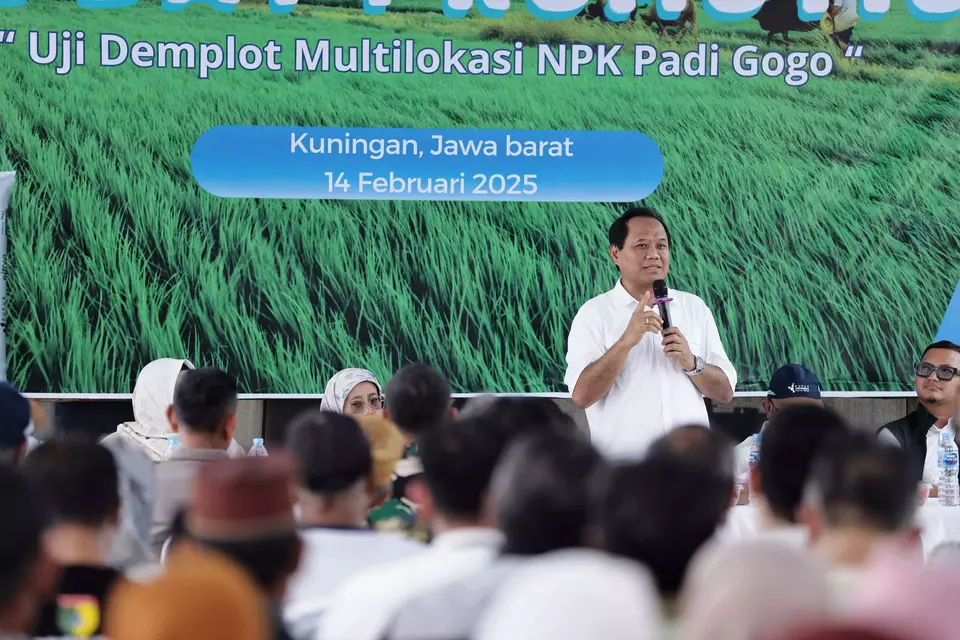
Jakarta. State-run fertilizer producer Pupuk Indonesia recently told farmers to embrace good farming practices as the company held its Safari Makmur campaign in Kuningan.
The campaign also saw the trial runs for Pupuk Indonesia’s NPK Padi Gogo fertilizers. Pupuk Indonesia’s marketing director Tri Wahyudi Saleh told the farmers that implementing the correct farming practices could spur productivity and income. Its implementation can also help Indonesia become self-sufficient in its food production.
"In this Safari Makmur program, we invite you not to spread fertilizer carelessly. You need to pay attention to what [your crops] are lacking. Just like when it comes to the human body. If we are not feeling well, it means we lack vitamin C. The same goes for soil,” Tri Wahyudi was quoted as saying in a press statement.
According to Tri Wahyudi, Pupuk Indonesia has an on-farm partnership program in the form of intensive supervision and assistance to farmers and sustainable agricultural cultivation supported by technology, namely the Makmur Program.
The program, which stands for "Let's Advance People's Business", is an integrated agricultural ecosystem that covers the upstream and downstream sectors. This way, it can help farmers boost productivity to support the national food self-sufficiency program. The Makmur program, which was first launched by State-Owned Enterprise Minister Erick Thohir in 2021, enables farmers to identify the nutrient content of the soil through the mobile soil testing (MUT) facility. It helps provide recommendations to farmers on the fertilizer doses according to the needs of the soil and the plants to be planted.
“Since its launch, the Makmur program continues with SHS [Sang Hyang Seri] as the seed producer and Pupuk Indonesia [as the fertilizer producer]. We also have the state-owned banks in providing the financial capital, the Agriculture Ministry's standardization body, as well as the [state logistics agency] Bulog as the off-taker,” Tri Wahyudi said.
He added: “This is a multi-stakeholder partnership.”
This year, Pupuk Indonesia aims to realize the Makmur program on an area of 500,000 hectares spread across various regions in Indonesia. About 200,000 hectares will be specifically for rice plants, while the remaining 300,000 hectares are for non-rice commodities (i.e. sugar cane, cassava, coffee, palm oil, horticulture, to name a few). As of 2024, Pupuk Indonesia’s Makmur program reach has spanned 450,000 hectares. It has helped over 200,000 farmers.
According to Tri Wahyudi, farmers need to be careful when purchasing fertilizers. He also advised against being tempted by cheap fertilizers as the products could be counterfeited. He had found such cases in West Java and other regions in Indonesia. As a case in point, Pupuk Indonesia has the NPK Phonska brand. Tri Wahyudi revealed that he had found an identical fertilizer product with the same color, brand, and packaging, and even had the name “Phoska”. When tested, the fertilizer did not have nitrogen (N) content. For context, an NPK fertilizer encompasses nitrogen, phosphorus, and potassium.
"As a fertilizer producer, we have a corporate responsibility. We are supervised by the government. Our production is also being supervised. We also have national standards SNI. If God is willing, there shall be no fertilizer by Pupuk Indonesia that does not meet those standards,” Tri Wahyudi said.
Tags: Keywords: as a preferred
Related Articles

Pupuk Indonesia Promotes Agriculture in Segoro Agung School
The company said that the harvest reflected its effort to use the school's land for productive activities and to generate economic value.
Pupuk Indonesia Expands MSME Market Access Through Kriyanusa 2026
Pupuk Indonesia showcases 16 MSME brands at Kriyanusa 2026, expanding market access for local craft and textile businesses
Pupuk Indonesia Backs Garlic Self-Sufficiency Goal
Pupuk Indonesia says that the company is ready to support garlic farmers.
Pupuk Indonesia Encourages Subsidized Fertilizer Distribution Ahead of Planting Season in Takalar
Pupuk Indonesia is strengthening coordination with local stakeholders to optimize the distribution of subsidized fertilizer in S.Sulawesi.
Pupuk Indonesia Urges Distribution Sites to Follow Rules in Fertilizer Rollout
Pupuk Indonesia has urged distribution sites in Bangkalan to ensure an accountable distribution of subsidized fertilizers.
Pupuk Indonesia Explores Strategic Fertilizer Partnership in Russia
Pupuk Indonesia (Persero) is exploring a strategic partnership to develop a large-scale ammonia and urea production facility in Russia.
Pupuk Indonesia Strengthens Subsidized Fertilizer Distribution in Mojokerto Through Pilar Tani Program
Pupuk Indonesia strengthens subsidized fertilizer distribution in Mojokerto to support farmers, productivity and sustainable food security.
Indonesia to Set Up Urea Fertilizer Factory in Vladivostok
Pupuk Indonesia has agreed to a joint study on the possibility for a Vladvistok-based urea fertilizer plant.
Pupuk Indonesia Prepares 205,451 Tons of Subsidized Fertilizers for Eastern Indonesia
The state-owned fertilizer company said that the stock were already available at the buffer warehouses and distributors.
Pupuk Indonesia’s NPK Phonska Plus Wins WOW Brand Award
NPK Phonska Plus is Pupuk Indonesia's non-subsidized fertilizer.The Latest

Chandra Asri Group Receives Trade Finance Excellence Award, Reinforcing Its Role in Indonesia’s Industrial Development
Chandra Asri Group receives the Trade Finance Excellence Award at CIMB Niaga Business Summit 2026.
AEON MALL Deltamas Brings 11 Sports and Creative Competitions to AEONLYMPIC 2026
AEON MALL Deltamas hosts AEONLYMPIC 2026, featuring 11 sports and creative competitions, with more than 3,100 participants.
Indonesian Stocks Extend Losses for Third Day, Fall 3.64% to 4,996
Indonesian stocks fell 3.64% on Monday, extending losses for a third straight session amid MSCI concerns and tighter trading limits.
Prabowo Calls Meeting on Forest Fires as Haze Reaches Jakarta, Singapore
Prabowo summons senior officials to discuss forest fires as smoke reaches Jakarta and Malaysia pushes for regional action.
Jakarta Outranks Amsterdam in Global Public Transport Survey
Jakarta climbs two places to 15th in Time Out's 2026 public transport survey, with its governor citing better network integration.Most Popular
