



Blinken Meets Chinese President Xi to Ease US-China Tensions
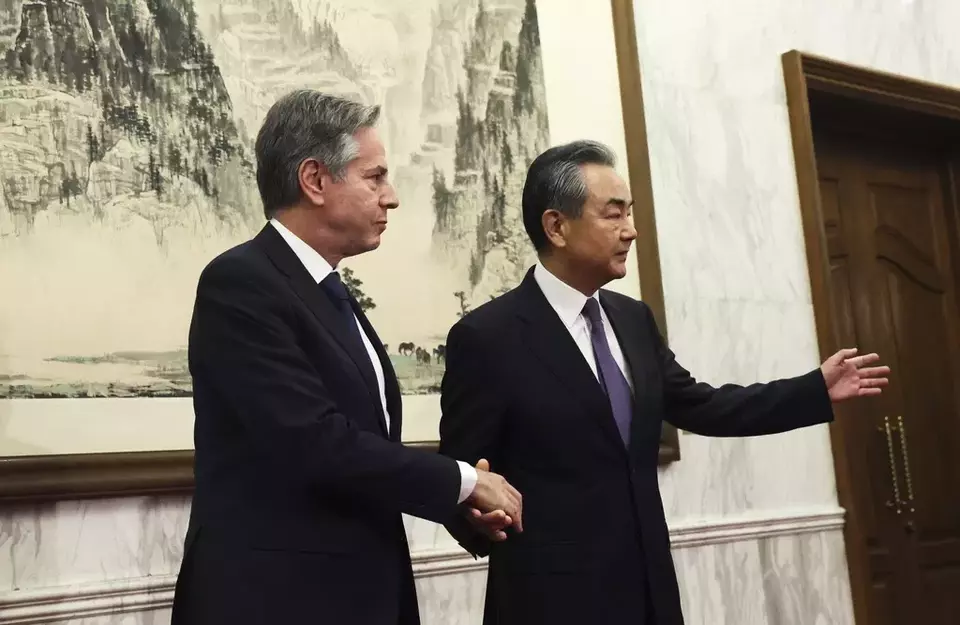
Beijing. U.S. Secretary of State Antony Blinken met with Chinese President Xi Jinping on Monday as he wrapped up a two-day high-stakes visit to Beijing aimed at easing soaring tensions between the countries.
The meeting at the Great Hall of the People had been expected and was seen as key to the success of the trip, but neither side confirmed it would happen until a State Department official announced it just an hour beforehand.
A snub by the Chinese leader would have been a major setback to the effort to restore and maintain communications at senior levels. In earlier meetings between Blinken and senior Chinese officials, the two sides expressed willingness to talk but showed little inclination to bend on hardened positions.
Blinken is the highest-level U.S. official to visit China since President Joe Biden took office, and the first secretary of state to make the trip in five years. His visit is expected to usher in a new round of visits by senior U.S. and Chinese officials, possibly including a meeting between Xi and Biden in the coming months.
The encounter with Xi came after Blinken held talks with other senior Chinese officials during which the two sides expressed a willingness to talk but showed little inclination to bend on hardened positions that have sent tensions soaring.
Blinken met earlier Monday with China’s top diplomat Wang Yi for about three hours, according to a U.S. official.
China’s Ministry of Foreign Affairs wrote in a statement that Blinken's visit "coincides with a critical juncture in China-U.S. relations, and it is necessary to make a choice between dialogue or confrontation, cooperation or conflict,” and blamed the “U.S. side’s erroneous perception of China, leading to incorrect policies towards China” for the current “low point” in relations.
It said the U.S. had a responsibility to halt “the spiraling decline of China-U.S. relations to push it back to a healthy and stable track” and that Wang had "demanded that the U.S. stop hyping up the ‘China threat theory’, lift illegal unilateral sanctions against China, abandon suppression of China’s technological development, and refrain from arbitrary interference in China’s internal affairs.”
Despite Blinken’s presence in China, he and other U.S. officials had played down the prospects for any significant breakthroughs on the most vexing issues facing the planet’s two largest economies.
Instead, these officials have emphasized the importance of the two countries establishing and maintaining better lines of communication.
The State Department said Blinken “underscored the importance of responsibly managing the competition between the United States and the PRC through open channels of communication to ensure competition does not veer into conflict."
In the first round of talks on Sunday, Blinken met for nearly six hours with Chinese Foreign Minister Qin Gang after which both countries said they had agreed to continue high-level discussions. However, there was no sign that any of the most fractious issues between them were closer to resolution.
The two sides both said Qin had accepted an invitation from Blinken to visit Washington but Beijing made clear that “the China-U.S. relationship is at the lowest point since its establishment.” That sentiment is widely shared by U.S. officials.
U.S. President Joe Biden said over the weekend that he hoped to be able to meet with Xi in the coming months to take up the plethora of differences that divide them.
That long list includes disagreements ranging from trade to Taiwan, human rights conditions in China and Hong Kong to Chinese military assertiveness in the South China Sea and Russia’s war in Ukraine.
In his meetings on Sunday, Blinken also pressed the Chinese to release detained American citizens and to take steps to curb the production and export of fentanyl precursors that are fueling the opioid crisis in the United States.
Xi offered a hint of a possible willingness to reduce tensions on Friday, saying in a meeting with Microsoft Corp. co-founder Bill Gates that the United States and China can cooperate to “benefit our two countries.”
Since the cancellation of Blinken’s trip in February, there have been some high-level engagements. CIA chief William Burns traveled to China in May, while China’s commerce minister traveled to the U.S. And Biden’s national security adviser Jake Sullivan met with senior Chinese foreign policy adviser Wang Yi in Vienna in May.
But those have been punctuated by bursts of angry rhetoric from both sides over the Taiwan Strait, their broader intentions in the Indo-Pacific, China’s refusal to condemn Russia for its war against Ukraine, and U.S. allegations from Washington that Beijing is attempting to boost its worldwide surveillance capabilities, including in Cuba.
And, earlier this month, China’s defense minister rebuffed a request from U.S. Defense Secretary Lloyd Austin for a meeting on the sidelines of a security symposium in Singapore, a sign of continuing discontent.
Tags: Keywords: as a preferred
Related Articles

Xi Says Looks Forward to Discussing 'Global Situation' with Trump
After officials literally rolled out the red carpet, Trump and First Lady Melania shook hands with Xi and his wife Peng Liyuan.
'AI Development Should Not Be a Solo Performance by Any Single Country,' Says Xi Jinping
Over the next five years, he said, China will provide 5,000 training opportunities on artificial intelligence to developing countries.
Chinese Court Hands Former Local Official Death Sentence in $325M Bribery Case
The graft case is one of the most dramatic corruption scandals in recent years in terms of the sheer scale of the bribes involved.
Does G7 Make Sense Without China?
China's exclusion looks odd, given its now immense sway over the world's economic well-being and affairs.
Xi Jinping to Visit North Korea Next Week
The announcement came a day after North Korea unveiled a new facility to produce the ingredients for nuclear bombs.
Hegseth Reassures Pacific Allies While Softening China Rhetoric
Hegseth reassured Indo-Pacific allies of U.S. commitment while adopting a more measured tone toward China.
China's Rise: What Indonesia Can Learn
China’s experience suggests that the debate between the state and the market is rarely black-and-white.
The Differences -- and Similarities -- In the Trump and Putin Visits to China
China and Russia reached more than 40 cooperation agreements covering areas including trade, technology and media exchanges.
Trump, Xi Wrap Up Summit Claiming Progress in Stabilizing US-China Relations
The leaders agreed that the Strait of Hormuz -- effectively closed since the start of the Iran conflict -- needs to be reopened.
Trump-Xi Meeting Opens in Beijing With Low Expectations on Trade, Security
Trump met Xi in Beijing as both sides opened talks, with little expectation of breakthroughs on Iran, Taiwan and trade.The Latest

Prabowo Calls Meeting on Forest Fires as Haze Reaches Jakarta, Singapore
Prabowo summons senior officials to discuss forest fires as smoke reaches Jakarta and Malaysia pushes for regional action.
Jakarta Outranks Amsterdam in Global Public Transport Survey
Jakarta climbs two places to 15th in Time Out's 2026 public transport survey, with its governor citing better network integration.
MSCI Concerns, Tighter IDX Trading Rules Send Indonesian Stocks Down 5% by Midday
Indonesian stocks plunge 5% by midday as MSCI concerns weigh on sentiment and the IDX tightens its daily downside limit to 7%.
Jakarta Prepares 367 Health Facilities as Haze Reaches the Capital
Jakarta prepares 367 health facilities to treat potential haze-related illnesses after smoke from Sumatra and Kalimantan crosses the region.
Jakarta Expands Flood Prevention With New Water Storage Ponds
Jakarta opens two East Jakarta water storage ponds as it expands flood prevention efforts through reservoirs and river normalization.Most Popular
