



Trump-Xi Meeting Opens in Beijing With Low Expectations on Trade, Security
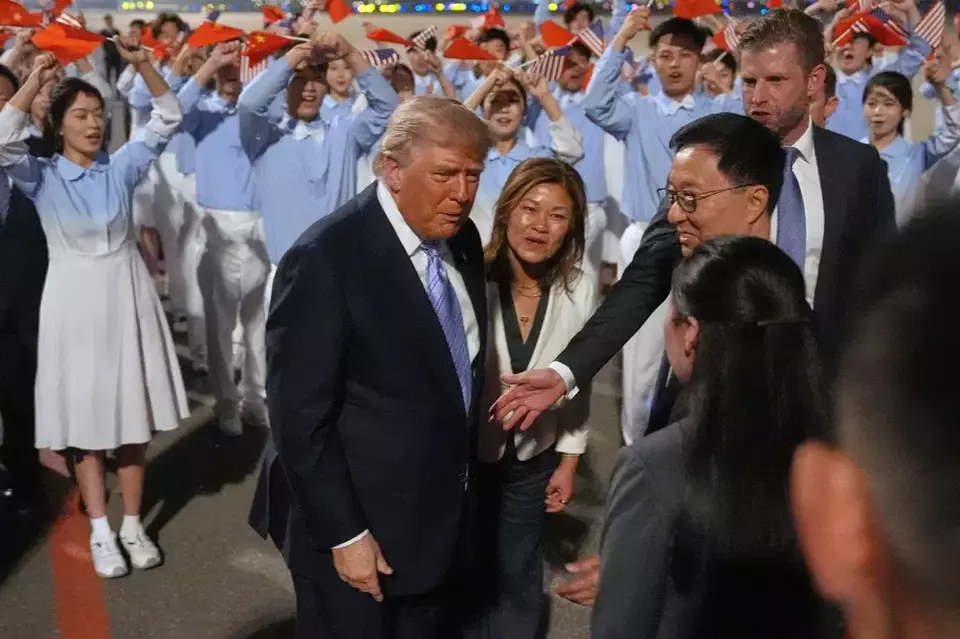
Beijing. President Donald Trump on Thursday kicked off a summit with Chinese leader Xi Jinping that is expected to be heavy on pageantry and symbolism but unlikely to yield major breakthroughs on key issues such as trade, the US relations with Taiwan, or the war in Iran.
After landing in Beijing to an elaborate welcome ceremony Wednesday night, Trump was greeted by Xi the following morning at the Great Hall of the People, the imposing building on Tiananmen Square that houses China’s legislature.
The pair shook hands and briefly chatted, with Trump patting Xi on the arm before they posed for photos.
Cannons boomed in salute as a military band played “The Star-Spangled Banner.” Following instructions from a goose-stepping, sword-carrying military officer, Xi and Trump inspected an honor guard.
Tiananmen Square was cleared for the event, with only officials, journalists, and military personnel present. The hall featured towering red-carpeted staircases and sweeping marble interiors, while soldiers displayed large American and Chinese flags.
Hundreds of primary school children in brightly colored outfits performed a welcome routine, waving flowers and Chinese and American flags as the two leaders walked past.
Trump and Xi were then scheduled to hold a bilateral meeting before the Republican president visits the Temple of Heaven, a 15th-century religious complex symbolizing the relationship between heaven and earth. The two leaders will also attend a state banquet.
The White House has insisted Trump would not make the trip without seeking tangible results, suggesting possible announcements on trade, including a Chinese commitment to purchase more US soybeans, beef, and aircraft. Administration officials are also pushing to establish a Board of Trade with China to address commercial disputes between the two countries.
Still, neither side has provided concrete details about what might emerge from the three-day visit, particularly at a time when Beijing’s close economic ties to Iran could complicate negotiations.
Economic Questions Follow Trump to China
Trump’s visit comes as Iran continues to dominate his domestic agenda and fuel concerns about a weakening US economy as campaigning ahead of November’s midterm elections intensifies.
The US-Israel war involving Iran has effectively closed the Strait of Hormuz, stranding oil and natural gas tankers and sending energy prices soaring, threatening global economic growth.
The extended time Trump and Xi will spend together — often against lavish backdrops — is expected to provide opportunities to discuss several thorny issues, including Iran, trade, Taiwan, and a potential three-way nuclear arms agreement involving the US, China, and Russia.
Still, significant progress may prove difficult.
“Neither side will make much progress on the two major foreign policy issues,” predicted Jim Lewis, a tech policy fellow at the Center for European Policy Analysis. “Trump will press the Chinese to help him on Iran. They’ll be unwilling. The Chinese will press Trump to make concessions on Taiwan. We’ll see what we get out of that.”
Back in Washington, the politics surrounding the war grew more complicated. Senate Republicans on Wednesday again blocked Democratic legislation aimed at halting hostilities in Iran, though Sen. Lisa Murkowski of Alaska joined two other Republicans in opposing continued military involvement.
China is the largest purchaser of Iranian oil, and Secretary of State Marco Rubio said in an interview with Fox News host Sean Hannity that Trump would urge Beijing to use its influence with Tehran. Rubio said that administration officials would emphasize that “economies are melting down because of this crisis,” meaning consumers are “buying less Chinese product.”
“So it’s in their interest to resolve this,” Rubio said of Chinese officials. “We hope to convince them to play a more active role in getting Iran to walk away from what they’re doing now in the Persian Gulf.”
That messaging contrasted with Trump’s own comments, in which he downplayed the idea that he would pressure Xi to do more regarding Iran or that economic concerns would affect US negotiating demands.
Asked before departing the White House whether the financial stability of Americans factored into negotiations with Iran, Trump responded, “Not even a little bit.”
“I don’t think about Americans’ financial situation,” Trump said. “I think about one thing: We cannot let Iran have a nuclear weapon.”
Vice President JD Vance later appeared to soften Trump’s remarks, saying the president’s comments had been mischaracterized.
“I don’t think the president said that,” Vance said. “I think that’s a misrepresentation of what the president said.”
Trade and Taiwan Discussions Could Be Tense
The status of Taiwan also looms large over the visit, as China remains angered by US plans to sell weapons to the self-governing island, which Beijing claims as part of its territory.
The Trump administration has approved an $11 billion weapons package for Taiwan but has yet to begin fulfilling it. Trump has also shown greater ambivalence toward Taiwan, raising questions about whether he might be open to scaling back support for the island democracy.
Taiwan is the world’s leading chip manufacturer, producing components critical to artificial intelligence development. Trump has sought trade deals with Taiwan aimed at boosting semiconductor production in the United States.
Trump personally invited Nvidia CEO Jensen Huang to join Air Force One during a refueling stop in Alaska en route to Beijing. Huang is among a large delegation of executives from the technology, defense, finance, and agriculture sectors accompanying the president.
Other officials on the trip include Secretary of State Marco Rubio, Treasury Secretary Scott Bessent, Defense Secretary Pete Hegseth, Trump’s son Eric Trump, and Lara Trump, his daughter-in-law.
Elon Musk, the SpaceX chief who previously led Trump’s effort to reduce the federal workforce and shrink government operations, is also in China.
The US and China reached a trade truce last year that eased threats of steep tariffs from both sides. The White House says discussions about extending the agreement remain ongoing, though it is unclear whether any announcement will emerge during Trump’s visit.
Trump has said he plans to urge Xi to give American firms greater access to Chinese markets, calling on China to “open up” so US businesses can “work their magic.”
He is also seeking to extend a deal allowing China to continue exporting rare earth minerals to the US, while China has refrained from restricting global supply in response to Trump’s threatened tariffs.
Senior US officials have also said Trump plans to raise the possibility of a trilateral nuclear arms agreement among the US, China, and Russia — an idea Beijing has previously viewed skeptically.
Tags: Keywords: as a preferred
Related Articles

Trump’s New Press Secretary Out After Less Than a Week
Katie Zacharia’s brief White House tenure ends after less than a week, following a short first briefing and reported tensions over her role.
Defying Trump, Zelensky Says Will Keep Hitting Russian Refineries
Russia on Thursday said Ukraine had attacked an oil refinery in Ryazan, south of the capital, Moscow.
Fury as US Federal Agents Search Ilhan Omar's Home
"Make no mistake: this is an attempt to target political enemies and weaponize federal law enforcement," Omar wrote on X.
‘It’s Trump Who Sets Oil Price’: Prabowo’s Brother
Neither the Indonesian government nor OPEC sets the oil price, Hashim Djojohadikusumo says.
Navi Pillay, South African Rights Champion, Wins Nobel Peace Prize
"If you clap a little bit more, I may share this prize with Trump," the 85-year-old said.
Trump Vows to Hit Iran 'Very Hard' If Linked to Flydubai Attack
The US leader's threat of retaliation came as he took a harsher tone on the stalled Iran war overall.
Trump Slammed for 'Illegal' US TV Ads Funded by Taxpayers
Mike Levin, a Democratic member of the House of Representatives, said: "It’s propaganda, and you’re paying the bill."
Airlangga Says Indonesia Won’t Face US Tariffs Over Russian Oil
Airlangga says Indonesia won’t face US tariffs over Russian oil bought within an allowed window.
Masoud Tells Trump that Iran Will Never 'Bend at the Knee'
Pezeshkian accused Washington of "terrorism" for assassinating former supreme leader Ayatollah Ali Khamenei at the start of the conflict.
Trump Thanks Indonesia for Gaza Troops
Indonesia has not only committed troops to the ISF, but is in its upper management.The Latest

Jakarta Outranks Amsterdam in Global Public Transport Survey
Jakarta climbs two places to 15th in Time Out's 2026 public transport survey, with its governor citing better network integration.
MSCI Concerns, Tighter IDX Trading Rules Send Indonesian Stocks Down 5% by Midday
Indonesian stocks plunge 5% by midday as MSCI concerns weigh on sentiment and the IDX tightens its daily downside limit to 7%.
Jakarta Prepares 367 Health Facilities as Haze Reaches the Capital
Jakarta prepares 367 health facilities to treat potential haze-related illnesses after smoke from Sumatra and Kalimantan crosses the region.
Jakarta Expands Flood Prevention With New Water Storage Ponds
Jakarta opens two East Jakarta water storage ponds as it expands flood prevention efforts through reservoirs and river normalization.
Press Council Highlights AI Ethics at United Tractors Journalist Workshop
United Tractors’ 2026 journalist workshop highlights ethical AI use and the importance of trust and credibility in journalism.Most Popular
