



Wall Street Tumbles as Tariff Whiplash and Falling AI Stocks Drag Nasdaq 10% Below Its Record
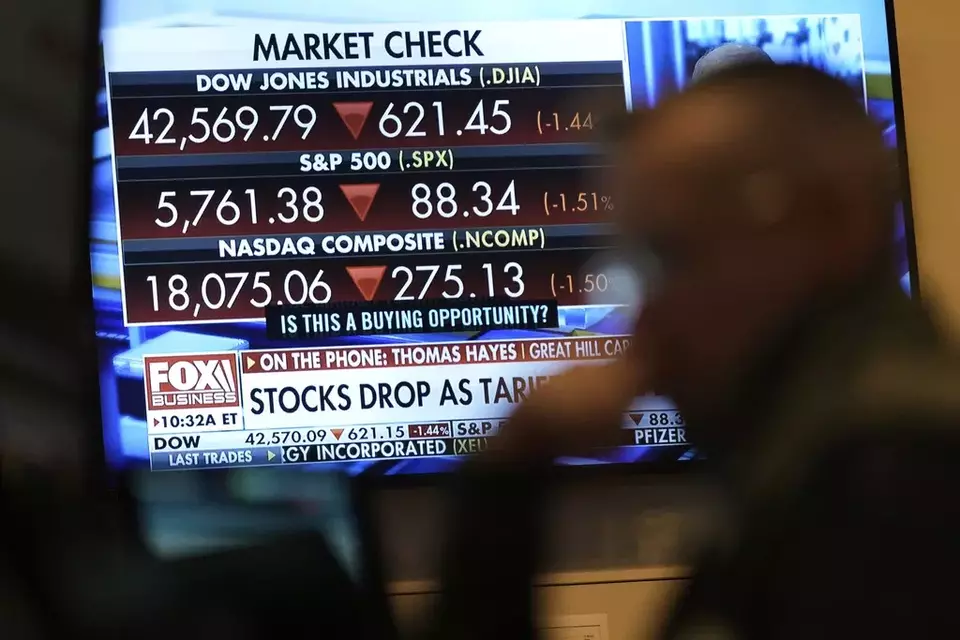
New York. Wall Street’s sell-off kicked back into gear on Thursday, and a US stock market rattled by the whiplash created by President Donald Trump’s tariffs and uncertainty about the economy fell sharply.
The S&P 500 tumbled 1.8 percent to resume its slide after a mini-recovery from the prior day clawed back some of its sharp drop over recent weeks. The Dow Jones Industrial Average dropped 427 points or 1 percent, and the Nasdaq composite sank 2.6 percent to finish more than 10 percent below its record set in December.
Stocks fell even though President Trump offered a one-month reprieve from his 25 percent tariffs on many goods imported from Mexico and Canada. That’s unlike the bounce stocks got the prior day from his giving a one-month exemption specifically for automakers.
All the moves keep hope alive that Trump may be using tariffs as just a tool for negotiations rather than as a permanent policy and that he may ultimately avoid a worst-case trade war that grinds down economies and sends inflation higher.
But Trump is still pressing ahead with other tariffs scheduled to take effect April 2. And the growing pile of dizzying back-and-forth moves on tariffs is only ramping up the uncertainty. It was just on Monday that Trump said there was “no room” left for negotiations to avert the tariffs on Mexico and Canada that took effect Tuesday.
“These exemptions don’t do much to resolve the general air of uncertainty,” said Yung-Yu Ma, chief investment officer at BMO Wealth Management. “Businesses will still be cautious in the current environment until a lot more of the tariff picture is clear.”
US businesses are already saying they’re confronting “chaos” because of all the uncertainty coming out of Washington while US households are bracing for higher inflation because of the tariffs, which is sapping their confidence.
“Much will depend on whether these new tariffs prove temporary or are toned down,” according to strategists at BNP Paribas. “But even if they are ultimately removed, we anticipate lasting damage to global economic activity.”
When asked whether his delays on tariffs reflected the slump in the stock market, Trump said Thursday, “I’m not even looking at the market.” He earlier in the Oval Office blamed the falling prices on “globalist countries and companies that won’t be doing as well because we’re taking back things that have been taken from us many years ago.”
Next up for Wall Street is a report coming Friday from the US Labor Department on how many workers US employers hired last month. A solid job market so far, along with the solid spending by US households that it’s allowed, have been linchpins in preventing a recession. Economists are expecting to see an acceleration in hiring for February.
Some big retailers have been offering warning signals recently about how much US consumers can keep spending.
Macy’s on Thursday reported slightly weaker revenue for the end of 2024 than analysts expected, though its profit topped expectations. It also gave a forecast for profit in 2025 that fell short of analysts’. Its shares fell 0.7 percent.
It was a similar story for Victoria’s Secret, which beat Wall Street’s fourth-quarter sales and profit forecasts but gave a revenue forecast for the upcoming year that fell short of analysts’ expectations. Its stock fell 8.2 percent.
Making things worse for the US stock market, some of its biggest stars are seeing their glow dim.
Semiconductor companies and their suppliers were particularly heavy weights, after soaring to staggering heights because of the frenzy around artificial intelligence technology.
Marvell Technology lost nearly a fifth of its value and dropped 19.8 percent even though it reported results for the latest quarter that edged past analysts’ forecasts. It also said it expects revenue growth in the current quarter of more than 60 percent from the prior year, give or take a bit.
But that wasn’t enough for investors, who have grown used to AI-related companies trouncing expectations.
The poster child of the AI boom, Nvidia, fell 5.7 percent, while Broadcom lost 6.3 percent ahead of the release of its earnings report.
AI superstars had been dominating Wall Street for years and helped it run to record after record. But those soaring performances, including a nearly 820 percent surge for Nvidia from 2023 into 2024, had critics saying prices had grown too expensive. They’re also facing threats as Chinese companies develop their own AI offerings, with DeepSeek famously saying it didn’t need to use the industry’s most expensive chips.
All told, the S&P 500 fell 104.11 points to 5,738.52. The Dow Jones Industrial Average dropped 427.51 to 42,579.08. The Nasdaq composite tumbled 483.48 to 18,069.26.
Tags: Keywords: as a preferred
Related Articles

Jakarta Stocks Slip Below 6,000 as Consumer Confidence Weakens
Indonesian stocks fell below 6,000 after reversing early gains as consumer confidence weakened to a three-month low in September.
Jakarta Stocks Open Higher on US Jobs Data, BI Policy Support
Jakarta stocks opened higher as weak US jobs data boosted hopes for a Fed rate pause, while BI continued supporting the rupiah.
Indonesia Stocks Rise at Open as Oil Prices Fall, Nasdaq Hits Record
Indonesian stocks opened higher as falling oil prices lifted sentiment, while Wall Street’s Nasdaq Composite closed at a record high.
Indonesian Stocks Rise as Fed Bets and MBG Savings Lift Sentiment
Indonesian stocks opened higher Friday as Wall Street gains and expectations of MBG budget savings boosted investor sentiment.
Canada to Unveil Response to Trump's Steep Tariffs
In an earlier phase of the dispute, Ontario imposed a temporary 25% surcharge on electricity exports to three US states.
Jakarta Stocks Rise as Balance of Payments Deficit Narrows
Indonesia's JCI rose 0.37% as the country's balance of payments deficit narrowed sharply in the second quarter.
Indonesian Stocks Rise as Government Delays 0.5% Marketplace Tax
Indonesia delayed a 0.5% marketplace tax to protect purchasing power as the JCI rose 0.48% amid stronger Fed rate-cut hopes.
Indonesia Stocks Rise at Open on Growth, Stimulus Hopes
Indonesian stocks opened higher as strong economic growth and stimulus plans outweighed cautious global sentiment ahead of US jobs data.
Jakarta Stocks Trade Choppy Ahead of Bond Auction, S&P Sovereign Review
Jakarta stocks traded choppy as investors awaited Indonesia's bond auction, S&P review, and key economic data from the US and China.
Jakarta Stocks Open Lower Despite Higher Forex Reserves, Eyes Profit-Taking Risks
JCI opened slightly lower as stronger forex reserves offset concerns over a wider 2026 budget deficit and profit-taking risks.The Latest

Chandra Asri Group Receives Trade Finance Excellence Award, Reinforcing Its Role in Indonesia’s Industrial Development
Chandra Asri Group receives the Trade Finance Excellence Award at CIMB Niaga Business Summit 2026.
AEON MALL Deltamas Brings 11 Sports and Creative Competitions to AEONLYMPIC 2026
AEON MALL Deltamas hosts AEONLYMPIC 2026, featuring 11 sports and creative competitions, with more than 3,100 participants.
Indonesian Stocks Extend Losses for Third Day, Fall 3.64% to 4,996
Indonesian stocks fell 3.64% on Monday, extending losses for a third straight session amid MSCI concerns and tighter trading limits.
Prabowo Calls Meeting on Forest Fires as Haze Reaches Jakarta, Singapore
Prabowo summons senior officials to discuss forest fires as smoke reaches Jakarta and Malaysia pushes for regional action.
Jakarta Outranks Amsterdam in Global Public Transport Survey
Jakarta climbs two places to 15th in Time Out's 2026 public transport survey, with its governor citing better network integration.Most Popular
