



Frugal Ramadan Spending Puts Pressure on Indonesia's Economy
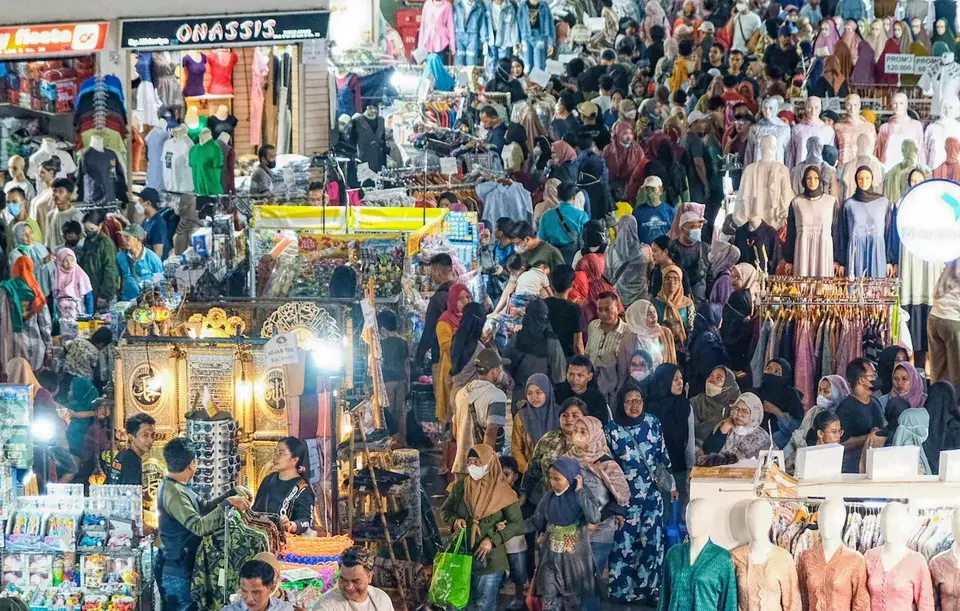
Jakarta. Ramadan and Eid have traditionally served as strategic periods for boosting Indonesia’s national economy, as consumer spending typically surges. However, this year's festive season is expected to see a weaker-than-usual rise in consumption due to ongoing economic uncertainty.
In recent months, economic instability has cast a shadow over consumer sentiment. Layoffs in the manufacturing sector, rising commodity prices, and weakened purchasing power have contributed to sluggish consumer spending. Consequently, the economic outlook for Eid appears less optimistic than in previous years.
Historically, household consumption has been a major driver of Indonesia’s gross domestic product (GDP), contributing over 50 percent to the economy. During last year's Ramadan and Eid, consumption helped push Indonesia’s annual GDP growth to 5.11 percent. However, growth in consumer spending is expected to be more subdued in 2025.

Declining Purchasing Power and Deflation
One of the primary factors behind this trend is the decline in purchasing power, reflected in a deflationary trend during the first two months of 2025. Indonesia experienced monthly deflation in January (0.76 percent) and February (0.48 percent), with an annual deflation rate of 0.09 percent in February—the first recorded annual deflation in 25 years, since March 2000.
The weakening purchasing power is also evident in the Consumer Confidence Index (CCI) compiled by Bank Indonesia (BI). In February 2025, the CCI fell slightly to 126.4 from 127.2 in January. This index measures consumer sentiment regarding current and future economic conditions, providing insights into household consumption and savings behavior.
Furthermore, mass layoffs in the manufacturing sector have dampened consumer optimism. The Manpower Ministry recorded 77,965 job losses in 2024, with 22 percent occurring in Jakarta alone. In early 2025, at least six manufacturing companies conducted mass layoffs, affecting approximately 16,000 workers.
The most significant case involved South East Asia's textile giant Sri Rejeki Isman (Sritex), which laid off 10,665 employees and ceased operations on March 1. These job losses have further strained consumer spending, especially as Ramadan approaches.
Read More: Indonesia's Eid Holiday Financial Turnover to Weaken to $8.3 Billion
Consumers Prioritizing Savings Over Spending
According to Bhima Yudhistira, Executive Director of the Center for Economic and Law Studies (Celios), the 2025 festive season is expected to be less vibrant than in previous years. Traditionally, heightened consumption during Ramadan and Eid boosts quarterly economic growth.
"Mass layoffs in the manufacturing sector have impacted both corporate earnings and workers' incomes, suppressing consumer purchasing power and creating an uncertain economic outlook," Bhima told B-Universe Media Holdings recently.
Bhima also noted that many consumers are choosing to save rather than spend due to economic uncertainty. A YouGov survey published on February 15, revealed that 58 percent of 2,012 respondents aged 18 and above planned to save their holiday bonuses instead of spending them immediately.
Senior economist Bustanul Arifin from the Institute for Development of Economics and Finance (Indef) said this shift in behavior reflects growing public concern over economic uncertainty. "Typically, when interest rates are low, consumers prefer spending over saving. However, despite Bank Indonesia maintaining interest rates in February 2025 to encourage spending, consumer expenditures have not significantly increased," he explained.
Economic activity usually rises by the second week of Ramadan, with increased transactions at markets and shopping centers. However, this trend has not been as pronounced in 2025. Additionally, as people travel for Eid, spending traditionally shifts from urban centers to rural areas. If expenditures in hometowns decline—particularly for gifts and holiday necessities—regional economies may also suffer, potentially hampering overall economic growth.
Surveys indicate that only 146.48 million Indonesians will travel during this Eid homecoming season, a 24 percent decrease from the 193.6 million travelers recorded last year.
Fewer travelers mean lower spending. A report from Red Strategy Consultant projects total consumer spending during Ramadan 2025 to reach $73 billion, equivalent to Rp 1,188 trillion, with growth estimated at only 5–7 percent—a slowdown compared to the 9–12 percent growth recorded in 2023 and 2024.
Government’s Economic Stimulus Measures
In response, the government has introduced several initiatives to stimulate consumer spending and sustain economic growth during Ramadan and Eid. Seven key incentives have been rolled out to bolster purchasing power and drive domestic consumption.
-
Social Assistance Programs – The government is optimizing the distribution of social assistance, including the Family Hope Program (PKH) and the Staple Food Card/Bantuan Pangan Non-Tunai (BPNT). The first phase of PKH disbursements for 2025, worth Rp 150 trillion, is being distributed through state-owned banks and postal service Pos Indonesia. Additionally, Perum Bulog has been allocated Rp 16.6 trillion to purchase 3 million tons of rice by April 2025.
-
Discounted Airfare – To facilitate domestic travel during Eid, the government is offering a 6 percent value-added tax (VAT) discount on economy-class airfare. This is expected to lower ticket prices by 13.2 percent to 14 percent from March 25 to April 7, 2025.
-
Toll Road Discounts – To ease holiday travel costs, the government is implementing a 20 percent discount on long-distance toll fares, aiming to reduce transportation expenses and support efficient goods distribution.
-
Retail Discounts – Promotional programs such as "Friday Mubarak" (February 28–March 28) and "Belanja di Indonesia Aja (BINA) Lebaran" (March 14–March 30) offer discounts across shopping malls and retail stores. These campaigns aim to generate Rp 105 trillion in transactions.
-
Tourism Integration – The government is promoting domestic travel through affordable travel packages and enhanced tourism infrastructure along major travel routes.
-
Food Price Stabilization – The government, in collaboration with state-owned enterprises, is conducting nationwide market operations to provide affordable food commodities. This program runs from February 24 to March 29.
-
Early Disbursement of Holiday Bonuses – The government has allocated Rp 50 trillion for early holiday bonus (THR) disbursements to civil servants, scheduled for three weeks before Eid. Private-sector employees are expected to receive their bonuses at least one week before the holiday.
With these measures, Chief Economic Affairs Airlangga Hartarto hopes to maintain economic stability while ensuring that citizens can celebrate Eid without financial strain.
Despite these efforts, experts caution that economic recovery largely hinges on food price stability and consumer confidence. Economist Syafruddin Karimi from Andalas University estimates that Indonesia’s GDP growth in Q1 2025 may reach only 4.7 percent–5 percent, falling short of government targets due to declining consumer spending.
"The government must take concrete steps to increase purchasing power," Syafruddin warned, emphasizing the importance of stabilizing food prices to prevent inflationary pressures that could further strain household budgets.
Tags: Keywords: as a preferred
Related Articles

Two Years Into Prabowo Presidency, Infrastructure Takes Back Seat
Prabowo’s social spending push raises concerns over infrastructure delays and uneven growth beyond Java.
Indonesia Can Hit 8% Growth With Housing, AI, Green Energy: Hashim
Hashim Djojohadikusumo says housing, AI, digital infrastructure and green energy could help Indonesia achieve 8% economic growth.
Airlangga Urges Indonesia to Catch Up With Vietnam in Digital, AI Industries
Indonesia needs to accelerate digital, semiconductor and AI industries to catch up with Vietnam and achieve its 8% growth target.
Apindo Warns Labor Bill Could Stall Investment, Job Creation
Apindo warns Indonesia’s proposed labor bill could deter investment and business expansion, slowing formal job creation.
Big Spending, Limited Revenue: Economists Question Prabowo’s Economic Strategy
Prabowo’s flagship programs face scrutiny as rising spending, weak job creation and deindustrialization threaten Indonesia’s growth.
Prabowo Faces Calls to Deliver Better Jobs as His Third Year Begins
Unions urge Prabowo to create more formal jobs, raise wages and expand worker protections as his administration enters its third year.
Indonesia Cuts 2027 Energy Subsidies by $635 Million
Indonesia will cut 2027 energy subsidies to Rp 261.5 trillion, citing improved recipient data to better target assistance.
Little Economic Progress, Tight Budgets Cloud Prabowo’s Second Year
UGM economists say Indonesia has seen little economic improvement under Prabowo, warning of fiscal risks in flagship programs.
Suahasil Inherits Fiscal Credibility Test as Investor Confidence Wavers
Suahasil Nazara faces pressure to restore fiscal credibility as investors seek consistent policies, clearer signals and market confidence.
Indonesia Consumer Confidence Rises to 118.5 in August
Indonesia’s consumer confidence strengthened in August, with the confidence index rising to 118.5 from 116.8 in July.The Latest

Prabowo Calls Meeting on Forest Fires as Haze Reaches Jakarta, Singapore
Prabowo summons senior officials to discuss forest fires as smoke reaches Jakarta and Malaysia pushes for regional action.
Jakarta Outranks Amsterdam in Global Public Transport Survey
Jakarta climbs two places to 15th in Time Out's 2026 public transport survey, with its governor citing better network integration.
MSCI Concerns, Tighter IDX Trading Rules Send Indonesian Stocks Down 5% by Midday
Indonesian stocks plunge 5% by midday as MSCI concerns weigh on sentiment and the IDX tightens its daily downside limit to 7%.
Jakarta Prepares 367 Health Facilities as Haze Reaches the Capital
Jakarta prepares 367 health facilities to treat potential haze-related illnesses after smoke from Sumatra and Kalimantan crosses the region.
Jakarta Expands Flood Prevention With New Water Storage Ponds
Jakarta opens two East Jakarta water storage ponds as it expands flood prevention efforts through reservoirs and river normalization.Most Popular
