



Xi Ends Southeast Asia Tour in Cambodia, Pledges Support and Investment
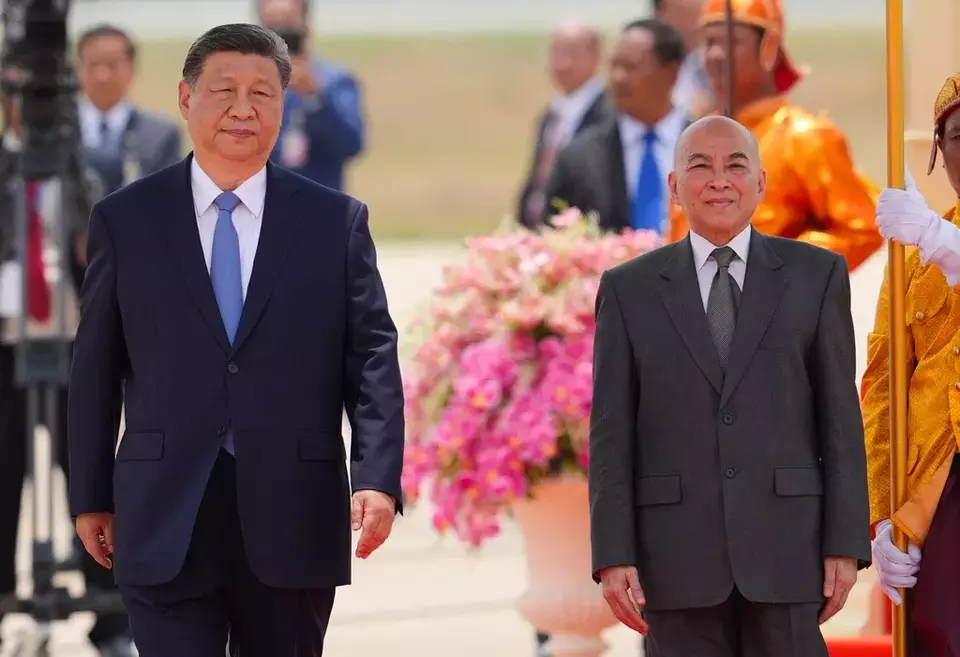
Phnom Penh. Chinese President Xi Jinping arrived in Cambodia on Thursday for a two-day state visit aimed at strengthening already close ties between the two countries, concluding his three-nation Southeast Asia tour that also included Vietnam and Malaysia.
The visit is Xi’s first to Cambodia since 2016 and comes as China expands its influence in the region, largely through economic investment and trade.
Cambodian Prime Minister Hun Manet recently described China as "an important and indispensable friend of Cambodia that has helped support the country's economic and social development."
Xi was greeted at Phnom Penh International Airport by King Norodom Sihamoni. He is expected to meet with Hun Manet and Senate President Hun Sen, Hun Manet’s father and predecessor, during his visit.
“I am delighted to visit Cambodia once again,” Xi said upon arrival, according to a transcript released by the Chinese Embassy. “Cambodia is a priority in China's neighborhood diplomacy. China will unswervingly support Cambodia in upholding strategic autonomy and pursuing a development path suited to its national conditions.”
Trade is expected to be a major focus of the talks, as Cambodia faces some of the highest proposed tariff rates by the United States. In addition to a universal 10 percent tariff, the country could be hit with a 49 percent duty on exports to the US once a 90-day pause expires.
Several bilateral agreements are expected to be signed during the visit, covering cooperation in various sectors. Xi has emphasized trade and investment ties during his regional tour, positioning China as a reliable partner amid global economic uncertainty and trade tensions with Washington.
China has framed itself as a source of stability in Southeast Asia, which is grappling with the impact of US tariffs that threaten the region’s export-driven economies.
The visit coincides with the 50th anniversary of the Khmer Rouge’s takeover of Cambodia on April 17, 1975. The Maoist regime killed an estimated 1.7 million people through starvation, forced labor, and executions. Although Beijing was the Khmer Rouge’s main international backer and continued to support the group after it was ousted in 1979 by Vietnamese forces, that part of the two countries' shared history is rarely discussed publicly.
In recent decades, China has played a major role in Cambodia’s rapid economic development. Earlier this month, Hun Manet praised China as "a first-class partner country" during the inauguration of a Chinese-funded road. He cited projects such as the Chinese-named Angkor Siem Reap Airport and the Phnom Penh ring road, which is named after Xi, as symbols of the deepening relationship. China remained Cambodia’s top investor in 2024.
Bilateral trade exceeded $15 billion in 2024, accounting for nearly 30 percent of Cambodia’s total trade, heavily skewed in China’s favor.
Beijing has also funded the expansion of the Ream Naval Base on Cambodia’s southern coast, prompting concerns it could serve as a strategic outpost for the Chinese navy in the Gulf of Thailand. Cambodia has denied granting China exclusive access or permission to establish a military base.
Officials have said that warships from all friendly countries are welcome to dock at the facility, provided they meet certain conditions. On Tuesday, Japan announced that two of its minesweepers would visit Ream this weekend, the first foreign navy visit since the expansion was completed.
Tags: Keywords: as a preferred
Related Articles

Xi Says Looks Forward to Discussing 'Global Situation' with Trump
After officials literally rolled out the red carpet, Trump and First Lady Melania shook hands with Xi and his wife Peng Liyuan.
BRICS Indirectly Hits Out at Trump’s Tariffs, WTO Paralysis
BRICS doesn't want to see unilateral tariffs and a paralyzed WTO court system, all of which are linked to the US.
Indonesia Denies US Accusation of Chinese Transshipment Scam
Senior minister Airlangga Hartarto says "Indonesia has never done transshipment", when asked about the US report.
US Accuses Indonesia of Helping China Dodge Trump Tariffs
The US accuses Indonesia and dozens of other countries of being part of "China's shadow transshipment network".
ASEAN Hopes for Predictability on Trump’s Tariffs
ASEAN says the region's businesspeople wish for a predictability and certainty as Trump launches a fresh round of tariff hikes.
Indonesia Banks On EU as Trump's 10% Tariff Kicks In
Indonesia wants to fast-track its European Union (EU) trade deal as Jakarta tries to find alternatives to the tariff-agressive US.
US Slaps 10% Tariff on Indonesia over Forced Labor
A new 10% tariff on Indonesia following a forced labor probe will take effect on Friday before noon.
'AI Development Should Not Be a Solo Performance by Any Single Country,' Says Xi Jinping
Over the next five years, he said, China will provide 5,000 training opportunities on artificial intelligence to developing countries.
Chinese Court Hands Former Local Official Death Sentence in $325M Bribery Case
The graft case is one of the most dramatic corruption scandals in recent years in terms of the sheer scale of the bribes involved.
Does G7 Make Sense Without China?
China's exclusion looks odd, given its now immense sway over the world's economic well-being and affairs.The Latest

Prabowo Calls Meeting on Forest Fires as Haze Reaches Jakarta, Singapore
Prabowo summons senior officials to discuss forest fires as smoke reaches Jakarta and Malaysia pushes for regional action.
Jakarta Outranks Amsterdam in Global Public Transport Survey
Jakarta climbs two places to 15th in Time Out's 2026 public transport survey, with its governor citing better network integration.
MSCI Concerns, Tighter IDX Trading Rules Send Indonesian Stocks Down 5% by Midday
Indonesian stocks plunge 5% by midday as MSCI concerns weigh on sentiment and the IDX tightens its daily downside limit to 7%.
Jakarta Prepares 367 Health Facilities as Haze Reaches the Capital
Jakarta prepares 367 health facilities to treat potential haze-related illnesses after smoke from Sumatra and Kalimantan crosses the region.
Jakarta Expands Flood Prevention With New Water Storage Ponds
Jakarta opens two East Jakarta water storage ponds as it expands flood prevention efforts through reservoirs and river normalization.Most Popular
