



Jakarta's Shift to Electric Vehicles: When Will Residents Make the Change?
The advent of modern electric vehicles, or EVs, in the late 1990s, sparked media coverage of their potential as a solution to air pollution. At COP26 in 2021, 30 countries, including Indonesia, committed to making EVs accessible, affordable, and sustainable by 2030 or sooner through the Glasgow Agreement and subsequent multilateral initiatives.
The government has quickly taken action to support the initiatives. President Joko "Jokowi" Widodo sees EVs as a unique opportunity to enhance Indonesia's industrial capabilities. To achieve this vision, the government has taken a range of steps, such as banning nickel exports - a crucial metal for EV batteries - and attracting Tesla, the leading EV producer, to invest in the country.
EVs are marketed to the public as saving money and reducing pollution, ignoring the questionable environmental track record of the mines that supply the metals for their battery and emission from coal-fired power plants that will power them for the foreseeable future.
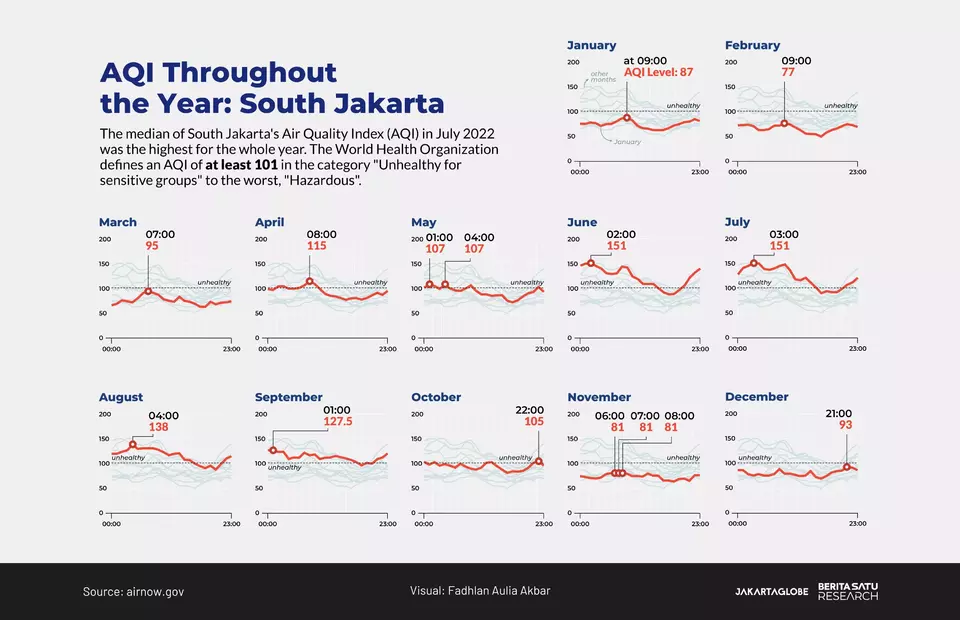
And the plan is well-received, especially among Jakarta residents who face daily exposure to harmful particulate matter in the air.
Changing Perceptions
"I just got home. I need to park my bicycle in a moment," a message sent from Bondan Andriyanu. He is a Climate and Energy Campaigner at Greenpeace Indonesia. He rides his bicycle every day, going back and forth between his office and home, both in Jakarta.
After the afternoon call to prayer, he presented the findings of the Resilience Development Initiative and Greenpeace Indonesia entitled "Jakarta Transportation Transformation: Reviewing the Transportation Sector Zero Emission Target in 2050".
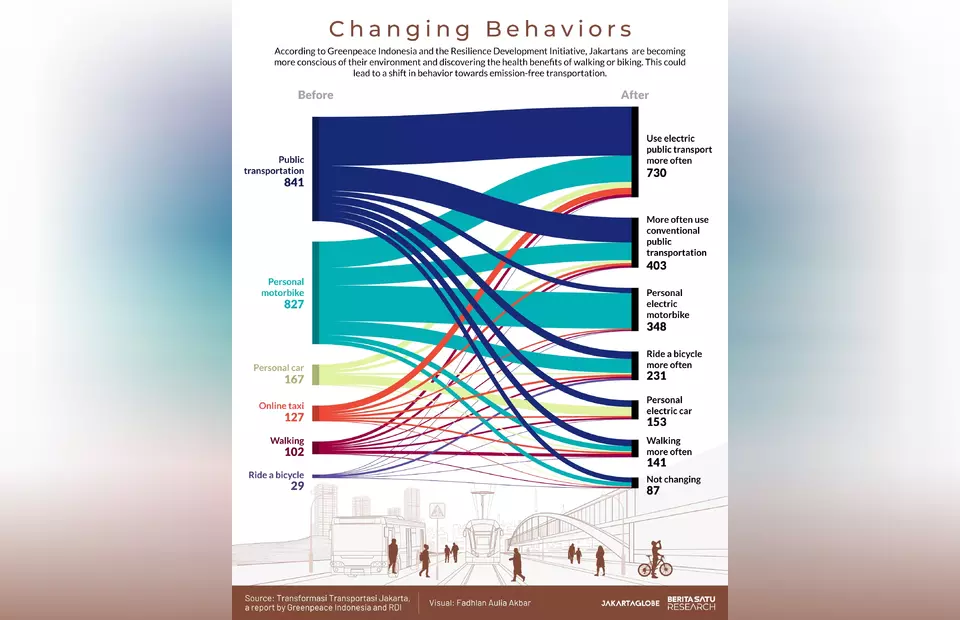
Published in July 2022, the study calculates emissions generated by vehicle operations. Based on data from 2,097 respondents over 18 years in Jakarta, Greenpeace found that the primary mode of transportation used by those respondents is public transportation (40.2 percent), followed by private motorbikes (39.5 percent).
Lufthansa Innovation Hub data reprocessed by Greenpeace Indonesia shows carbon emissions per passenger—expressed in grams per passenger kilometers (g/pkm)—oil-fueled cars are the largest in the mode of transportation category (210 g/pkm), followed by diesel-fueled cars ( 205 g/pkm). Gasoline-fueled motorcycles are in fifth place (137 g/pkm).
Still, the study showed a promising outcome with a predicted decline in motorized vehicle usage in Jakarta's future. Residents are opting for a mix of fossil-fuel and electric-powered public transportation and non-motorized options.
Some of the factors driving the shift towards alternative modes of transportation in Jakarta include cost efficiency, reduced pollution, and improved health outcomes.
"We often focus on emissions. But it's rare to disclose the access to vehicles that support emission reductions," said Andriyanu.
"Access and connectivity between public transportation, he said later, "must be affordable for all groups, be it women, children, people with special needs and marginalized communities."
Green and Gendered
When Indonesia held the presidency of the G20, it ensured that women would take a role in the zero-emissions initiatives. At one of the G20 meeting sessions, the Ministerial Conference on Women's Empowerment (MCWE), the Ministry of Women's Empowerment and Child Protection invited G20 members to promote gender equality accompanied by environmental preservation.
The ministry hoped that the effort made after the Covid-19 pandemic would continue developing by expanding EVs among female entrepreneurs.
Several partners took part in this initiative, including Grab Holdings—the MCWE electric transportation official partner—and Perusahaan Listrik Negara (PLN) as the country's sole electricity supplier.
Country Managing Director of Grab Indonesia, Neneng Goenadi, said that "women's empowerment, as well as environmental preservation, are the two main focuses of GrabForGood's mission." She prompted "the extraordinary fighting power of women, which has a positive effect on [Covid-19] post-pandemic." GrabforGood is Grab's endowment to help partners and communities in Southeast Asia.
Through GrabforGood, Grab distributes the rental of 8,500 GrabElectric units—in the form of electric motorbikes and cars—to driver-partners in eight Indonesian provinces. One of them is Jakarta. Even so, Grab did not release the number of female drivers who, at least throughout 2022, rent for GrabElectric.
Meanwhile, in 2022, PLN, through its corporate social responsibility (CSR) program, distributed 12 electric carts for female mobile vegetable sellers in Srengseng Sawah, South Jakarta. The Globe met with Yuni Wahyuningsih, one of the itinerant vegetable sellers who received electric cart assistance.
"We had used pushcart for a long time. Now we don't need to push it anymore. Just plug the cart at home, and we can sell vegetables all day long," Wahyuningsih said.
She said, "using an electric cart won't make us [she and her husband] exhausted." She hopes the cart could increase her turnover, which currently stands at Rp 2.5 million ($174) daily.
Barriers to EVs Adoption
Many EV manufacturers and governments worldwide claim that environmentally friendly products will create significant opportunities for women.
In a recent examination of European media coverage, the Globe traced the experiences of several female EV owners who spoke as informants. Their impressions included the observation that EVs have fewer moving parts than traditional vehicles and the perception that EVs are more enjoyable to drive than vehicles powered by internal combustion engines.
"Some of my former students in England and Taiwan told me EVs are fun," said Sri Setiawan, a teacher majoring in light vehicle engineering at the Warga Vocational High School (SMK) in Solo, Central Java. SMK is on the same level as a public high school.
"But here, I'm not sure. At least from my side as an assembler," Setiawan said. Amid the clanging of his students welding in the background, his voice rises and falls as he speaks on the phone.
In the workshop at the school where he teaches, the 44-year-old teacher assembles convertible motorbikes as part of the subject for 25 students per semester of education.
Working closely with Suzuki Motor, a motorcycle manufacturer, he initially received five motorcycles produced at least ten years ago. His homework begins. He had to buy conversion components, for example, batteries, battery boxes, and DC-to-DC converters.
He admitted that he had previously spent money to buy batteries and other propulsion systems from online-based shops, some from abroad.
"Even though the cost is reimbursed, still, I had to prepare myself with a bag of initial capital," he said. He spent at least Rp 25 million on spare parts during a shopping trip.
From an assembly standpoint, it isn't easy. Moreover, he said, "to determine the selling price and how the product, with that selling price, can be sold on a large scale to small businesses, is difficult," said Setiawan, who has been teaching in several vocational schools for 23 years.
"Despite the government's encouragement for SMKs to assemble EVs, the limited availability of conversion-certified workshops in Indonesia poses a challenge," said Setiawan. Of the ten certified workshops, none have SMK status, which hinders the goal of making the EVs assembly accessible to micro-, small-, and medium-sized enterprises, he said.

The Dream of Clean Batteries
Setiawan acknowledges that the supply chain for converting motorcycles to electric still involves processes that are not environmentally friendly. He notes, "Even the batteries, made from nickel derivatives, are not entirely green."
Nickel is a crucial component in electric vehicle assembly. Its high energy density makes it challenging for the world to move away from its dependence on this metal in battery production.
There has been growing concern about the detrimental impact of nickel on environmental sustainability. Not only does the extraction of the metal raise issues of people's land tenure without the consent of local communities, but it also leads to resistance and often conflict between nickel mining operations and indigenous peoples.
One such example occurred in June 2013, when members of the indigenous Sawai and Tobelo Dalam communities in Central Halmahera, North Maluku, staged a demonstration at a nickel mining site owned by Weda Bay Nickel and Tekindo.
The Tobelo Dalam tribe, who depend on the land for their livelihood through hunting and farming in the forest, were not included in the process of granting contracts of work to the two companies, according to environmental advocacy group Walhi. The absence of community involvement led to the concession encroaching on customary forest land.
In May 2013, a month before the protest, the Indonesian Constitutional Court declared that customary forests are not state forests and that no work permits can be granted in these areas. Only permits for state forest areas are permitted.
Senior Economist Faisal Basri reportedly warned in early 2022 that Indonesia might only benefit from low wages, minimal land rental fees from nickel investments, and the influx of foreign workers from China. Basri expressed concerns over the government allegedly disregarding or "protecting" practices of exploiting natural resources that harm the environment, as quoted by multiple national media outlets.
Nickel processing typically involves using rotary machines that require large amounts of energy. Often, smelter companies generate the power using their own power plants or getting it from PLN. However, most of the power plants run on coal-fired energy, presenting a challenge for the development of electric vehicles and the goal of utilizing clean energy.
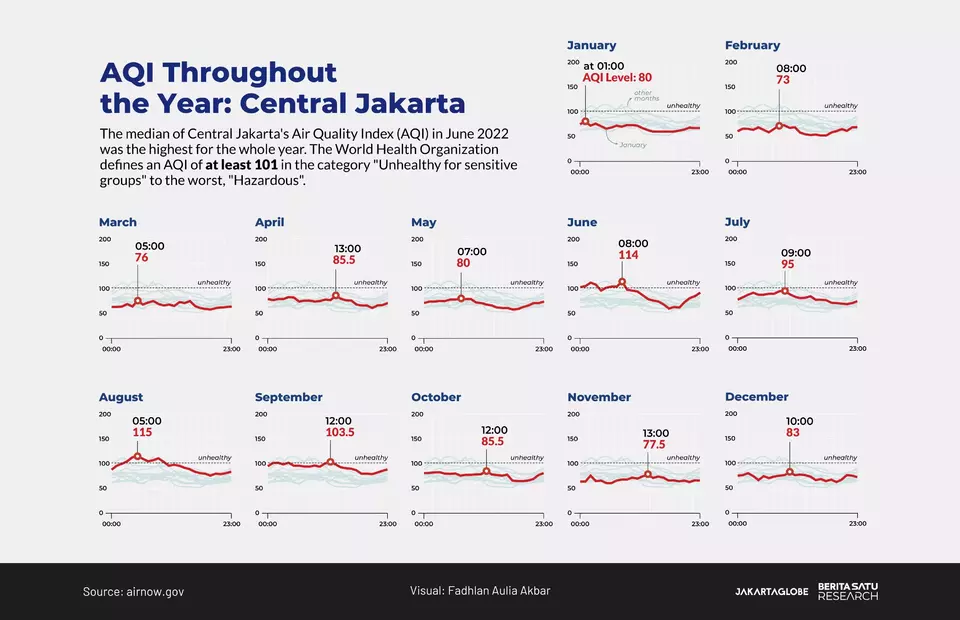
The same type of power plant also powers Jakarta and the EVs that would soon roam its street. In a 2017 report titled "Jakarta's Silent Killer," Greenpeace Indonesia revealed that Jakarta is near 22 coal-fired power plants, with four more operational in 2019 and 2024. The report highlighted that each power plant would have a lifespan of at least 30 years.
It's unclear what proportion of Jakarta's electricity supply originates from the PLTUs, due to the lack of specific data. However, given their proximity to the city, it's evident that they play a significant role in powering the capital.
Greenpeace wrote in the report, "Greater Jakarta could see more new coal-fired power stations built within 100 kilometers than any other capital city." In a big city where people often blame traffic for the polluted air they breathe, "the pollution from these plants is making the air in Greater Jakarta even more hazardous."
It seems there is still a long way to go to avoid headlines like "A Dirty Road to Clean Energy."
This story was produced with the support of Internews' Earth Journalism Network through the Clean Air Catalyst (Catalyst), a flagship program launched by the US Agency for International Development (USAID).
 as a preferred
Related Articles

PLN Urged to Prevent Blackouts to Protect Investor Confidence
Recurring blackouts can deter investment in Indonesia, experts say as Suroso leads state utility firm PLN.
Prabowo Orders PLN Overhaul, Acceleration of 100 GW Solar Power Plan
Prabowo orders Danantara to review PLN's business model and accelerate a 100 GW solar power plan to improve efficiency and reliability.
Power Restored in Eight Batam Areas After Hours-Long Blackout
Power has returned to eight areas of Batam after hours-long blackout disrupted public services, while the cause remains under investigation
Prabowo to Launch Indonesia’s First Electric Vehicle Battery Export
Indonesia is set to export its first electric vehicle batteries as Prabowo launches a $10.2 billion industrial program.
Data Center Power Demand to Reach 25,297 MW by 2034, PLN Says
Indonesia’s data center power demand could reach 25,297 MW by 2034, with 99% of current capacity concentrated in the Java-Bali grid.
Indonesia Disburses $18.7 Billion in Energy Subsidies, Compensation
Indonesia disbursed Rp 331.4 trillion in energy subsidies and compensation to PLN and Pertamina as of August, up 52.1% year-on-year.
El Nino Cuts South Sulawesi Hydropower Capacity by 600 MW, PLN Says
El Nino has cut hydropower capacity in South Sulawesi by 600 MW, prompting PLN to prepare an additional 627 MW of supply.
Let PLN Rent Out the Grid It Already Owns
Indonesia can unlock billions in solar investment by letting companies lease PLN’s grid to buy renewable power directly.
Palangka Raya Ranked World’s Most Polluted City as Haze Blankets Central Kalimantan
Palangka Raya was ranked the world’s most polluted city as forest fire haze pushed its air quality index to 199 on Thursday.
Health Ministry Calls for Remote Learning as Forest Fire Haze Worsens
Indonesia is urging remote learning and reduced outdoor activities as forest fire haze pushes air quality to hazardous levels.The Latest

Prabowo Calls Meeting on Forest Fires as Haze Reaches Jakarta, Singapore
Prabowo summons senior officials to discuss forest fires as smoke reaches Jakarta and Malaysia pushes for regional action.
Jakarta Outranks Amsterdam in Global Public Transport Survey
Jakarta climbs two places to 15th in Time Out's 2026 public transport survey, with its governor citing better network integration.
MSCI Concerns, Tighter IDX Trading Rules Send Indonesian Stocks Down 5% by Midday
Indonesian stocks plunge 5% by midday as MSCI concerns weigh on sentiment and the IDX tightens its daily downside limit to 7%.
Jakarta Prepares 367 Health Facilities as Haze Reaches the Capital
Jakarta prepares 367 health facilities to treat potential haze-related illnesses after smoke from Sumatra and Kalimantan crosses the region.
Jakarta Expands Flood Prevention With New Water Storage Ponds
Jakarta opens two East Jakarta water storage ponds as it expands flood prevention efforts through reservoirs and river normalization.Most Popular
