



Father of Chinese Indonesians: How Gus Dur Revives Imlek

Jakarta. The Chinese New Year, locally known as Imlek, is getting closer. On Feb. 1, we will enter the year of the water tiger.
Ornaments like lanterns and door couplets in the lucky color red will soon decorate the homes of Chinese Indonesians. People will light up firecrackers, which in traditional Chinese culture, were believed to scare away evil spirits. The loud bangs and crackles make the moment even livelier. Lion dance (barongsai) performers dancing to the rhythm of drums and cymbals are a common sight during this time of the year.
For Chinese Indonesians to be able to celebrate Imlek openly without the need to hide behind closed doors was one of fourth president Abdurrahman “Gus Dur” Wahid’s greatest legacies.
Long-serving leader Soeharto had prohibited Imlek from being celebrated in public, as stipulated under the 1967 presidential instruction on Chinese religion, beliefs, and traditions.
Chinese Indonesians at the time could only celebrate Imlek with families quietly in their homes — a striking contrast to the festivity we see nowadays.
For more than three decades the discriminatory rule was in force. It was in 2000 when Gus Dur inked a decree that lifted the 1967 presidential instruction.
“The president considers that religious practices, beliefs, and traditions are essentially an inseparable part of human rights,” the 2000 presidential decree reads.
On April 9 2001, Gus Dur declared Imlek as a facultative holiday or a holiday that only applied to those who celebrate it. Indonesia’s fifth president Megawati Soekarnoputri then turned Imlek into a national holiday in 2003.
Gus Dur passed away at the age of 69 in December 2009. But to this day, the late Gus Dur remains at the heart of Chinese Indonesians.
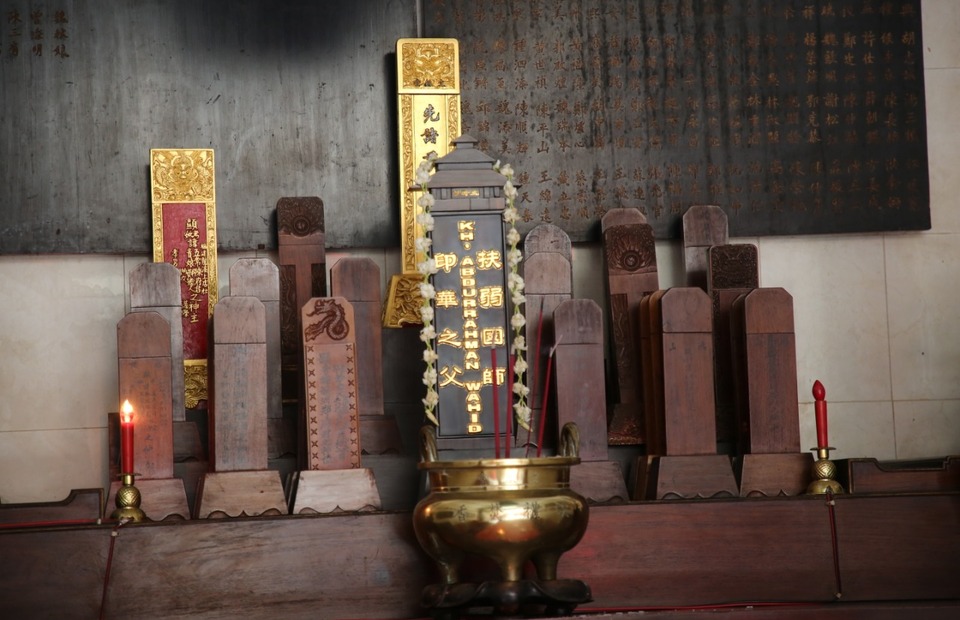
There is an ancestral tablet dedicated to Gus Dur in Semarang’s Chinatown, namely at the community association Boen Hian Tong or Rasa Dharma building.
The memorial tablet has “KH Abdurrahman Wahid” with Chinese writing on the sides carved in golden letters. News outlet CNN Indonesia reported that the Chinese writing read “the Father of Chinese Indonesians”.
“Chinese Indonesians truly respect Gus Dur. [He] protected the minorities and gave them freedom. We place [the ancestral tablet] here as a form of respect,” Rasa Dharma altar head Haryanto Halim said back in January 2020, as quoted from the Central Java provincial government official website.
Gus Dur’s thoughtfulness of the Chinese Indonesians portrays Indonesia’s motto Bhinneka Tunggal Ika or “University in Diversity”. The motto signifies how Indonesia consists of people of diverse cultures, religions, beliefs, and traditions. But despite the differences, Indonesians all live together in unity.
Tags: Keywords: as a preferred
The Latest

Ye Concert, Other Events to Draw 130,000 to GBK, Here’s What to Know
Around 130,000 visitors are expected at Jakarta’s GBK on Saturday as Ye’s concert and several major events take place.
Indonesia Allocates Rp 722 Billion for Year-End Flight Ticket Tax Relief
Indonesia allocates Rp 722 billion to cover domestic flight ticket VAT during the 2026/2027 Christmas and New Year holidays.
Greece Floats Shipbuilding Partnership with Indonesia
Greece says that it possesses “extensive expertise” as it woos Indonesia in shipbuilding partnership.
Indonesian Stocks Rally 4.9%, but Foreign Investors Keep Selling
Indonesia’s JCI rose 4.9% last week, but foreign selling and MSCI downgrade risks continue to cloud the market outlook.
Ye Concert in Jakarta to Deploy 2,000 Security Personnel
More than 2,000 personnel will secure Ye’s Jakarta concert on Saturday, as organizers urge fans to use public transport.Most Popular
