



Perry Leaves Rupiah Near Its Weakest Level Since the Asian Crisis
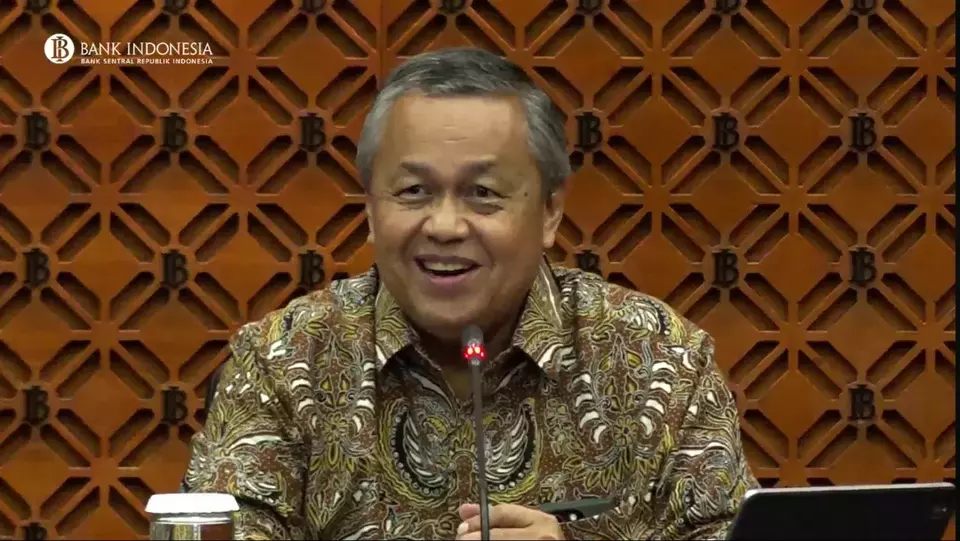
Jakarta. When Perry Warjiyo was sworn in as Bank Indonesia's 16th governor on May 24, 2018, the rupiah was already under strain, trading in the mid-Rp 13,000s as emerging markets buckled under a stronger US dollar and rising American interest rates.
Seven years into what was expected to be his second five-year term, the currency he leaves behind is hovering just below the psychologically Rp 18,000 mark, a level not seen since the Asian financial crisis.
Perry's abrupt resignation, announced Monday, closes one of the longer tenures in Bank Indonesia's history and hands his successor, acting governor Destry Damayanti, a currency under some of the heaviest pressure it has faced since the 1998 monetary crisis.
Bhima Yudhistira, executive director of the Center of Economic and Law Studies (CELIOS), argued the rupiah's weak performance should not be viewed as a reflection of Perry's leadership alone. He said Bank Indonesia had borne the brunt of criticism over issues extending well beyond monetary policy, from the widening fiscal deficit to concerns over funding President Prabowo Subianto's flagship free nutritious meals program.
"But the one that gets the blame has always been Bank Indonesia for failing to maintain rupiah stability and investors' confidence. Fiscal authority intervention in the monetary sector is already too much. It is no longer a synergy," Bhima told the Jakarta Globe.
A Governorship Defined by Currency Pressures
Days after Perry’s appointment was approved by the House of Representatives in March 2018, the rupiah was already sliding as the US Federal Reserve tightened policy and capital flowed out of emerging markets.
He would spend much of his first year defending the currency with a string of rate hikes, later crediting the central bank's resilience to what he described as conviction in the economy's underlying health, the political will to adopt tough measures, and close coordination with the government.
That pattern -- external shocks met with rate hikes, market intervention and moral suasion -- would define his time in office. The rupiah weakened again during the 2018–2019 emerging-market selloff, stabilized somewhat through the pandemic years as Bank Indonesia and the finance ministry pursued a "burden-sharing" arrangement to fund Covid-19 spending, and came under pressure through 2024 and 2025 as the Fed kept rates elevated for longer than markets expected.
Rupiah fell to around Rp 17,000 last year after Washington announced reciprocal tariffs, adding to pressure from an already strong US dollar and cautious investor sentiment. By September 2025, Perry was again pledging to deploy every tool available -- from spot-market interventions to bond purchases -- to defend a rupiah that had slipped past Rp 16,700.
Throughout his tenure, interest rates remained Bank Indonesia's primary tool to defend the rupiah against successive external shocks. Between May 2018 and July 2026, the central bank raised its benchmark rate 22 times and cut it 12 times across several monetary policy cycles, for a cumulative increase of 550 basis points and cumulative cuts of 400 basis points. Perry took office with the BI-Rate at 4.25% and left with it at 5.75%.
The Final Slide
The pressure only intensified into 2026. In May, the rupiah breached Rp 17,600, its weakest level since the Asian financial crisis, amid persistent capital outflows and increasingly cautious assessments of Indonesia's economic outlook from MSCI, Moody's and Fitch. The currency fell well below the government's 2026 budget assumption of Rp 16,500 to the dollar.
President Prabowo Subianto convened his top economic ministers as the rupiah later touched Rp 17,600 again, with Bank Indonesia raising its benchmark rate by a cumulative 100 basis points between May and June in a bid to draw foreign capital back in. Even so, the currency continued grinding toward, and briefly through, Rp 18,000 by late June, its weakest level in nearly three decades, before stabilizing somewhat in the Rp 17,900s through July on hopes the Fed would hold rates steady.
Perry remained publicly optimistic to the end. As recently as May, he told parliament he expected the rupiah to strengthen to around Rp 16,200–16,800 by the third quarter of 2026, arguing the currency was undervalued relative to Indonesia's economic fundamentals.
The rupiah slipped 0.16% to Rp 17,991 after news of Perry's resignation.
A Question of Independence
State Secretary Prasetyo Hadi announced Monday that President Prabowo had accepted Perry's resignation letter, thanking him for seven years of service leading the central bank.
Senior Deputy Governor Destry Damayanti has stepped in as interim governor, with officials describing the decision as Perry's own, made for "personal reasons" that were not detailed further.
The rupiah was already hovering near the psychologically significant Rp 18,000 mark after months of sustained pressure, while investors continued to weigh global oil prices, lingering Middle East tensions and questions about Indonesia's fiscal direction under Prabowo.
Attention has now shifted to who will permanently succeed him. Kiwoom Sekuritas Research Head Liza Camelia Suryanata warned that concerns over Bank Indonesia's independence could deepen if Deputy Governor Thomas Djiwandono — President Prabowo Subianto's nephew — is appointed governor.
"Legality does not automatically create credibility," Liza said, adding that Thomas's family ties to the president and limited central banking experience could create the perception that the relationship between the government and Bank Indonesia is shifting "from policy coordination towards political control."
Yusuf Rendy Manilet, an economist at the Center of Reform on Economics (CORE) Indonesia, said the leadership transition at Bank Indonesia will remain a key focus for investors.
"This moment will be a real test for Bank Indonesia as an institution. The market will judge whether the leadership transition can proceed smoothly without undermining the central bank's independence, credibility, or the consistency of its monetary policy," Yusuf said.
RHB Sekuritas analyst Andrey Wijaya said the change could trigger short-term uncertainty, particularly amid increased global volatility ahead of this week's Federal Open Market Committee (FOMC) meeting and escalating geopolitical tensions.
"The appointment of Destry Damayanti should reassure markets that Bank Indonesia's commitment to maintaining rupiah stability, keeping inflation under control and protecting financial system stability will remain intact," Andrey said.
Under Indonesian law, Destry automatically serves as acting governor until a permanent successor is nominated by the president and confirmed by the House of Representatives.
Tags: Keywords: as a preferred
Related Articles

Rupiah Buckles Under MSCI Pressure, Sinks Past Rp 18,000
Rupiah fell 0.50% to Rp 18,027 per dollar as MSCI’s proposed downgrade of Indonesia’s market status rattled investor confidence.
Bank Indonesia Defends Rupiah as MSCI Review Fuels Selling Pressure
Bank Indonesia pledges continued market intervention as the rupiah breaches Rp 18,000 per dollar amid MSCI-related selling pressure.
Rupiah Breaks Rp 18,000 as MSCI Review Triggers Market Turmoil
Rupiah breached Rp 18,000 per USD as MSCI's proposed market reclassification rattled investor sentiment and intensified market pressure.
Rupiah Edges Toward Rp 18,000 as Riyadh Attacks Rattle Markets
Rupiah weakens to Rp 17,913 per dollar as Fed rate hike fears, Middle East tensions and MSCI uncertainty weigh on sentiment.
Rupiah Strengthens to Rp 17,899 per Dollar Despite Fiscal Deficit
Rupiah rose 0.09% to Rp 17,899 per dollar despite Indonesia’s Rp 319 trillion budget deficit and ongoing US-Iran tensions.
Indonesia’s FX Reserves Dip $200 M to $146.3 B in September
Indonesia’s FX reserves fell $200 million to $146.3 billion in September as rupiah stabilization and debt payments weighed.
Jakarta Stocks Struggle to Hold Gains as Forex Reserves Slip to $146.3B
Jakarta stocks struggle to hold gains as forex reserves slip to $146.3B, while global market pressure weighs on investor sentiment.
Jakarta Stocks Extend Gains as Investors Await Forex Reserves Data
Indonesian stocks rose for a third day as investors awaited September forex reserves data and assessed economic growth prospects.
Rupiah Gains as World Bank Upgrades Indonesia’s 2026 Growth Forecast
Rupiah strengthens to Rp17,899 as the World Bank raises Indonesia’s 2026 growth forecast to 5.2%.
Jakarta Stocks Open Higher on US Jobs Data, BI Policy Support
Jakarta stocks opened higher as weak US jobs data boosted hopes for a Fed rate pause, while BI continued supporting the rupiah.The Latest

Students Plan Jakarta Protests to Mark Two Years of Prabowo's Presidency
Police have advised the public to avoid areas around the House of Representatives complex, the National Monument and the State Palace.
UN Boss Commends Indonesian Forest Protection Despite Persistent Haze Problem
Outgoing UN boss António Guterres' comment comes at an ironic time amid Indonesia's struggle with forest fires.
Indonesia Must Benefit Most From Its Minerals: UN Chief
Outgoing UN chief António Guterres says that Indonesia must "retain a far greater share of the economic value" from its minerals.
Chandra Asri Group Receives Trade Finance Excellence Award, Reinforcing Its Role in Indonesia’s Industrial Development
Chandra Asri Group receives the Trade Finance Excellence Award at CIMB Niaga Business Summit 2026.
AEON MALL Deltamas Brings 11 Sports and Creative Competitions to AEONLYMPIC 2026
AEON MALL Deltamas hosts AEONLYMPIC 2026, featuring 11 sports and creative competitions, with more than 3,100 participants.Most Popular
