



BI's Response Crucial as Rupiah Dips Below State Budget Expectations
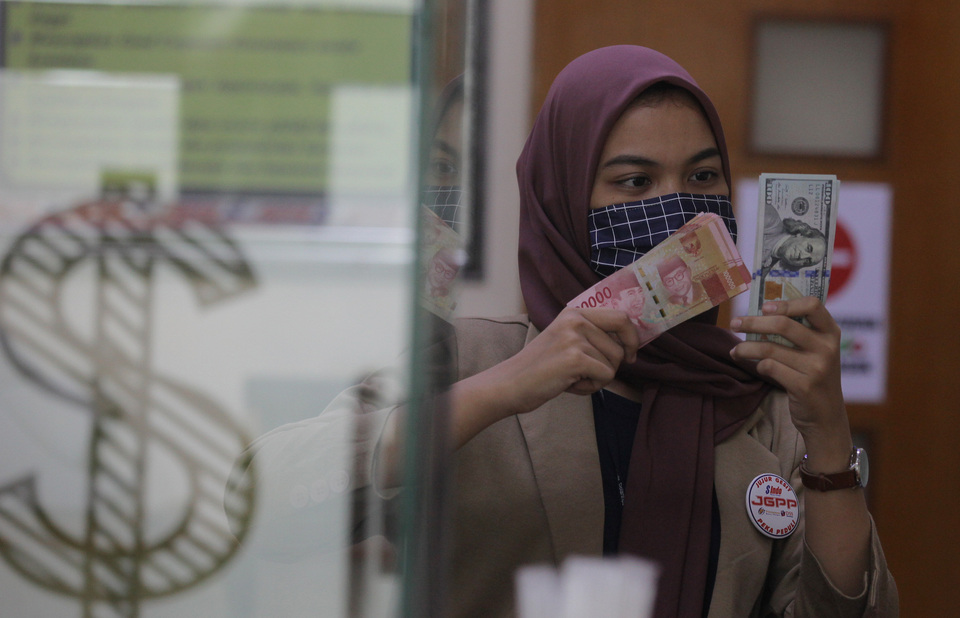
Jakarta. The weakening rupiah, now significantly deviating from the 2024 state budget assumption, poses risks to Indonesia's trade performance. Bank Indonesia (BI) needs to intervene across short, medium, and long-term strategies.
According to Bloomberg, the rupiah closed at Rp 16,412 per dollar on Tuesday, far exceeding the state budget's assumption of Rp 15,000 per dollar.
Permata Bank Chief Economist Josua Pardede highlighted the need for the central bank to continue foreign exchange market interventions as a short-term solution to the rupiah's depreciation. In the medium term, BI should enhance policies on export proceeds and deepen Indonesia's financial markets. Long-term efforts should focus on diversifying exports to reduce reliance on volatile commodity prices.
“Export diversification should reduce dependence on a few countries, while import diversification should lower the need for imported inputs. Additionally, the tourism industry should be boosted as a source of foreign exchange,” Josua told Investor Daily.
Josua anticipates the rupiah will remain between Rp 15,900 and 16,200 per dollar until the end of 2024, considering temporary sentiment factors and potential US Federal Reserve rate cuts.
Based on data from the Central Statistics Agency (BPS), Indonesia's trade balance has been in surplus for four consecutive years, with a cumulative value of $157.21 billion. Indonesia's trade surplus in April 2024 was $3.56 billion, down by $1.02 billion monthly.
Meanwhile, Said Abdullah, Chairman of the House of Representatives (DPR) Budget Committee, emphasized the need for national unity to address the weakening of the rupiah. He pointed out that the US Federal Reserve's high interest rates would continue to exert pressure on the currency. Abdullah recommended various measures for fiscal and monetary policymakers:
He suggested optimizing foreign exchange management, especially in handling export proceeds from natural resources, with appropriate incentives and sanctions. He also called for reforms in the financial sector to attract foreign capital and ensure positive portfolio investment inflows. Additionally, he proposed tightening import policies to safeguard foreign exchange reserves and protect domestic industries.
Abdullah emphasized the importance of keeping government securities (SBN) attractive to foreign investors by maintaining moderate yields and securing standby buyers. He also advocated for expanding creative financing solutions involving large liquidity organizations and business associations.
Furthermore, he highlighted the necessity of increasing the use of local currency swaps to reduce dependency on the US dollar. Lastly, Abdullah urged the implementation of effective hedging policies to manage foreign exchange liquidity for government, state-owned enterprises (SOEs), and private sector debt payments.
“These measures are crucial to stabilize the rupiah and support the national economic structure amidst tightening global liquidity,” Said concluded.
Last week, BI Governor Perry Warjiyo defended the central bank's strategies in response to the weakening rupiah, highlighting that despite recent fluctuations, the currency's performance remains relatively robust compared to other regional counterparts. A
Governor Perry said that Indonesia's depreciation rate is significantly lower than that of countries like Korea, the Philippines, Thailand, and Japan. He reassured stakeholders in Jakarta that despite global economic volatility, the rupiah has demonstrated stability, supported by BI's proactive triple intervention strategy involving the Domestic Non-Delivery Forward (DNDF) market, the spot market, and government bonds (SBN).
"We've implemented comprehensive measures, including interventions and initiatives to attract foreign portfolio investment, all of which have contributed to maintaining stability and have received positive feedback from the president," Perry affirmed.
Tags: Keywords: as a preferred
Related Articles

Rupiah Buckles Under MSCI Pressure, Sinks Past Rp 18,000
Rupiah fell 0.50% to Rp 18,027 per dollar as MSCI’s proposed downgrade of Indonesia’s market status rattled investor confidence.
Bank Indonesia Defends Rupiah as MSCI Review Fuels Selling Pressure
Bank Indonesia pledges continued market intervention as the rupiah breaches Rp 18,000 per dollar amid MSCI-related selling pressure.
Rupiah Breaks Rp 18,000 as MSCI Review Triggers Market Turmoil
Rupiah breached Rp 18,000 per USD as MSCI's proposed market reclassification rattled investor sentiment and intensified market pressure.
Indonesia’s External Debt Rises to $459.3 Billion in August
Indonesia’s external debt rose 5.6% year-on-year to $459.3 billion in August, as public borrowing offset a decline in private debt.
Rupiah Edges Toward Rp 18,000 as Riyadh Attacks Rattle Markets
Rupiah weakens to Rp 17,913 per dollar as Fed rate hike fears, Middle East tensions and MSCI uncertainty weigh on sentiment.
Rupiah Strengthens to Rp 17,899 per Dollar Despite Fiscal Deficit
Rupiah rose 0.09% to Rp 17,899 per dollar despite Indonesia’s Rp 319 trillion budget deficit and ongoing US-Iran tensions.
Rupiah Gains as World Bank Upgrades Indonesia’s 2026 Growth Forecast
Rupiah strengthens to Rp17,899 as the World Bank raises Indonesia’s 2026 growth forecast to 5.2%.
Jakarta Stocks Open Higher on US Jobs Data, BI Policy Support
Jakarta stocks opened higher as weak US jobs data boosted hopes for a Fed rate pause, while BI continued supporting the rupiah.
Indonesia Pushes Rupiah-Yuan, Rupiah-Ringgit Trade to Reduce Dollar Demand
BI is urging greater use of local currencies in cross-border trade to reduce dollar demand as the rupiah trades beyond Rp 18,000.
Rupiah Struggles to Hold Gains After Breaching Rp 18,000
Rupiah is forecast to weaken as high oil prices and Fed rate hike bets keep pressure on the currency after it breached Rp 18,000.The Latest

Prabowo Calls Meeting on Forest Fires as Haze Reaches Jakarta, Singapore
Prabowo summons senior officials to discuss forest fires as smoke reaches Jakarta and Malaysia pushes for regional action.
Jakarta Outranks Amsterdam in Global Public Transport Survey
Jakarta climbs two places to 15th in Time Out's 2026 public transport survey, with its governor citing better network integration.
MSCI Concerns, Tighter IDX Trading Rules Send Indonesian Stocks Down 5% by Midday
Indonesian stocks plunge 5% by midday as MSCI concerns weigh on sentiment and the IDX tightens its daily downside limit to 7%.
Jakarta Prepares 367 Health Facilities as Haze Reaches the Capital
Jakarta prepares 367 health facilities to treat potential haze-related illnesses after smoke from Sumatra and Kalimantan crosses the region.
Jakarta Expands Flood Prevention With New Water Storage Ponds
Jakarta opens two East Jakarta water storage ponds as it expands flood prevention efforts through reservoirs and river normalization.Most Popular
