



US' Stand on Gaza Resolution Lacks Legal Standing
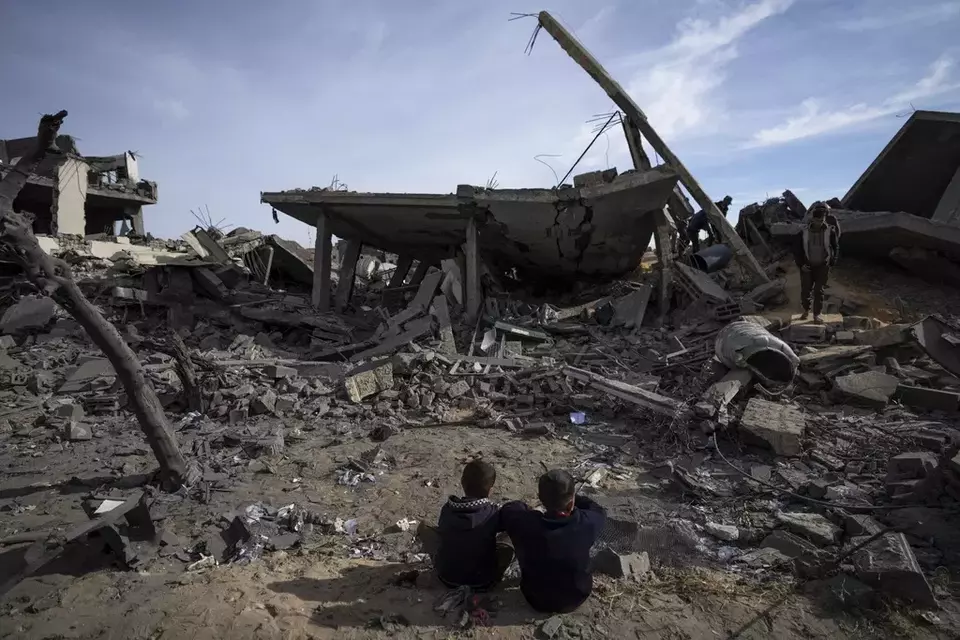
On March 25, the United Nations Security Council adopted resolution 2728 (2024), demanding an immediate ceasefire in the Gaza Strip for the month of Ramadan leading to a lasting sustainable ceasefire. This was the first resolution calling for an immediate ceasefire in Gaza passed by the Security Council since the latest escalation of the Palestinian-Israeli conflict on October 7 last year.
Hence, the international community had high expectations, hoping that this historic resolution would be implemented swiftly and effectively, bringing the dawn of peace to the people of Gaza and putting an end to the ongoing, unprecedented humanitarian disaster.
When the resolution was voted on at the Security Council's 9586th meeting, 14 members of the Council, including China, voted in favor, and the United States abstained.
While the US did not veto this resolution, as it did with many previous Gaza-related decisions, its Permanent Representative to the UN and its spokesperson for the Department of State insisted that the resolution was non-legally binding, arguing that "this resolution lacks binding provisions and lacks new requirements that are imposed on the parties."
The Permanent Representative of the Republic of Korea to the UN made similar arguments, citing a lack of reference to Chapter VII of the UN Charter and the missing of the word "decide" in the text. These arguments were immediately refuted by the spokesperson for the UN Secretary-General and by diplomats from countries such as Russia, Malaysia, and Algeria.
Fact is, resolution 2728 (2024) and all other similar decisions adopted by the Security Council are legally binding, as stipulated in the UN Charter.
First, all decisions made by the Security Council that are related to international peace and security are legally binding, regardless of whether there is a reference to the Charter's Chapter VII or not. As long as its content constitutes a "decision" under Article 25 of the Charter, such a decision shall have legally binding force.
Article 25 stipulates that "the Members of the United Nations agree to accept and carry out the decisions of the Security Council in accordance with the present Charter." Furthermore, in the event of a conflict between the obligations of UN Members under the present Charter and their obligations under other international agreements, their obligations under the present Charter shall prevail.
In practice, the Security Council can adopt both legally binding decisions and non-legally binding recommendations. The argument of the US has further narrowed down the scope of legally binding decisions to only enforcement actions under Articles 41 and 42 of Chapter VII of the Charter. This is against the provisions of the Charter, and also runs counter to international practices.
The Charter's Article 24 confers on the Security Council primary responsibility for the maintenance of international peace and security and grants specific powers to the Council for the discharge of these duties as laid out in the provisions of the Charter. This means that all Council decisions related to international peace and security shall be legally binding. Apart from enforcement actions under Articles 41 and 42, such decisions also include provisional measures under Article 40 as well as decisions on peacekeeping operations as they are also related to the discharge of the Council's primary responsibility, and shall therefore have legally binding force.
In the Namibia Case (1971), the International Court of Justice stated in its advisory opinion that the decisions taken by the Security Council under Article 25 of the Charter were not limited to "decisions" on enforcement actions under Chapter VII. This has been confirmed by the subsequent practices of the Security Council. Security Council resolution 1746 (2007) on the extension of the mandate of the UN Assistance Mission in Afghanistan as well as resolution 1755 (2007) on the extension of the mandate of the UN Mission in the Sudan, without invoking Chapter VII of the Charter, were accepted and carried out by Members of the UN, and the legally binding force of these resolutions has not been questioned.
Second, whether a Security Council decision is legally binding or not depends on its content, not the use of specific words such as "decide". In the aforementioned Namibia Case (1971), the International Court of Justice stated that "the legally binding nature of a Security Council resolution should be judged by careful analysis of its formulation." As long as its content creates obligations on the parties concerned, a resolution shall be legally binding, even if it uses words other than "decide". As a matter of fact, the Security Council cannot "decide" a ceasefire between the parties, it can instead clearly "demand" the parties to act in accordance with its resolution 2728 (2024), therefore the legally binding nature of that resolution is beyond question.
Furthermore, the formulation and specific provisions of resolution 2728 (2024) also attest to its legally binding force. The resolution in its operative part has laid down four demands on the parties concerned: an immediate ceasefire for the month of Ramadan respected by all parties leading to a lasting sustainable ceasefire; the immediate and unconditional release of all hostages; the compliance with their obligations under international law by the parties; and the lifting of all barriers to the provision of humanitarian assistance, in line with international humanitarian law as well as relevant Security Council resolutions. These demands impose specific obligations on all parties to the conflict, including Israel, which reaffirms the legally binding nature of resolution 2728 (2024).
Also, the word "demand" is frequently used in legally binding Security Council resolutions to create new obligations for relevant parties, and it has a well-established legal meaning of "to require something forcefully which shall not be refused." For example, in resolution 1542 (2004) for the establishment of the UN Stabilization Mission in Haiti, the Security Council "demands further that all parties in Haiti provide safe and unimpeded access to humanitarian agencies to allow them to carry out their work," which imposed new obligations on all parties in Haiti.
In conclusion, resolution 2728 (2024), in clear formulation, demands a ceasefire, the release of hostages, and compliance with international humanitarian law by relevant parties, including Israel. It imposes specific legal obligations on all parties concerned and its legally binding force is universally accepted. The challenge by the US to this resolution is inconsistent with the Charter and recognized international laws. The whole international community should stand together against such hegemonic acts and firmly uphold the authority of the Security Council.
__
Xin Ping is a commentator on international affairs based in Beijing. The views expressed in this article are those of the author.
Tags: Keywords: as a preferred
Related Articles

UN Security Council Bid on New Foreign Minister Arrmanatha’s To-Do List
Newly appointed Foreign Minister Arrmanatha Nasir says the UN Security Council bid shows Indonesia's belief in multilateralism.
Dialogue-Seeking Indonesia Pitches for UN Security Council Seat
Indonesia promises to "keep dialogue open" if chosen to return to the UN Security Council.
Indonesia Demands UN Security Council Reforms in AI Era
As AI goes rampant, Indonesia demands reforms to the UN Security Council, a body established in 1945.The Latest

Prabowo Calls Meeting on Forest Fires as Haze Reaches Jakarta, Singapore
Prabowo summons senior officials to discuss forest fires as smoke reaches Jakarta and Malaysia pushes for regional action.
Jakarta Outranks Amsterdam in Global Public Transport Survey
Jakarta climbs two places to 15th in Time Out's 2026 public transport survey, with its governor citing better network integration.
MSCI Concerns, Tighter IDX Trading Rules Send Indonesian Stocks Down 5% by Midday
Indonesian stocks plunge 5% by midday as MSCI concerns weigh on sentiment and the IDX tightens its daily downside limit to 7%.
Jakarta Prepares 367 Health Facilities as Haze Reaches the Capital
Jakarta prepares 367 health facilities to treat potential haze-related illnesses after smoke from Sumatra and Kalimantan crosses the region.
Jakarta Expands Flood Prevention With New Water Storage Ponds
Jakarta opens two East Jakarta water storage ponds as it expands flood prevention efforts through reservoirs and river normalization.Most Popular
