



Trump’s Tariff on ASEAN: Ignoring a Trillion-Dollar Partner
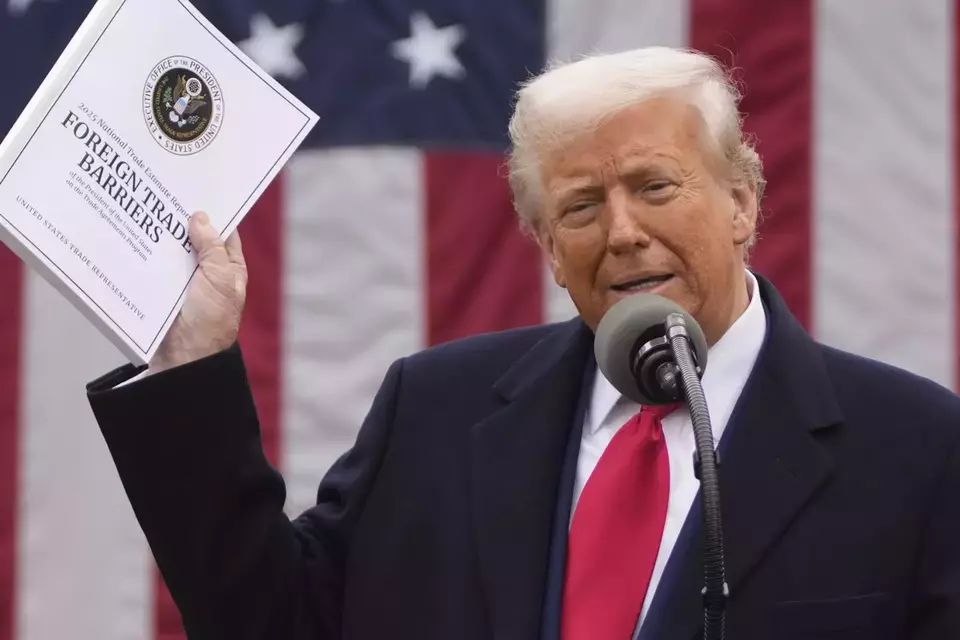
As of April 21, 2025, Trump’s tariff policy has become unbearable for the American public. He imposed a 245% tariff on US imports from China, while placing a 90-day freeze on tariff hikes for roughly 70 countries, including the 10 ASEAN nations.
Trump has once again wielded tariffs as a bargaining chip, under the misleading pretense that they are paid by foreign governments and will miraculously restore American jobs. This narrative is not only false, but it is also economically harmful. His tariff aggression toward ASEAN is not just deeply disappointing; it is profoundly destabilizing for the global economy.
Over the past 50 years of economic partnership, ASEAN has played a meaningful role in America’s economic ascent. The average income of Americans has risen from around USD 7,000 in the 1970s to USD 86,000 today (World Bank, 2024). This progress has been built on mutual benefit and shared growth, anchored in a predictable, rules-based multilateral trading system, not transactional or unilateral policies. For decades, ASEAN has been a steadfast and constructive partner of the United States, supporting its growth through trade, investment, and supply chain integration.
First, in trade of goods, particularly in the manufacturing sector, American manufacturers no longer operate in isolation. East Asia, including ASEAN --often accused by Trump of “stealing” American jobs-- has, in fact, played a vital role in strengthening the US economy. ASEAN supports American manufacturing by providing access to high-quality, competitively priced inputs, and efficient supply chains. These are the very ingredients that keep American industries globally competitive.
Most rely heavily on intermediate goods --components and raw materials--sourced from global partners. ASEAN plays a pivotal role in this system, supplying high-quality, competitively priced inputs and enabling efficient supply chains. These are not marginal contributions, they are central to the global competitiveness of US industries. They reduce production costs, enhance operational efficiency, and spur innovation. By ensuring access to cost-effective inputs, ASEAN helps sustain millions of American jobs and reinforces the very foundation of the US economy.
Second, consider trade in services, the true engine of the US economy, which accounted for 81% of GDP in 2024. US services exports reached a record high of USD 1.03 trillion that year, with ASEAN countries contributing an estimated USD 330 billion, or roughly 32% of the total. This reflects not only the depth of economic integration between ASEAN and the US but also the region’s growing role as a key market for American innovation, finance, education, digital platforms, and professional services. ASEAN is also one of the fastest-growing regions, spending billions of US dollars annually on education and tourism in the US.
Moreover, ASEAN has long been a crucial partner in US defense-related trade. Beyond military procurement, Indonesia’s landmark deal with Boeing in 2012 --then the largest single aircraft transaction in the company’s history valued at USD 22 billion-- underscores the region’s strategic economic weight. With a rapidly growing middle class and surging demand for air travel, Southeast Asia is emerging as one of the world’s most dynamic aviation markets.
Third, in terms of investment, American firms --from mining (ExxonMobil, Chevron, and Freeport-McMoRan), banking and payments (Visa and Mastercard), insurance (Chubb and Liberty Mutual), electronics (IBM, General Electric, and Intel), electric vehicles (Tesla), telecommunications (Starlink), and e-commerce and digital platforms (Amazon and Meta), to consumer goods (Johnson & Johnson, Procter & Gamble), and food and beverages (Starbucks, McDonald’s, Coca-Cola, and PepsiCo)-- are deeply embedded in the ASEAN region.
ASEAN’s contribution to US investors is not peripheral; it is central to America’s economic strength. The region generates trillions of dollars in profits for US companies each year, fuels their global expansion, and helps sustain the United States’ position as a leading economic power, all while supporting millions of jobs at home.
Last, ASEAN’s success has been strengthened by a network of economic partnerships built over the past two decades, alongside political and economic stability, and investments in education and infrastructure. Key milestones include the ASEAN Free Trade Area (AFTA) established in 1992, and several ASEAN+1 Free Trade Agreements signed between 2010 and 2015 with important partners. The Regional Comprehensive Economic Partnership (RCEP), the world’s largest trading bloc, came into effect in January 2022, uniting ASEAN with Australia, China, Japan, South Korea, and New Zealand. ASEAN also engages with the United States through the Trade and Investment Framework Agreement and the Expanded Economic Engagement Work Plan, both aimed at deepening trade, investment, and digital cooperation.
Trump’s tariff confrontation is both unjustified and detrimental to the global economy. This is not a stance against US businesses or the American people, but a direct response to a destructive policy that threatens decades of US-ASEAN cooperation and shared growth. In response, ASEAN member states issued the ASEAN Economic Ministers’ Joint Statement on April 10, 2025, reaffirming three core principles. First, ASEAN underscored its commitment to a predictable, transparent, free, fair, inclusive, sustainable, and rules-based multilateral trading system, with the WTO at its center. Second, it pledged to strengthen intra-regional integration. Third, ASEAN emphasized the need to maintain strong, mutually beneficial trade and investment relations with key partners, while also expanding engagement with emerging regions such as the Middle East, Eurasia, Latin America, and Africa.
ASEAN has consistently maintained that it does not and will not take sides. The region remains committed to positive, inclusive engagement in trade, investment, and technology, treating all partners as equally important. For ASEAN, the United States is as vital as China, Japan, South Korea, Australia, the European Union, and others. Mutual respect, openness, and constructive dialogue are the cornerstones of ASEAN’s external economic relations. It has reaffirmed its stance on maintaining constructive engagement, grounded in the principles of sovereignty, multilateralism, and balanced development.
There is no question: ASEAN is not merely a partner to the United States, it is a pillar of American prosperity and a cornerstone of global economic stability. While many of Trump’s core supporters remain unaware --or indifferent-- to the rising costs of inflation, job losses, and a plunging stock market, the damage to America’s image and its relationships with the rest of the world, including ASEAN, may prove lasting. Trump’s disregard has cut deep and the consequences may not be undone.
---
Lili Yan Ing
Secretary General of the International Economic Association (IEA}
*The views expressed here are personal
Tags: Keywords:
 as a preferred
Related Articles

Indonesia’s US Trade Surplus Defies Tariffs, but Economists Warn Risks Remain
Indonesia posted a $12.47 billion surplus with the US in January-August 2026, up from $12.26 billion a year earlier.
US Defends Tariffs on ASEAN Amid $327.4 Billion Deficit
US says it wants to "bring reciprocity and balance" to its ASEAN trade ties amid double-digit tariff hikes.
BRICS Indirectly Hits Out at Trump’s Tariffs, WTO Paralysis
BRICS doesn't want to see unilateral tariffs and a paralyzed WTO court system, all of which are linked to the US.
Trump Tariffs Cripple EU Firms’ Confidence in ASEAN
As many as 81% of the surveyed European businesses admit that the US tariffs had weakened their confidence in ASEAN.
'We Don't Export Plastic to US': Indonesia on ‘False’ Transshipment Scam Claims
Indonesia denies enabling Chinese goods, namely plastic packaging, avoid Trump's tariffs.
Indonesia Denies US Accusation of Chinese Transshipment Scam
Senior minister Airlangga Hartarto says "Indonesia has never done transshipment", when asked about the US report.
US Accuses Indonesia of Helping China Dodge Trump Tariffs
The US accuses Indonesia and dozens of other countries of being part of "China's shadow transshipment network".
ASEAN Hopes for Predictability on Trump’s Tariffs
ASEAN says the region's businesspeople wish for a predictability and certainty as Trump launches a fresh round of tariff hikes.
Indonesia in Talks with US for 0% Tariff on Palm Oil
Indonesia is in talks with the US to have its palm oil exempted from the latest tariff measure.
Indonesia Banks On EU as Trump's 10% Tariff Kicks In
Indonesia wants to fast-track its European Union (EU) trade deal as Jakarta tries to find alternatives to the tariff-agressive US.The Latest

Jakarta Outranks Amsterdam in Global Public Transport Survey
Jakarta climbs two places to 15th in Time Out's 2026 public transport survey, with its governor citing better network integration.
MSCI Concerns, Tighter IDX Trading Rules Send Indonesian Stocks Down 5% by Midday
Indonesian stocks plunge 5% by midday as MSCI concerns weigh on sentiment and the IDX tightens its daily downside limit to 7%.
Jakarta Prepares 367 Health Facilities as Haze Reaches the Capital
Jakarta prepares 367 health facilities to treat potential haze-related illnesses after smoke from Sumatra and Kalimantan crosses the region.
Jakarta Expands Flood Prevention With New Water Storage Ponds
Jakarta opens two East Jakarta water storage ponds as it expands flood prevention efforts through reservoirs and river normalization.
Press Council Highlights AI Ethics at United Tractors Journalist Workshop
United Tractors’ 2026 journalist workshop highlights ethical AI use and the importance of trust and credibility in journalism.Most Popular
