



Trump’s Board of Peace and Indonesia: Shaping the Agenda or Being Dragged Along?
January 31, 2026 | 10:16 pm
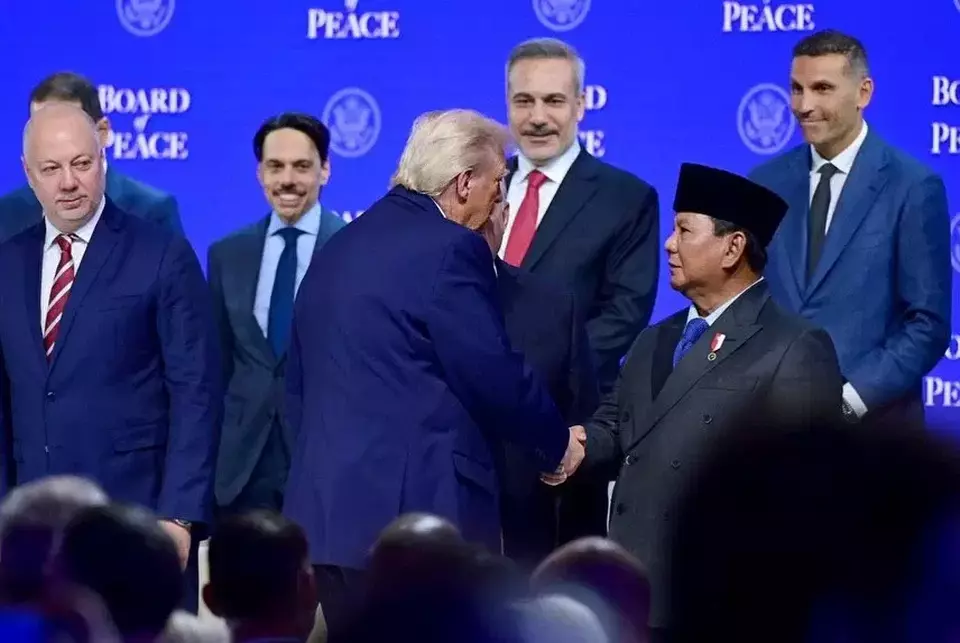
The conflict in Gaza is still ongoing and has yet to show any clear signs of resolution, despite various efforts having been made to end the hostilities. As the conflict drags on, diplomatic space narrows, and the ceasefire negotiations that have taken place are highly fragile and offer no guarantee of de-escalation. At the same time, the longer the war lasts, the higher the price of reconstruction, making coordinated major-donor action unavoidable, not only to fund recovery but also to shape whose priorities define “peace.” Against this backdrop, Washington has floated a new vehicle to address the crisis: the Board of Peace (BoP).
Trump has frequently touted his ambition to “deliver peace” and “end the war” since the start of his second term. The Board of Peace (BoP) is presented as a continuation of that agenda, promoted as a platform for the stabilization and recovery of Gaza. Announced in mid-January 2026, the BoP was brought to the stage at the World Economic Forum in Davos, featuring a charter-based coalition of states and claiming a more “action-oriented” approach than conventional multilateralism. However, the BoP quickly sparked debate, from concerns that it would supplant the UN’s role, widely seen as ineffective in resolving the conflict, to criticism of a membership scheme that requires substantial fees or large financial commitments from participating states.
Amid the criticism, the need for an “exit strategy” remains urgent: a protracted conflict requires a post-war design encompassing reconstruction, governance, and security. As a great power, the United States has an interest in presenting itself as a leader, and the BoP has been framed as a Trump-style “new order.” It is here that legitimacy concerns have sharpened, with the BoP accused of being overly personal and too centered on Trump. Even so, Washington has continued to invite countries to join. Indonesia was among those invited and has stated its intention to take part. Indonesia declared that it was joining the BoP through diplomatic communications alongside 21 other countries. This was further reinforced by the presence of President Prabowo Subianto at the council’s launch during the World Economic Forum in Davos, Switzerland, on Thursday, 22 January 2026.
“Those who seek peace and assist the people of Gaza, the people of Palestine,” Prabowo said after the signing of the charter in Davos, signaling his view that this membership is an opportunity for Indonesia and the world to help advance peace in Gaza. Minister of State Secretariat Sepa Aradz stressed that the decision to join was taken to accelerate Israeli-Palestinian peace. “The aim is to speed up the peace process in Gaza,” he said at the Presidential Palace in Jakarta on Thursday. Meanwhile, Foreign Minister Sugiono emphasized that the BoP is intended to complement the UN, not replace it. Taken together, these statements have sparked a public question: what positive and negative impacts might Indonesia face as a result of this membership?
Indonesia’s decision to join Trump’s BoP could offer strategic advantages if the forum proves genuinely operational. Because the format is smaller, Indonesia’s proposals, from aid corridors to civilian protection, may be more readily placed on the agenda and acted upon more quickly. This membership also reinforces Indonesia’s position as a Global South bridge-builder and a credible humanitarian actor. Joining early provides access to reconstruction and post-conflict governance coordination networks, enabling Indonesia to help shape the division of roles and the standards adopted, rather than merely following decisions that have already been made. Finally, the BoP adds an additional diplomatic channel through which Indonesia can push for humanitarian outcomes while maintaining dialogue with multiple parties, without relying on a single forum.
On the other hand, Indonesia’s decision to join the BoP carries serious risks in terms of legitimacy, agenda control, and reputation. If the BoP is perceived as bypassing universal multilateralism, Indonesia could be criticized for helping to legitimize a parallel structure that fractures global consensus. A vague mandate also creates room for mission creep, potentially nudging Indonesia into positions beyond the humanitarian agenda it intends to pursue. Because the forum’s governance is sponsor-centered, it is vulnerable to shifts driven by US domestic politics, and Indonesia could be pulled along with them. Funding politics are also fraught: voluntary contributions can easily create the impression of “paying for influence,” attracting public scrutiny and reputational costs. Finally, if the BoP splits major powers into opposing camps, Indonesia risks being boxed in as part of one bloc, undermining its non-aligned image and diplomatic flexibility.
In response to these two sides, Indonesia is likely to maintain a “join-to-shape” strategy: remaining in the BoP in order to steer its direction through a tight mandate, clear humanitarian parameters, legal standards, and accountability. At the same time, Indonesia would emphasize that the BoP must be complementary, supporting, not replacing, universal multilateralism. To prevent drift and strengthen its bargaining position, Indonesia would build a coalition with like-minded members so that common positions and institutional “brakes” can be put in place. Its contributions would be kept proportionate, technical capacity and humanitarian assistance, without heavy political or financial burdens. Indonesia’s involvement would also be reviewed periodically as the BoP’s direction and operating practices become clearer.
Ultimately, Indonesia’s decision to join Trump’s BoP is a diplomatic gamble that is only worthwhile if it produces real influence rather than mere symbolism. A “seat at a smaller table” and early access to reconstruction networks could create room to advance civilian protection and measurable humanitarian priorities, yet the risks of fragmenting multilateralism, mission creep, and becoming trapped in sponsor politics could also erode Indonesia’s non-aligned reputation. For that reason, the benchmark of success is not membership status, but strategic consistency: limiting the mandate, ensuring funding transparency, locking in accountability, and reaffirming that the BoP must complement, not replace, the universal institutions. If Indonesia can “join to shape” without being dragged into bloc interests, the BoP could become an additional channel that accelerates humanitarian outcomes; if not, Indonesia risks becoming part of a diplomatic problem larger than the conflict it seeks to end.
----
Anak Agung Banyu Perwita and Sekar Hesti Suminar are lecturers at the Indonesia Defense University.
The views expressed in this article are those of the authors.
 as a preferred
Related Articles

Prabowo Calls Meeting on Forest Fires as Haze Reaches Jakarta, Singapore
Prabowo summons senior officials to discuss forest fires as smoke reaches Jakarta and Malaysia pushes for regional action.
Books on Prabowo's Ideas Distributed Free at Jakarta Car-Free Day
Prabowo, who took office on Oct. 20, 2024, will mark the second anniversary of his presidency on Tuesday.
Trump’s New Press Secretary Out After Less Than a Week
Katie Zacharia’s brief White House tenure ends after less than a week, following a short first briefing and reported tensions over her role.
Two Years Into Prabowo Presidency, Infrastructure Takes Back Seat
Prabowo’s social spending push raises concerns over infrastructure delays and uneven growth beyond Java.
Defying Trump, Zelensky Says Will Keep Hitting Russian Refineries
Russia on Thursday said Ukraine had attacked an oil refinery in Ryazan, south of the capital, Moscow.
Fury as US Federal Agents Search Ilhan Omar's Home
"Make no mistake: this is an attempt to target political enemies and weaponize federal law enforcement," Omar wrote on X.
Prabowo, Egypt’s Sisi Talk Trade Pact for $5 Billion Commerce
Egypt's Sisi tells Prabowo that he wants to see annual trade to reach $5 billion by 2030 as Jakarta seeks tariff deals.
Egypt's Sisi Arrives in Indonesia for Talks With Prabowo
Egyptian President Abdel Fattah el-Sisi arrives in Indonesia for talks with Prabowo Subianto to strengthen strategic ties.
‘It’s Trump Who Sets Oil Price’: Prabowo’s Brother
Neither the Indonesian government nor OPEC sets the oil price, Hashim Djojohadikusumo says.
Navi Pillay, South African Rights Champion, Wins Nobel Peace Prize
"If you clap a little bit more, I may share this prize with Trump," the 85-year-old said.The Latest

Students Plan Jakarta Protests to Mark Two Years of Prabowo's Presidency
Police have advised the public to avoid areas around the House of Representatives complex, the National Monument and the State Palace.
UN Boss Commends Indonesian Forest Protection Despite Persistent Haze Problem
Outgoing UN boss António Guterres' comment comes at an ironic time amid Indonesia's struggle with forest fires.
Indonesia Must Benefit Most From Its Minerals: UN Chief
Outgoing UN chief António Guterres says that Indonesia must "retain a far greater share of the economic value" from its minerals.
Chandra Asri Group Receives Trade Finance Excellence Award, Reinforcing Its Role in Indonesia’s Industrial Development
Chandra Asri Group receives the Trade Finance Excellence Award at CIMB Niaga Business Summit 2026.
AEON MALL Deltamas Brings 11 Sports and Creative Competitions to AEONLYMPIC 2026
AEON MALL Deltamas hosts AEONLYMPIC 2026, featuring 11 sports and creative competitions, with more than 3,100 participants.Most Popular
