



Anwar Ibrahim and Leadership Wisdom
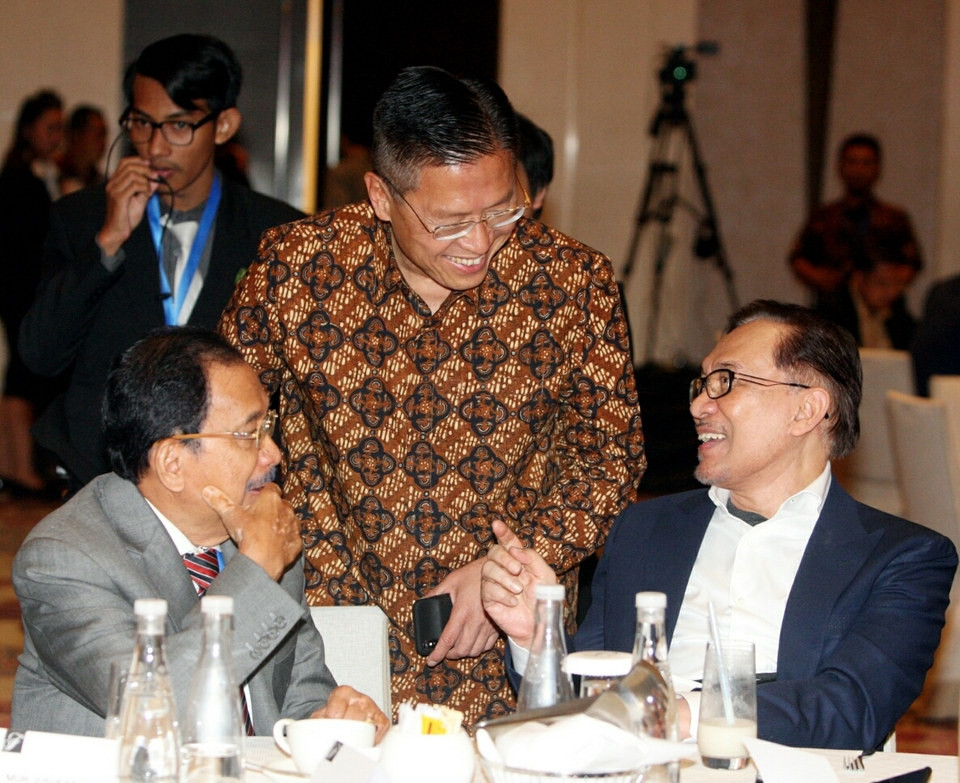
Jakarta. The discussion with Malaysian Prime Minister Dato Sri Anwar Ibrahim at the CT Leadership Forum on January 9 is an interesting one to zoom in on.
The 10th Malaysian prime minister has chosen Indonesia as the first country he visited since taking office. Other than political considerations, Anwar is a friend to Indonesian public figures from all walks of life.
As someone who studies management, I still believe that “a country is only as good as its leader.” I believe our neighboring country will become even better in the future under Dato Sri Anwar Ibrahim’s leadership.
There are some key takeaways from the wisdom aspect of a leader of a country. First, one’s conscience that touches the humanity aspect — a humanist leader.
“What is life without humanity and blessings, or life without values and morals?” Dato Sri Anwar Ibrahim said.
I find it interesting that Dato Sri Anwar Ibrahim makes education a priority, even calling forth his education minister to get things in order for the future of the nation. From a management perspective, what makes a good leader is their capability in setting priorities among many important choices.
He criticized the youngsters’ tendency to learn from social media platforms like TikTok, and how they are becoming less interested in acquiring the myriad, ever-changing knowledge. But of course, he did not deny how crucial digital technology is and the importance of its mastery.
The second thing to note from the prime minister’s priorities is the way he sees corruption as a deeply rooted social disease. I do share his concerns, as corruption has long held back Indonesia’s progress as well.
Reflecting on Pancasila as the national ideology, especially the second principle which promotes " just and civilized humanity", and the fifth principle on "social justice for all Indonesian people", we have yet to fully realize it even after 77 years of independence. We must contemplate it together in the context of wise and just leadership.
Another interesting point is the view of pedagogic thinker and psychologist Howard Gunner in one of his books “Five Minds for the Future” quoted by Dato Sri Anwar Ibrahim. Having studied management, I’m intrigued to learn more about the said five qualities in human intelligence, namely: (1) the disciplined mind; (2) the synthesizing mind; (3) the creating mind; (4) the respectful mind; and (5) the ethical mind.
These five minds are of the essence in interactions within the society that has become a “society of organization”, according to Peter Drucker. There is no one that isn’t a member of an organization. In fact, there are those who belong to several organizations. For example, a politician-turned-businessman and vice versa.
“The disciplined mind” is an entry for those who wish to become professionals, be it an accountant, or even a footballer. A disciplined mind demands them to fully master their respective fields in depth. However, mastering pure science like psychology, sociology, math, physics, or applied sciences such as history and communications, is also crucial in socializing. This is where the capability to integrate minds from various disciplines may enable a professional to possess a broad horizon to interact and contribute to an organizational society wisely. This is the point of the synthesizing mind.
“The creating mind” is necessary in the business world. However, government organizations also need to have the creativity to provide services, which may require them to step out of the lengthy bureaucracy for the sake of solving problems that call for deliberation and wisdom.
“The respectful mind” is pivotal to building cooperation or teamwork, which is needed in business organizations during Board meetings, and also during cabinet meetings when it comes to the government's policy-making process.
Last but not least is “the ethical mind”. Ethics encompasses moral values, and sets of rules and conduct accepted by people of various cultural backgrounds. For a person or an organization, ethics, beyond the law, is the basis of behavior that will earn others’ respect and admiration. As a practitioner and management learner, I’m quite concerned about the ethics of Indonesian people, including politicians and businesspeople.
In the business sector, we can clearly see the absence of ethics that sparks social envy. If not managed wisely, this social envy will lead to political instability. The bigger the role of the economic actor or business people in national development, the more we feel that business ethics should be of utmost concern for global economic leaders.
But Gordon Parson in his book “Integrity in Organizations: An Alternative Business Ethic, 1995” argued that “there has always been a natural tension between behavior which is broadly accepted as being ethical and the imperatives of a successful business.”
This tension is not easy to solve.
I too think that “absolute profit is necessary to compensate for the equity capital and risks taken by the investors and the owners of the company. But profit achievements must embrace ethical standards. If not, it is the greedy animals that will appear.” (Abeng, Management Profession, 2006)
What about political ethics and the government? Here we must refer to The Leaders Magazine, September 1987, titled "A New Top Down Moral Reform” which concludes as follows: “The act on accountability of Public Servants is in fact, a code of ethics that demands of public employees the kind of behavior that adheres to the highest legal principles of morality. This code sets forth the concepts of impartiality, economy, efficiency, loyalty, and honesty as principles to be lived by every public employee”.
This then left us with a question: what if business ethics and governmental ethics are both out of their track? The economic actors’ interests may influence government policies based on their business interests. But the problem is: a bad policy is worse than corruption, says a wise man. I think there seems to be a fine line between ethics and corruption that requires wisdom to understand and solve.
At the Leadership Forum, Dato Sri Anwar Ibrahim addressed the corruption problem in Malaysia. But isn’t this problem also extremely crucial in our own country? Perhaps this corruption practice is the biggest challenge yet in the context of leadership management in Malaysia and Indonesia. We have truly gained a piece of leadership wisdom from a humanist friend and leader. May this wisdom be fruitful for us all.
---
Tanri Abeng is the Chairman of the Indonesia-Malaysia Business Council. The views expressed in this article are those of the author.
Tags: Keywords: as a preferred
Related Articles

Anwar Says Malaysia Ready to Assist Indonesia in Tackling Wildfires
Anwar acknowledged Indonesia's efforts to contain the fires, including the deployment of personnel and aircraft to affected areas.
Indonesia Briefs Malaysia on Wildfire Response as Haze Spreads Across Borders
Indonesia has deployed over 60,000 personnel and 48 aircraft to fight forest fires as worsening haze prompts talks with Malaysia.
Anwar Invites Prabowo to Malaysia in Forest Fire Talks
Malaysian Prime Minister Anwar Ibrahim wants President Prabowo Subianto to visit his country for bilateral talks.
Anwar to Address KWAP's Investment Losses in Indonesia's eFishery
Malaysia's prime minister will explain Parliament's questions over KWAP's losses from its investment in Indonesia's eFishery.
More, Please: ASEAN Wants Russian Goods Trade to Exceed $17.8 Billion
ASEAN's two-way merchandise trade with Russia hit $17.8 billion in 2025.The Latest

Jakarta Outranks Amsterdam in Global Public Transport Survey
Jakarta climbs two places to 15th in Time Out's 2026 public transport survey, with its governor citing better network integration.
MSCI Concerns, Tighter IDX Trading Rules Send Indonesian Stocks Down 5% by Midday
Indonesian stocks plunge 5% by midday as MSCI concerns weigh on sentiment and the IDX tightens its daily downside limit to 7%.
Jakarta Prepares 367 Health Facilities as Haze Reaches the Capital
Jakarta prepares 367 health facilities to treat potential haze-related illnesses after smoke from Sumatra and Kalimantan crosses the region.
Jakarta Expands Flood Prevention With New Water Storage Ponds
Jakarta opens two East Jakarta water storage ponds as it expands flood prevention efforts through reservoirs and river normalization.
Press Council Highlights AI Ethics at United Tractors Journalist Workshop
United Tractors’ 2026 journalist workshop highlights ethical AI use and the importance of trust and credibility in journalism.Most Popular
