



AI and the Challenges of Democracy in Indonesia
At the end of 2024, Canadian computer scientist and artificial intelligence (AI) expert Geoffrey Hinton made waves with his famous statement about AI. He remarked that the pace of technological change today is far faster than anticipated. According to this Nobel Prize-winning physicist, there is a 10 percent chance that AI could trigger a major disaster for humanity. "Perhaps within the next 20 years, we will develop AI that is smarter than humans. And that is a very frightening thought," he said.
From a technological standpoint, AI advancements have significantly impacted development across various sectors. However, these advancements also bring new challenges. Two American academics, Sarah Kreps and Doug Kriner, have written an insightful analysis titled "How AI Threatens Democracy." They argue that the rise of AI, particularly in generating content, has transformed numerous fields and has profoundly influenced the political sphere. In democratic spaces, AI can be misused to produce large-scale disinformation and misinformation, which in turn threatens democratic representation and erodes social and political trust.
A major challenge is the proliferation of AI-generated content that can distort information and mislead voters during elections. AI-generated text, images, and videos circulating online can make it difficult for people to discern what is true. Kreps and Kriner warn that such content can damage public trust, ultimately leading to a severe decline in confidence in the government. They emphasize that "social trust drives civic engagement and political participation, strengthens confidence in political institutions, and fosters respect for democratic values—essential safeguards against democratic backsliding and authoritarianism." However, the opposite can also occur.
In Indonesia, AI's role in democracy has become a pressing concern. During the 2024 elections, many legislative candidates, regional leaders, and even presidential candidates leveraged AI to boost their popularity. AI's presence in democracy appears to be entering a new phase. Recently, the Constitutional Court (MK) partially granted Case No. 166/PUU-XXI/2023, which challenged the phrase "self-image" related to photos in Article 1, Section 35 of Law No. 7 of 2017 on Elections. In essence, the court ruled that AI-generated photos are prohibited in election campaigns.
Constitutional Judge Saldi Isra argued that excessive manipulation of election candidates' photos using AI creates legal uncertainty and contradicts the principles of free, fair, and honest elections. Misrepresenting candidates through manipulated images can undermine voter loyalty and, more broadly, harm individual voters and the quality of democracy itself. AI in democratic contests has thus become a double-edged sword, especially as readily available online tools can actively promote rumors and misinformation.
Hoaxes in the AI Era
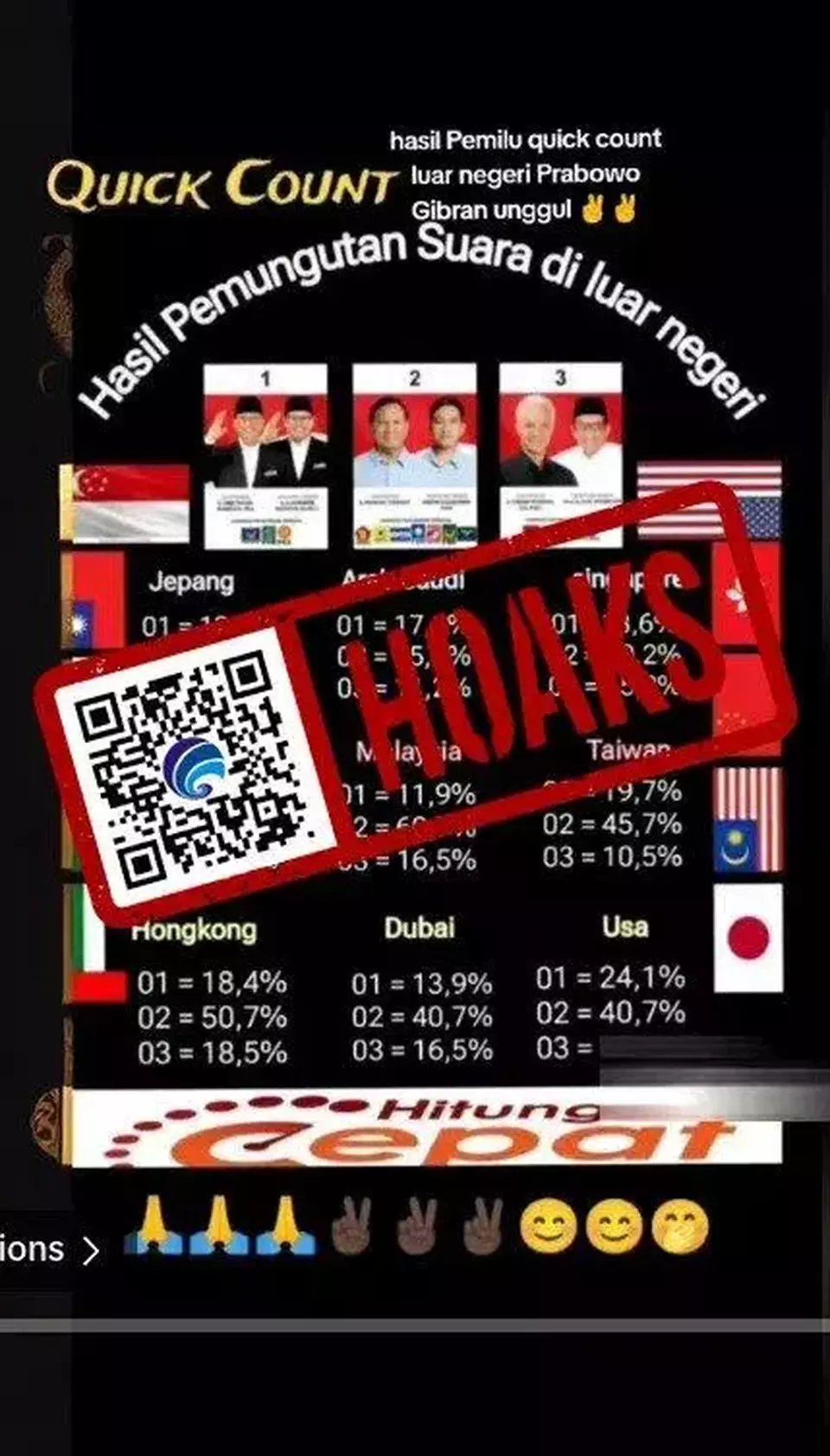
During the 2024 elections, all participating political parties used social media, which directly integrates AI technology. The issue lies in AI-generated content, which makes it difficult for users to differentiate between authentic and fake (hoax) information. Social media algorithms continuously display content aligned with users' tendencies, making them more susceptible to misinformation. The real threat to democracy often does not stem from AI technology itself but from individuals who exploit it for malicious purposes. AI can be misused in political contexts as a tool to attack opposing groups.
According to the Communication and Digital Affairs Ministry, 1,615 hoax-related contents were circulated on digital platforms and websites in 2023—a rise from the previous year. Political hoaxes ranked as the third most prevalent category, with many instances occurring in the year leading up to the 2024 elections. Political hoaxes were deployed to push certain propaganda narratives, influence public opinion, and provoke the masses for short-term gains, often presenting one-sided information while omitting other perspectives.
The implications of this phenomenon threaten the integrity of democratic processes and, if left unchecked, could severely impact social stability. It may fuel divisions and deepen polarization, further eroding public trust and fragmenting society. The rising number of AI-driven hoaxes highlights the pressing challenges facing Indonesian democracy. Unfortunately, political actors often fail to foster a mature democratic process and instead exacerbate communication issues. AI misuse in professional settings has already been well-documented, and its effects have now infiltrated politics and policymaking. It has become increasingly difficult to distinguish between hoaxes generated by politicians and those created by internet users (netizens).
Democracy in the Digital Era
The technological explosion is unstoppable, and AI is evolving at an unprecedented pace. The result is disruption across multiple domains, including politics and democracy. AI has the potential to reshape political processes, decision-making, public participation, political communication, and democratic security. In political communication, AI can enhance campaign strategies, but it can also be used to manipulate and mislead. However, treating technology as an enemy is misguided. AI is not a threat; rather, it is a tool that should be approached with prudence.
AI can provide significant benefits in political communication. This underscores the importance of digital literacy. Paul Gilster, author of Digital Literacy, defines it as the ability to understand and use digital information from various sources via digital devices. Digital literacy encompasses the ability to find, evaluate, utilize, share, and create content using internet-based technology. From this definition, it is evident that the problem does not lie with AI or digital devices but with humans themselves. People must develop their skills to become responsible users before fully integrating AI into their activities.
Thus, strengthening Indonesia's democracy requires a focus on digital literacy. The rapid advancement of technology has interconnected all aspects of life through various platforms. Whether we like it or not, the ability to navigate the digital realm must be improved. Users need to cultivate at least four key competencies: digital ethics, critical information analysis, fundamental networking skills, and basic electronic transaction knowledge.
Ultimately, technological progress is inevitable. AI is a fundamental part of this advancement. Its use should be approached wisely to enhance productivity and innovation. However, in a political context, we must recognize that AI is being utilized for electoral competition—both for propaganda and popularity. At this stage, the public must be empowered to critically assess AI-generated content, one of the key measures being the application of digital literacy to discern how AI is employed in political messaging.
---
Andi Anggana is a master's student in political communication at Paramadina University
The views expressed in this article are those of the author.
Tags:
Tags: Keywords: as a preferred
Related Articles

Indonesia Businesses Urged to Move Beyond AI Pilot Projects
Salesforce warns Indonesian companies risk missing AI productivity gains by delaying deployment and failing to prepare workers.
AI Adoption Exposes Indonesian Firms to Data Leak Risks
AI adoption is surging in Indonesia, raising concerns over data leaks, weak safeguards and the risks of unauthorized AI use.
Indonesia Can Hit 8% Growth With Housing, AI, Green Energy: Hashim
Hashim Djojohadikusumo says housing, AI, digital infrastructure and green energy could help Indonesia achieve 8% economic growth.
Airlangga Urges Indonesia to Catch Up With Vietnam in Digital, AI Industries
Indonesia needs to accelerate digital, semiconductor and AI industries to catch up with Vietnam and achieve its 8% growth target.
AI Data Centers Could Consume 4% of Global Power by 2035, World Bank Says
AI data centers are set to triple global power demand by 2035, putting Southeast Asia’s electricity grids under pressure.
Jakarta Stocks Rise 1.21% as Indonesia Lags in AI Boom
Indonesia’s stocks gained 1.21% as the World Bank said the country is lagging Malaysia and Vietnam in benefiting from the AI boom.
Malaysia, Vietnam Ride AI Boom as Indonesia Misses Out: World Bank
Malaysia and Vietnam are benefiting from the global AI investment boom, while Indonesia has yet to gain from AI value chains.
Cooling the Data Center Debate
Indonesia needs data centers to power its digital economy, but water, energy and community impacts require transparent planning.
Companies Need Real-Time Data to Scale AI, CloudMile Says
Companies need real-time data infrastructure to scale AI adoption and turn investments into measurable business results, CloudMile says.
AI Firm Manus to Resume 'Independent' Operations after China Blocks Meta Deal
Meta agreed to acquire Manus, an artificial intelligence (AI) agent developed by the startup Butterfly Effect, in a $2 billion deal.The Latest

Chandra Asri Group Receives Trade Finance Excellence Award, Reinforcing Its Role in Indonesia’s Industrial Development
Chandra Asri Group receives the Trade Finance Excellence Award at CIMB Niaga Business Summit 2026.
AEON MALL Deltamas Brings 11 Sports and Creative Competitions to AEONLYMPIC 2026
AEON MALL Deltamas hosts AEONLYMPIC 2026, featuring 11 sports and creative competitions, with more than 3,100 participants.
Indonesian Stocks Extend Losses for Third Day, Fall 3.64% to 4,996
Indonesian stocks fell 3.64% on Monday, extending losses for a third straight session amid MSCI concerns and tighter trading limits.
Prabowo Calls Meeting on Forest Fires as Haze Reaches Jakarta, Singapore
Prabowo summons senior officials to discuss forest fires as smoke reaches Jakarta and Malaysia pushes for regional action.
Jakarta Outranks Amsterdam in Global Public Transport Survey
Jakarta climbs two places to 15th in Time Out's 2026 public transport survey, with its governor citing better network integration.Most Popular
