



Robots, AI and Singing Lollipops: The Coolest Tech at CES 2026
Las Vegas. From humanoid robots and AI superchips to musical lollipops and Star Wars-powered Lego, CES 2026 opened with a familiar message delivered in increasingly unfamiliar forms: artificial intelligence is no longer just software — it is becoming physical, personal, and everywhere.
On the first two days of the world’s largest consumer electronics show, Nvidia, AMD, and Intel rolled out major chip and AI platform announcements, while automakers, airlines, robotics firms, and even candy makers showcased how AI is moving off screens and into factories, homes, vehicles, and bodies. Yet for many attendees, the most memorable moments came not from slides or silicon, but from robots waddling onstage with Nvidia CEO Jensen Huang and pop-culture crossovers that blurred the line between tech and entertainment.
Nvidia Pushes “Physical AI”
No company shaped the CES narrative more forcefully than Nvidia. Huang introduced what the company calls “physical AI” — models trained in simulated, physics-based virtual environments using synthetic data, then deployed into real-world machines once they have mastered their tasks.
At the center of that push is Cosmos, a new AI foundation model designed to simulate environments governed by real-world physics. Huang also unveiled Alpamayo, an AI model purpose-built for autonomous driving, and confirmed that Nvidia’s next-generation AI superchip platform, Vera Rubin, has entered full production.
Nvidia also announced a new partnership with Siemens, signaling a deeper push into industrial AI. The announcements underscored Nvidia’s determination to defend its dominance as competition intensifies across chips, data centers, and applied AI.
Still, it was Huang’s surprise reveal of two chirping, waddling robots that stole the show — an unscripted reminder that physical AI may be Nvidia’s most compelling pitch yet.
Chips Make A Comeback
AMD and Intel also used CES to reassert their relevance in the AI era.
AMD CEO Lisa Su introduced a new lineup of Ryzen AI processors, part of the company’s broader effort to expand its footprint in AI-powered personal computers. For gamers, AMD debuted the Ryzen 7 9850X3D, its latest performance-focused processor.
Intel, meanwhile, announced Panther Lake — also branded as Intel Core Ultra Series 3 — its next AI chip for laptops. The company also revealed plans for a new platform aimed at the growing handheld gaming market.
The announcements come as Intel seeks to recover from years of strategic missteps that left it trailing Nvidia during the AI boom. The U.S. government recently acquired a 10% stake in Intel, citing the need to support domestic manufacturing and strategic technology capabilities.
Uber Returns to Robotaxis
Uber re-entered the autonomous vehicle spotlight by unveiling a luxury robotaxi developed with Lucid Motors and autonomous tech firm Nuro.
The vehicle features a customized Uber-designed cabin, 360-degree perception through cameras, sensors, and radar, and a low-profile roof “halo” that uses LEDs to display rider initials and trip status. Inside, passengers can personalize climate controls, seating, and music, while live visuals show what the car “sees” and the route it plans to take.
On-road testing began last month in San Francisco, with the companies targeting a commercial launch before the end of 2026.
Lego, Star Wars, and Smart Bricks
CES also leaned heavily into entertainment. Lego announced its new Lego Smart Play platform, introducing sensor-equipped bricks, tags, and interactive minifigures capable of responding with lights and sounds.
The reveal was paired with a new partnership with Lucasfilm’s Star Wars franchise. When Lucasfilm chief creative officer Dave Filoni appeared alongside X-wing pilots, Chewbacca, R2-D2, and C-3PO, the crowd reaction was instant. The collaboration allows users to build interactive space battles and lightsaber duels — melding physical play with embedded intelligence.
Robots at Home and at Work
Robots dominated CES show floors, from factories to living rooms.
LG previewed a humanoid robot designed to perform household tasks such as folding laundry and fetching food. While details remain limited, LG is one of the largest consumer electronics companies to signal a serious intention to bring service robots into homes.
Hyundai-owned Boston Dynamics demonstrated Atlas, its humanoid robot, in a public CES showcase for the first time. The company said a version designed for automotive assembly is already in production and will be deployed by 2028 at Hyundai’s electric vehicle plant in Georgia.
Delta Goes Spherical
Delta Air Lines announced a multiyear partnership with Sphere Entertainment Co., becoming the official airline of the Las Vegas Sphere. The deal includes a Delta SKY360° Club lounge and exclusive Sphere experiences for SkyMiles members, beginning with the final weekend of the Backstreet Boys’ residency in February.
Delta branding will also appear on the Sphere’s massive exterior LED display, with more experiences planned through 2026 and beyond.
CES Gets Weird in A Good Way
CES tradition dictates that not all innovation must be practical.
Lollipop Star unveiled a candy that plays music as you eat it, using what the company calls “bone induction technology.” By biting or licking the lollipop, users can hear songs — ranging from Ice Spice to Akon — transmitted through their jaw. The lollipops will retail for $8.99 after CES.
Meanwhile, Chinese robotics firm Roborock debuted the Saros Rover, a robotic vacuum cleaner with retractable, chicken-like legs that allow it to climb and clean stairs. While still in development, the demo drew crowds.
AI Everywhere on Day 2
Day 2 saw packed halls and a deeper focus on applied AI.
Siemens CEO Roland Busch opened with a keynote on AI-driven industrial transformation, joined by Huang to announce an expanded partnership aimed at reinventing manufacturing and supply chains.
Lenovo closed the day with a star-studded showcase of its AI platforms, featuring appearances by Huang, Su and Intel CEO Lip-Bu Tan.
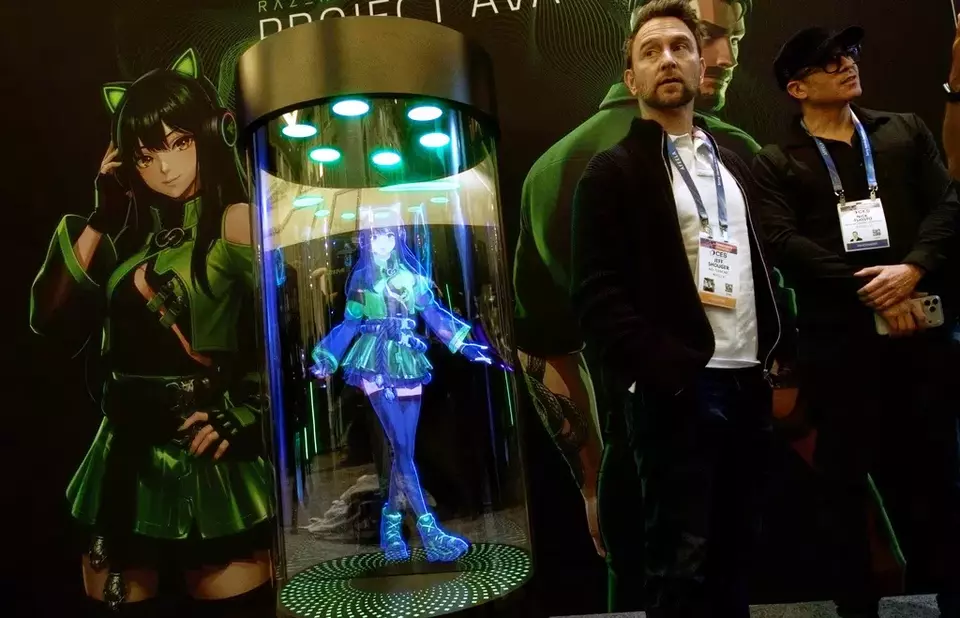
Gaming company Razer unveiled two AI-powered prototypes: Project Motoko, an over-ear headset that doubles as a general AI assistant, and Project Ava, a holographic desk companion housed in a glass tube. Both are model-agnostic and are expected to launch later this year.
Robots on the Runway
Oshkosh Corporation pitched a future where autonomous robots guide planes to gates and unload luggage. The company debuted airport robots designed to automate ground operations — even during extreme weather — aiming to reduce delays while improving safety. Airline testing is already underway.
Health, Longevity, and Fusion Power
Withings introduced Body Scan 2, a $600 smart scale that measures 60 biomarkers in 90 seconds, including heart age, vascular health, and nerve function. A companion app offers personalized health insights for a subscription fee.
Finally, Commonwealth Fusion Systems, Nvidia, and Siemens announced a partnership to accelerate nuclear fusion research. Using AI and a “digital twin” of its SPARC prototype reactor, the group aims to compress years of experimentation into weeks — bringing fusion power closer to reality in the 2030s.
Tags: Keywords: as a preferred
Related Articles

Indonesia Businesses Urged to Move Beyond AI Pilot Projects
Salesforce warns Indonesian companies risk missing AI productivity gains by delaying deployment and failing to prepare workers.
AI Adoption Exposes Indonesian Firms to Data Leak Risks
AI adoption is surging in Indonesia, raising concerns over data leaks, weak safeguards and the risks of unauthorized AI use.
Indonesia Can Hit 8% Growth With Housing, AI, Green Energy: Hashim
Hashim Djojohadikusumo says housing, AI, digital infrastructure and green energy could help Indonesia achieve 8% economic growth.
Airlangga Urges Indonesia to Catch Up With Vietnam in Digital, AI Industries
Indonesia needs to accelerate digital, semiconductor and AI industries to catch up with Vietnam and achieve its 8% growth target.
AI Data Centers Could Consume 4% of Global Power by 2035, World Bank Says
AI data centers are set to triple global power demand by 2035, putting Southeast Asia’s electricity grids under pressure.
Jakarta Stocks Rise 1.21% as Indonesia Lags in AI Boom
Indonesia’s stocks gained 1.21% as the World Bank said the country is lagging Malaysia and Vietnam in benefiting from the AI boom.
Malaysia, Vietnam Ride AI Boom as Indonesia Misses Out: World Bank
Malaysia and Vietnam are benefiting from the global AI investment boom, while Indonesia has yet to gain from AI value chains.
Cooling the Data Center Debate
Indonesia needs data centers to power its digital economy, but water, energy and community impacts require transparent planning.
Companies Need Real-Time Data to Scale AI, CloudMile Says
Companies need real-time data infrastructure to scale AI adoption and turn investments into measurable business results, CloudMile says.
Indonesian Stocks Rise as Fed Bets and MBG Savings Lift Sentiment
Indonesian stocks opened higher Friday as Wall Street gains and expectations of MBG budget savings boosted investor sentiment.The Latest

Minimum Wage Hikes Fail to Keep Up With Rising Living Costs
Indonesia’s 2026 minimum wage hikes offer limited relief as rising prices erode purchasing power and job insecurity persists.
Prabowo Government Gets Poor Ratings from 66% of Surveyed Professionals
According to the findings, 66% of respondents rated the government's overall performance as poor or very poor.
Rupiah Strengthens to Rp 17,992 as Investment Data Lifts Sentiment
Rupiah gains 0.30% to Rp 17,992 per dollar as strong investment realization and easing US-Russia tensions lift market sentiment.
UK to Deploy Typhoon Fighter Jets to Help Protect Saudi from Houthi Attacks
Saudi forces on Tuesday said they had intercepted a Houthi ballistic missile aimed at the kingdom's capital.
Standard Chartered Expands Financing for PT EMI, ALVA Electric Motorcycle Maker
Standard Chartered raises ALVA's financing facility to $20m to support operations, manufacturing and electric motorcycle supply chain.Most Popular
