



Trump Handshake Caps Syrian Leader’s Journey from Anti-US Insurgent to Nascent Mideast Partner
Beirut. As an al-Qaida fighter in Iraq, he was detained by the American military. As the leader of a US-designated terror group fighting in Syria's civil war, he had a $10 million bounty on his head.
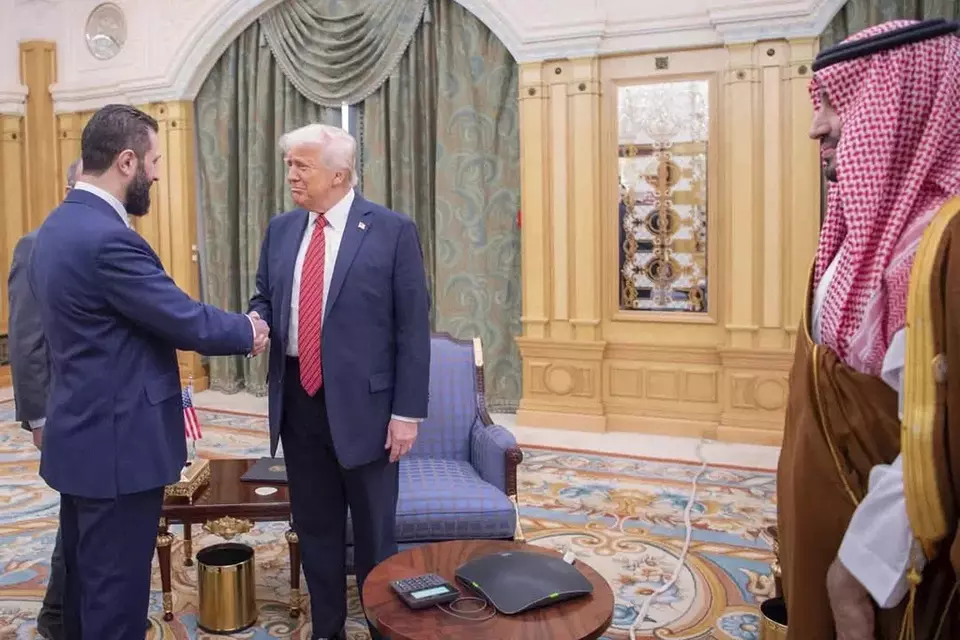
As the leader of a fast-changing Syria, Ahmad al-Sharaa shook hands Wednesday with US President Donald Trump, who later described him as a “young, attractive guy” with a “very strong past.”
The handshake, at a meeting orchestrated by the leaders of Saudi Arabia and Turkey, captured al-Sharaa’s long journey from hardened jihadi to the leader of a country that is gradually shedding its pariah status as it cements ties with America’s top allies in the Middle East.
Trump said he would lift crippling sanctions that were imposed on the government of deposed Syrian President Bashar Assad, who was overthrown in December, expressing hope that al-Sharaa, who led the insurgency, can move Syria in a new direction.
“He’s got a real shot at holding it together,” Trump said. “He’s a real leader. He led a charge, and he’s pretty amazing.”
The news sparked celebrations across Syria, where the economy has been ravaged by 14 years of civil war and international isolation. But al-Sharaa still faces daunting challenges to building the kind of peaceful, tolerant Syria he has promised.
From Al-Qaida Extremist to Statesman
Before toppling Assad, al-Sharaa was known by the jihadi nickname he adopted, Abu Mohammed al-Golani. His ties to al-Qaida stretch back to 2003, when he joined the insurgency after the US-led invasion of Iraq.
He helped al-Qaida form an offshoot in Iraq that attacked both US forces and the country's Shiite majority, often using car and truck bombs. He was detained by the US and held for over five years without being charged.
The group's Iraqi leader, Abu Bakr al-Baghdadi, sent al-Sharaa to his native Syria in 2011 after a popular uprising led to a brutal crackdown and eventually a full-blown civil war. There, al-Sharaa established an al-Qaida branch known as the Nusra Front.
The two insurgent leaders had a brutal falling out when al-Sharaa refused to join al-Baghdadi's Islamic State group and remained loyal to al-Qaida's central leadership. The Nusra Front later battled the Islamic State group.
In his first interview in 2014 on Qatari network Al Jazeera, he kept his face covered and said Syria should be governed by Islamic law, an alarming prospect for the country's Christian, Alawite, and Druze minorities. Al-Sharaa also said he couldn't trust Gulf and other Arab leaders, whom he said had sold themselves to Washington to stay in power.
“They paid a tax, these Arab rulers, to the United States," he said.
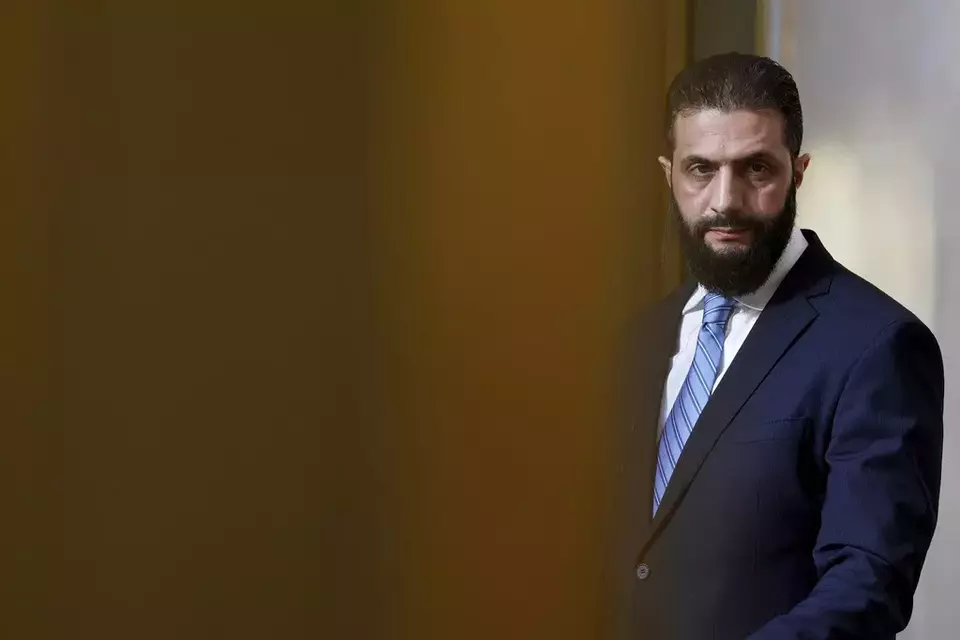
But in the following years, he began rebranding himself and the armed group he led. In 2016, he announced that he had severed ties with al-Qaida. He began appearing in public unmasked and in military garb, and changed his group's name to Hayat Tahrir al-Sham -- the Organization for Liberating Syria -- as it consolidated control over a swath of northwestern Syria.
His transformation -- both political and sartorial -- continued in 2021, when he gave an interview to an American network. This time he appeared in a shirt and trousers, with his short hair gelled back, and said his group posed no threat to the West. He also called for the lifting of sanctions on Syria.
A Promise of Change, But Many Obstacles
After leading the lightning insurgency that toppled Assad, al-Sharaa promised a new Syria.
He vowed to rid the country of Iranian influence and Iran-backed armed groups such as the Lebanese militia Hezbollah. He promised an inclusive, representative government that would allow the country's many ethnic and religious groups to live in peace.
Washington lifted the terror designation weeks after he took power, and he was embraced by Turkey and Saudi Arabia, whose de facto leader, Crown Prince Mohammed bin Salman, hosted Wednesday's meeting with Trump.
But the difficulties have been daunting.
Fourteen years of war left large areas in ruins and, along with the sanctions, devastated the economy. An estimated 90 percent of the population lives in poverty. Assad's rule and the civil war also left deep fissures between the country's Sunni minority and the Alawite minority from which Assad hailed, and which benefited from his rule. Those rifts have proven tough to heal.
Al-Sharaa formed a transitional government that gave some positions to minorities but was dominated by his inner circle.
A constitutional declaration later broadened al-Sharaa's powers and said Islamic law would remain at the heart of legislation for a five-year interim period. Al-Sharaa argued that the measures were needed to stabilize the country, while many critics viewed it as a power grab.
“It appears that many of the steps taken have been rushed and performative rather than offering genuine, meaningful change in Syria,” said Lara Nelson, policy director at the Syrian research and policy group Etana. “There are concerns about authoritarian consolidation.”
Sectarian Clashes As Civil War Tensions Linger
The biggest test for al-Sharaa came in early March, when the country witnessed its worst sectarian clashes since Assad's downfall.
After security forces crushed an armed rebellion, apparently led by Assad loyalists, on the mostly Alawite Mediterranean coast, fighters loyal to the new government carried out a wave of revenge killings.
More than 1,000 people were killed over two days, mostly Alawite civilians. Videos surfaced online showing houses set ablaze and bodies in the streets. Others showed Alawites being rounded up, mocked, and beaten.
Weeks later, clashes broke out between fighters loyal to the government and minority Druze living in the Damascus suburbs. Smaller such incidents have occurred elsewhere in the country.
Meanwhile, Israel has invaded southern Syria and carried out a wave of airstrikes that it says are aimed at destroying the country's military capabilities and any armed groups that could pose a threat. A strike hit near the presidential palace earlier this month.
Al-Sharaa has opened an investigation into the sectarian violence on the coast and has reached a settlement with the Druze. Those steps have calmed things down for now. But the internecine violence and Israel's incursions have fed a sense among many Syrians that there is a security vacuum.
Even as he praised al-Sharaa, Trump acknowledged the huge challenges he faces.
“I think they have to get themselves straightened up," Trump said. "They have a lot of work to do.”
Tags: Keywords: as a preferred
Related Articles

Trump’s New Press Secretary Out After Less Than a Week
Katie Zacharia’s brief White House tenure ends after less than a week, following a short first briefing and reported tensions over her role.
Defying Trump, Zelensky Says Will Keep Hitting Russian Refineries
Russia on Thursday said Ukraine had attacked an oil refinery in Ryazan, south of the capital, Moscow.
Fury as US Federal Agents Search Ilhan Omar's Home
"Make no mistake: this is an attempt to target political enemies and weaponize federal law enforcement," Omar wrote on X.
‘It’s Trump Who Sets Oil Price’: Prabowo’s Brother
Neither the Indonesian government nor OPEC sets the oil price, Hashim Djojohadikusumo says.
Navi Pillay, South African Rights Champion, Wins Nobel Peace Prize
"If you clap a little bit more, I may share this prize with Trump," the 85-year-old said.
Trump Vows to Hit Iran 'Very Hard' If Linked to Flydubai Attack
The US leader's threat of retaliation came as he took a harsher tone on the stalled Iran war overall.
US-Led Coalition Ends Mission in Iraq
Coalition troops were deployed to Iraq and Syria in 2014 to fight the Islamic State group, which had seized large swathes of territory.
Trump Slammed for 'Illegal' US TV Ads Funded by Taxpayers
Mike Levin, a Democratic member of the House of Representatives, said: "It’s propaganda, and you’re paying the bill."
Airlangga Says Indonesia Won’t Face US Tariffs Over Russian Oil
Airlangga says Indonesia won’t face US tariffs over Russian oil bought within an allowed window.
Masoud Tells Trump that Iran Will Never 'Bend at the Knee'
Pezeshkian accused Washington of "terrorism" for assassinating former supreme leader Ayatollah Ali Khamenei at the start of the conflict.The Latest

Chandra Asri Group Receives Trade Finance Excellence Award, Reinforcing Its Role in Indonesia’s Industrial Development
Chandra Asri Group receives the Trade Finance Excellence Award at CIMB Niaga Business Summit 2026.
AEON MALL Deltamas Brings 11 Sports and Creative Competitions to AEONLYMPIC 2026
AEON MALL Deltamas hosts AEONLYMPIC 2026, featuring 11 sports and creative competitions, with more than 3,100 participants.
Indonesian Stocks Extend Losses for Third Day, Fall 3.64% to 4,996
Indonesian stocks fell 3.64% on Monday, extending losses for a third straight session amid MSCI concerns and tighter trading limits.
Prabowo Calls Meeting on Forest Fires as Haze Reaches Jakarta, Singapore
Prabowo summons senior officials to discuss forest fires as smoke reaches Jakarta and Malaysia pushes for regional action.
Jakarta Outranks Amsterdam in Global Public Transport Survey
Jakarta climbs two places to 15th in Time Out's 2026 public transport survey, with its governor citing better network integration.Most Popular
