



Nissan Promises Aggressive Electrification Push to Boost Global Sales
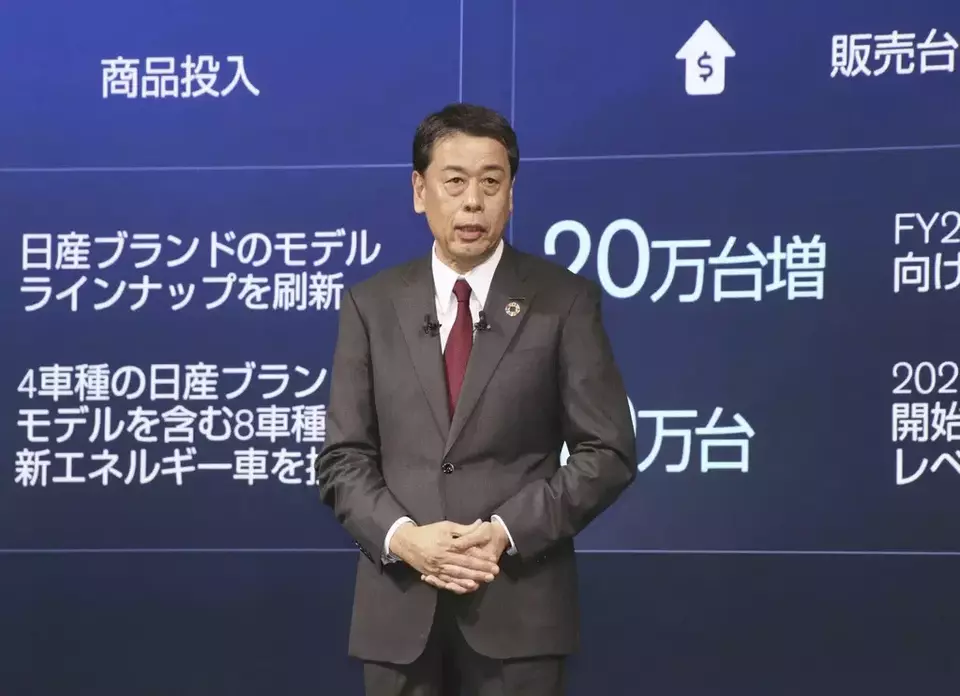
Tokyo. Nissan will expand its electric vehicle lineup, develop more powerful batteries and cut production costs, while speeding up the whole process, in what the Japanese automaker’s chief called “The Arc” pathway to higher sales by 2030.
“The auto industry is now being forced to reshape its values so we can say continuous change is the new normal,” Chief Executive Makoto Uchida told reporters Monday, in outlining a sprawling but ambitious business plan.
“Nissan must change. We cannot succeed if we continue along the same path.”
Costs will come down for electric models so they’ll be about the same as gasoline-engine models by fiscal 2030, while global sales will grow by a million vehicles during that period, he added.
Last year, Nissan Motor Co. sold nearly 3.4 million vehicles around the world, up about 5 percent from the previous year.
The company is planning 30 new models over the next three years, 16 of them EVs. Nissan plans to launch 34 EV models from fiscal 2024 through fiscal 2030, so that EVs will account for 40 percent of its global offerings by fiscal 2026, and 60 percent by the end of the decade.
To slash costs, Nissan says it will start working with suppliers from the development stage, upgrade production methods to incorporate robotics and artificial intelligence, and have models sharing components -- not just platforms but also parts. It also promised innovation in autonomous vehicles to make driving safer.
Nissan, based in the port city of Yokohama, southwest of Tokyo, will leverage its partnerships around the world, including those with Mitsubishi Motors Corp., Dongfeng Nissan in China, and in the alliance it has with French automaker Renault.
Earlier this month, Nissan announced it was in talks to form a partnership with Japanese rival Honda Motor Co. in electrification and artificial intelligence.
Such tie-ups between rivals are relatively unusual but are needed to keep up with surging demand for more sustainable transport as concerns grow over carbon emissions and sustainability, analysts say.
Nissan, Japan’s No. 2 automaker, was an early EV adapter, coming out with the Leaf EV in late 2010. In recent years, Japanese automakers have fallen behind Tesla of the U.S. and Chinese manufacturers like BYD.
Automakers, including Nissan, have taken a hit from shortages of computer chips and other parts due to disruptions related to the pandemic.
Nissan’s offerings of new EVs, plug-ins, and hybrids will increase across all global markets, including the U.S., Europe, Japan, the rest of Asia, Australia and Africa, Uchida said.
“The Arc plan shows our path to the future. It illustrates our continuous progression and ability to navigate changing market conditions. This plan will enable us to go further and faster in driving value and competitiveness,” he said, referring to Nissan’s goals.
Tags: Keywords: as a preferred
Related Articles

Molinas Launch Targets Indonesia’s 140 Million-Motorcycle Market
Indonesia launched its Molinas electric motorcycle initiative with low-interest financing and zero down payments to accelerate EV adoption.
EVs vs. Gasoline Cars: Which Is Cheaper to Own Over 10 Years?
EVs offer lower energy and maintenance costs, but depreciation and battery replacement can shape their 10-year ownership costs.The Latest

Prabowo Calls Meeting on Forest Fires as Haze Reaches Jakarta, Singapore
Prabowo summons senior officials to discuss forest fires as smoke reaches Jakarta and Malaysia pushes for regional action.
Jakarta Outranks Amsterdam in Global Public Transport Survey
Jakarta climbs two places to 15th in Time Out's 2026 public transport survey, with its governor citing better network integration.
MSCI Concerns, Tighter IDX Trading Rules Send Indonesian Stocks Down 5% by Midday
Indonesian stocks plunge 5% by midday as MSCI concerns weigh on sentiment and the IDX tightens its daily downside limit to 7%.
Jakarta Prepares 367 Health Facilities as Haze Reaches the Capital
Jakarta prepares 367 health facilities to treat potential haze-related illnesses after smoke from Sumatra and Kalimantan crosses the region.
Jakarta Expands Flood Prevention With New Water Storage Ponds
Jakarta opens two East Jakarta water storage ponds as it expands flood prevention efforts through reservoirs and river normalization.Most Popular
