



Indonesia Tightens Market Controls After JCI Crash, Sets 15% Auto-Rejection Cap
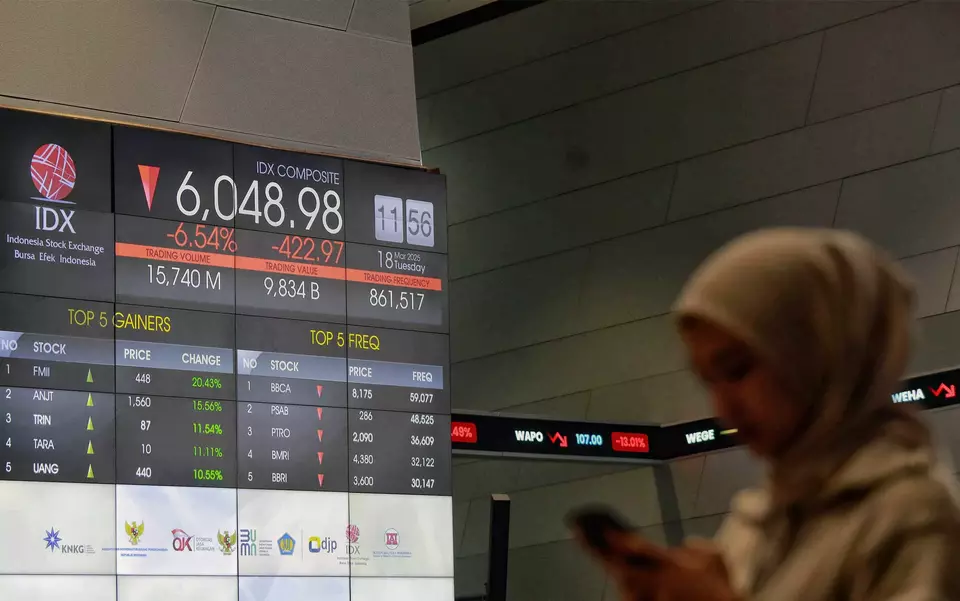
Jakarta. The Financial Services Authority (OJK) has officially set a 15 percent lower auto-rejection limit (ARB) for stocks as part of broader efforts to maintain capital market stability and protect investors amid increasing market volatility.
The announcement came just days after the Indonesia Stock Exchange (IDX) suffered a sharp sell-off on Tuesday, triggering a temporary trading suspension as investors reacted to new US tariffs on Indonesian goods and mounting trade tensions between the US and China.
The Jakarta Composite Index (JCI) plummeted 9.19 percent in early trading Tuesday. Under the revised circuit breaker mechanism, a 30-minute halt will be enforced if the JCI falls more than 8 percent—up from the previous 5 percent threshold. A second 30-minute freeze is triggered if losses deepen past 15 percent. Should the index plunge beyond 20 percent, trading may be suspended for the remainder of the session with OJK’s approval.
Inarno Djajadi, Chief Executive of Capital Market, Derivatives, and Carbon Exchange Supervision at OJK, said the ARB policy is the result of a comprehensive review conducted in collaboration with market participants and self-regulatory organizations (SROs).
“This approach seeks to strike a balance between investor protection and market efficiency,” Inarno said at the agency’s monthly board of commissioners meeting in Jakarta on Friday.
The 15 percent ARB cap took effect on Tuesday, April 8, and applies to all stocks listed on the main board, development board, and new economy board, as well as exchange-traded funds (ETFs) and real estate investment trusts (REITs) across all price levels.
In tandem, the IDX has updated its trading halt policy in response to the recent volatility. The enhanced circuit breaker system aims to curb panic-driven selloffs while allowing time for market participants to assess developments.
As a further safeguard, OJK and IDX have suspended short-selling and allowed listed companies to conduct share buybacks without shareholder approval, as permitted under OJK Regulation No. 13/2023.
These temporary measures will remain in effect for six months starting March 18. As of April 9, 21 listed companies had submitted buyback plans totaling Rp 14.97 trillion. Of these, 15 issuers had executed buybacks amounting to Rp 429.72 billion.
“We will continue to evaluate the effectiveness of these measures and are ready to make adjustments as needed in response to future market developments,” Inarno said.
Tags: Keywords: as a preferred
Related Articles

MSCI Concerns, Tighter IDX Trading Rules Send Indonesian Stocks Down 5% by Midday
Indonesian stocks plunge 5% by midday as MSCI concerns weigh on sentiment and the IDX tightens its daily downside limit to 7%.
Indonesian Bank Stocks Hit Pandemic-Era Valuations After MSCI Shock
Indonesian bank stocks hit crisis-era lows as MSCI's downgrade proposal sparks a selloff and fuels fears of foreign outflows.
Black Week for Indonesia Stocks Exchange as Market Loses $85 Billion
Indonesia’s stocks plunged 14.91% in a week, wiping out $94 billion in market value as MSCI weighs a downgrade to standalone status.
Indonesia Fines DSSA, BREN and CUAN Rp 2.1 Trillion for Market Violations
OJK fines DSSA, BREN and CUAN Rp 2.1 trillion over stock manipulation and alleged irregularities in share offerings.
Indonesia Could Join Zimbabwe, Palestine in MSCI Standalone Market Downgrade
Indonesia risks joining Zimbabwe and Palestine in MSCI’s Standalone Market category, threatening foreign fund flows.
MSCI Warning Raises Existential Questions for Indonesia's Stock Market, Economist Says
MSCI's downgrade threat tests Indonesia's market credibility, with an economist urging reforms to restore investor trust.
Explainer: What Is MSCI Market Classification and Why Does It Matter for Indonesia?
MSCI classifies stock markets as developed, emerging, frontier or standalone. Here’s how the system works and why Indonesia’s status matters
OJK Says Indonesian Market Still Attractive After MSCI Threat
OJK says the domestic market will remain "attractive" following MSCI's threat to downgrade Indonesia to a "standalone" status.
MSCI Mulls Downgrading Indonesia to Standalone Market
MSCI is now weighing launching a consultation on the standalone market downgrade unless Jakarta shows meaningful progress by November.
OJK Flags 19 Stocks for High Ownership Concentration
OJK flags 19 stocks for high ownership concentration and will step up scrutiny of actively traded shares over manipulation risks.The Latest

Prabowo Calls Meeting on Forest Fires as Haze Reaches Jakarta, Singapore
Prabowo summons senior officials to discuss forest fires as smoke reaches Jakarta and Malaysia pushes for regional action.
Jakarta Outranks Amsterdam in Global Public Transport Survey
Jakarta climbs two places to 15th in Time Out's 2026 public transport survey, with its governor citing better network integration.
MSCI Concerns, Tighter IDX Trading Rules Send Indonesian Stocks Down 5% by Midday
Indonesian stocks plunge 5% by midday as MSCI concerns weigh on sentiment and the IDX tightens its daily downside limit to 7%.
Jakarta Prepares 367 Health Facilities as Haze Reaches the Capital
Jakarta prepares 367 health facilities to treat potential haze-related illnesses after smoke from Sumatra and Kalimantan crosses the region.
Jakarta Expands Flood Prevention With New Water Storage Ponds
Jakarta opens two East Jakarta water storage ponds as it expands flood prevention efforts through reservoirs and river normalization.Most Popular
