



What MC14 Reveals About the Future of the WTO
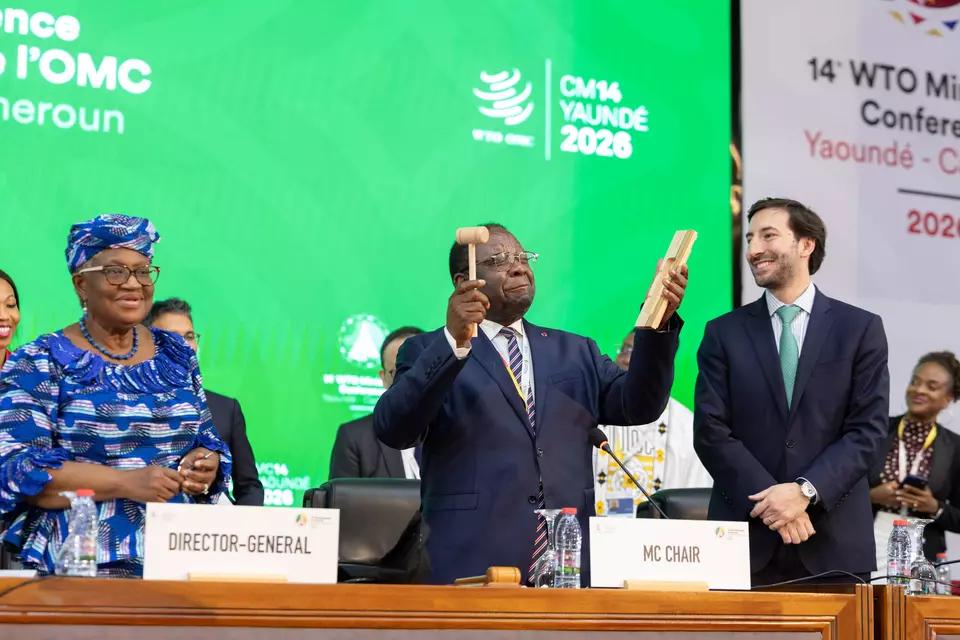
The World Trade Organization is not collapsing, but the latest ministerial meeting shows it is entering a new era where plurilateral initiatives, regional agreements and developing-country priorities will increasingly shape global trade governance.
The 14th Ministerial Conference of the World Trade Organization (MC14), held in Yaoundé, Cameroon, from 26-29 March 2026, took place at a moment of profound uncertainty for the global trading system. Intensifying geopolitical rivalry, rising economic securitization, and the proliferation of unilateral trade measures have collectively weakened the foundations of multilateral cooperation.
At the time of writing, the conference’s final outcome document has yet to be released. Yet even without a formal declaration, the discussions and negotiations that unfolded in Yaoundé already reveal important truths about the direction of the WTO and the future of the multilateral trading system. In many ways, MC14 reflected a defining paradox of our time: a multilateral meeting taking place in an increasingly unilateral world.
Over the past decade, trade multilateralism has come under mounting pressure. Major economies have increasingly resorted to unilateral measures, including tariffs imposed beyond agreed commitments, industrial subsidies and trade restrictions justified on national security grounds. Such actions challenge two of the WTO’s most fundamental principles: non-discrimination under the Most Favored Nation rule and the binding nature of tariff commitments negotiated among members. This environment has made consensus within the WTO far more difficult to achieve.
Against this difficult backdrop, the leadership of WTO Director-General Ngozi Okonjo-Iweala deserves recognition. Since taking office, she has consistently emphasized the need to restore trust in the system and ensure that the WTO remains relevant to contemporary economic realities. In Yaoundé, she again urged members to adapt the organization to a changing global economy while preserving the rules-based foundation that has governed global trade for nearly three decades.
The discussions at MC14 were therefore less about dramatic breakthroughs and more about navigating structural tensions that have been building for years. One of the most visible themes was the push for WTO reform. Many members agreed that the organization’s three core functions — negotiation, monitoring and dispute settlement — must be revitalized.
Restoring a fully functioning dispute settlement system remains a top priority, particularly after the Appellate Body ceased operating in 2019. While no definitive solution emerged in Yaoundé, there was broad recognition that rebuilding confidence in the dispute settlement mechanism will be essential to maintaining the credibility of the rules-based system.
Another notable development was the continued rise of plurilateral initiatives. Efforts such as the Investment Facilitation for Development initiative and ongoing negotiations on digital trade illustrate how groups of willing members are increasingly pursuing rule-making outside the traditional consensus-based model.
This “variable geometry” approach reflects both necessity and pragmatism. With 166 members representing diverse economic interests, achieving universal agreement on complex new issues has become increasingly difficult. Plurilateral initiatives therefore offer a pathway for progress among members prepared to move forward, while keeping the door open for others to join later.
At the same time, MC14 underscored the persistent divides between developed and developing members, particularly in areas such as agriculture and digital trade. Developing countries continue to emphasize the importance of food security, policy space and special and differential treatment in agricultural negotiations. These concerns remain central to coalitions such as the G-33 under Indonesia’s coordination, which advocate mechanisms that allow governments to support small farmers and maintain public food stockholding programs.
Debates surrounding digital trade highlighted another fault line. While many advanced economies and technology companies advocate the permanent extension of the moratorium on customs duties for electronic transmissions, several developing countries question whether such commitments would limit their fiscal and industrial policy options in the digital economy. The debate ultimately reflects a deeper challenge confronting the WTO: balancing the need for new rules in emerging sectors with the development priorities of poorer members.
For countries like Indonesia and many economies across the Global South, this balance is critical. Multilateral trade rules have historically provided smaller and middle-income countries with predictability, fairness and protection against economic coercion by larger powers. A weakened multilateral system risks leaving these economies more exposed to unilateral pressures and power-based bargaining.
At the same time, developing countries are increasingly shaping the evolution of the trading system. Indonesia, for instance, has played an active role in advancing the concerns of developing members, including through leadership in food security discussions and broader efforts to ensure that global trade rules remain development-oriented.
Beyond the WTO itself, regional economic frameworks are also becoming increasingly important. Initiatives such as the Association of Southeast Asian Nations and the Regional Comprehensive Economic Partnership provide additional platforms for economic integration and rule-making in Asia and the Global South. Rather than replacing the WTO, these frameworks may increasingly complement it by advancing cooperation in areas where multilateral consensus proves elusive.
In this sense, MC14 may ultimately be remembered less for specific negotiated outcomes than for what it revealed about the structural evolution of the global trading system. The WTO is unlikely to disappear. Its core principles — predictability, transparency and non-discrimination — remain essential to global economic stability. But the institution is clearly entering a new phase in which progress may depend on flexible approaches, incremental reforms and greater interaction between multilateral and regional frameworks.
What MC14 ultimately reveals is not the collapse of the multilateral trading system, but its uneasy transition into a new era. The WTO is no longer operating in the relatively stable geopolitical environment that shaped its creation three decades ago. Instead, it must function in a fragmented world marked by strategic rivalry, industrial policy and economic securitisation. For developing economies—including Indonesia and many across the Global South—the stakes are particularly high. A predictable and rules-based system remains their best safeguard against power-driven trade relations.
The real challenge therefore, is not whether the WTO will survive, but whether its members can muster the political will to adapt the institution to a changing world while preserving the principles that made multilateral trade cooperation possible in the first place.
---
Iman Pambagyo is the Trade Ministry’s Director General of International Trade Negotiations (2012-2014, 2016-2020) and Indonesia’s Ambassador to the WTO (2014-2015). The views expressed in this article are those of the author.
 as a preferred
Related Articles

Indonesia Secures Partial WTO Win Over EU Fatty Acid Duties
Indonesia wins a partial WTO ruling against EU anti-dumping duties on fatty acids, but most of its legal claims are rejected.
Indonesia Caught Between Trade Opportunities and Sanctions Risks
Indonesia weighs trade with Russia and Belarus against sanctions risks as firms navigate a more complex global landscape.The Latest

Chandra Asri Group Receives Trade Finance Excellence Award, Reinforcing Its Role in Indonesia’s Industrial Development
Chandra Asri Group receives the Trade Finance Excellence Award at CIMB Niaga Business Summit 2026.
AEON MALL Deltamas Brings 11 Sports and Creative Competitions to AEONLYMPIC 2026
AEON MALL Deltamas hosts AEONLYMPIC 2026, featuring 11 sports and creative competitions, with more than 3,100 participants.
Indonesian Stocks Extend Losses for Third Day, Fall 3.64% to 4,996
Indonesian stocks fell 3.64% on Monday, extending losses for a third straight session amid MSCI concerns and tighter trading limits.
Prabowo Calls Meeting on Forest Fires as Haze Reaches Jakarta, Singapore
Prabowo summons senior officials to discuss forest fires as smoke reaches Jakarta and Malaysia pushes for regional action.
Jakarta Outranks Amsterdam in Global Public Transport Survey
Jakarta climbs two places to 15th in Time Out's 2026 public transport survey, with its governor citing better network integration.Most Popular
