



Underrated Indonesia-Australia Ties
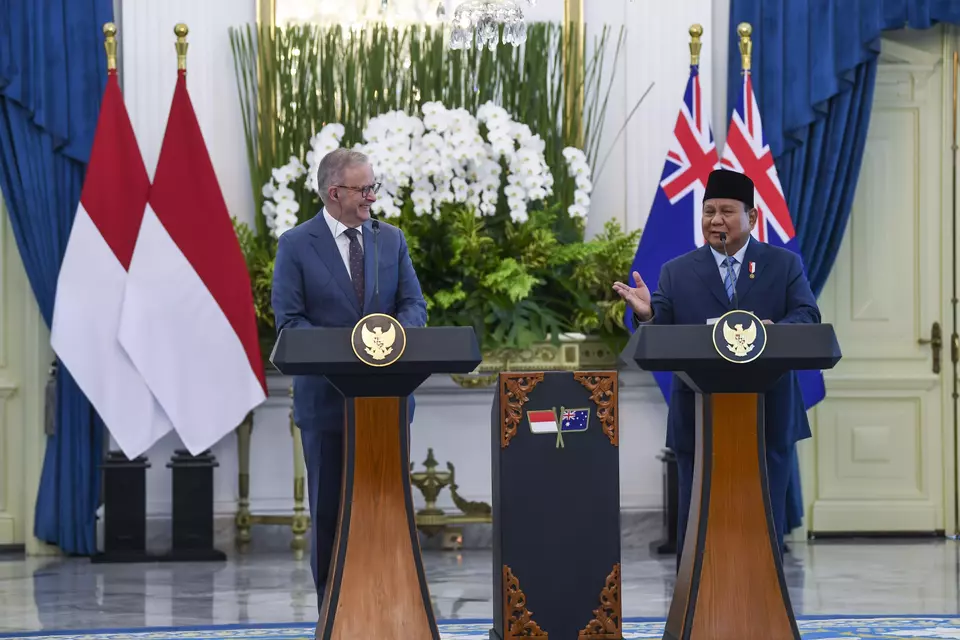
Australian Prime Minister Anthony Albanese’s meeting with Indonesian President Prabowo Subianto on his first international visit set defence, trade and investment firmly at the center of the agenda. Albanese was welcomed to the palace by dozens of soldiers on horseback, around 3,000 school children waving flags, and a military ceremony, a typical reception for a foreign leader under Prabowo’s administration.
While the visit signals that Indonesia is a clear priority for the Australian government, the geographic proximity of the two neighbors is not matched by commensurate depth in trade and investment ties.
The bilateral relationship has been set to the level of comprehensive and strategic, yet data shows that Australia is not even in the top 10 list of Indonesia’s trading partners, with less trade activity than any other neighbor. Similarly, Indonesia ranks as Australia’s 13th largest two-way trading partner, after India, New Zealand, and Taiwan, and accounting for only 2 percent of total trade for Australia at $17 billion in 2023.
On the investment front, Australia places low on the list at 11th as a source of foreign direct investment in Indonesia, showcasing only modest growth in projects and volume in recent years, amounting to about half a billion USD in total investment last year. Invitations to increase Australian investment in Indonesia have been repeated intensively since President Jokowi’s leadership, with a strong emphasis on downstreaming industry. However, more significant progress has yet to be seen.
From this high-level visit, there is a strong call to synergise Indonesia's economic development agenda under the Asta Cita and Australia’s Southeast Asia Economic Strategy 2040, which the two leaders have placed as the priority.
Asta Cita represents the eight key priorities of the Prabowo administration’s strategic agenda to enhance Indonesia’s resilience and competitiveness. The goals focus on strengthening the national ideology of Pancasila, advancing defence and economic sovereignty, achieving self-reliance in food, energy, and water, and promoting the creative, green, and blue economies.
Other priorities include quality job creation, human capital development, downstreaming and industrial transformation, rural empowerment to reduce poverty, governance reform, and environmental harmony. The goals reflect ambitions for a prosperous and just Indonesia, amid an era of global uncertainty.
Meanwhile, Australia’s Southeast Asia Economic Strategy to 2040 aims to boost trade and investment between Australia and Southeast Asia. It offers 75 recommendations under four pillars: raising awareness, removing blockages, building capacity, and deepening investment. The strategy calls out 10 priority sectors including: agriculture and food, resources, the green energy transition, infrastructure, education and skills, the visitor economy, healthcare, digital economy, professional and financial services, and creative industries.
With shared priorities underpinning both strategic agendas, action must accelerate on low-hanging fruit initiatives across these sectors.
Australia’s Southeast Asia Strategy established a Deal Team in Jakarta to identify investment opportunities. Offering on the ground support, this team must bolster business capabilities and confidence to navigate regulatory and cultural complexities. While it is hoped that this will rapidly lift investment, Aussie investors have lagged peers in capturing opportunities in Indonesia. Statistics from 2023 show Indonesia’s investment in Australia was almost double the investment in the other direction.
Unfortunately, the relationship between Indonesia and Australia remains underrated despite the enormous potential that the two countries share. Four concrete ways might help the ties to flourish:
First, Prabowo has taken a leading approach to foreign affairs to-date, seeking to cement Indonesia’s position as a major economic and geostrategic actor internationally. This aligns with the never-changing principle of ‘free and active’ foreign policy, that translates to not taking part in any major conflicting sides. Despite Australia’s strategic proximity with the Western world, Indonesia hopes Canberra takes into consideration that dragging Indonesia into the competition of major power dominance will not be productive. Instead, moving forward with Indonesia to develop concrete initiatives to maintain a stable, peaceful region is more pressing and necessary.
Second, within a short period of Prabowo’s presidency, there have been decisive moves that may influence the dynamics of Indonesia’s regional and global affairs. Indonesia joined the BRICS this January - in a strategic move to deepen economic cooperation with Brazil, Russia, India, China, and South Africa and diversify trade and investment links. Additionally, Prabowo is committed to continuing Indonesia’s application to join the Comprehensive and Progressive Agreement for Trans-Pacific Partnership (CPTPP) and the Organisation for Economic Co-operation and Development (OECD) to broaden the markets for exports, and also deepen domestic reforms.
Albanese’s support for Indonesia’s participation at the CPTPP is appreciated, and this should go along with more joint work to actualise the maximum benefits of such a trade agreement. For Indonesia, the CPTPP sets high standards on e-commerce, state-owned enterprises, and intellectual property, areas where improvement could unlock a huge net gain for Indonesia’s economic competitiveness and investment climate.
On another note, Australia’s backing in supporting Indonesia’s greater trade connectivity with a wider region will also send a signal of promoting a multilateral and rules-based trade regime. Given recent unilateral trade decisions and ongoing threats of a trade war more globally, support for diversification is timely.
Third, utilizing the key modalities of its people-to-people ties. Interpersonal connections between Indonesia and Australia are booming. Indonesian students studying in Australia each year has increased by 75% in a decade. The New Colombo Plan and ACICIS have boosted study exchanges in the other direction. And Indonesia has become the top holiday destination for Australians, who made over 1.4 million trips in 2023. Education and tourism offer a foundation for further deepening ties. Perhaps more importantly, diaspora links are strong, with almost 90,000 Australians claiming Indonesian heritage in the 2021 Census. Australia and Indonesia must proactively engage these cohorts in building connections.
Fourth, Indonesia must invest more of its strategic resources to engage with Australia. The presence of Professor Jennifer Westacott AO as a business champion of Australia to Indonesia in strengthening investment, business, and talent ties is crucial. Recognizing Indonesia as a key strategic partner, her work has also highlighted the importance of two-way investment opportunities in sectors such as agriculture, critical minerals, information and communications technology and digital services, energy transition, education, and healthcare system. She has taken large strides to break down the perception that doing business in Indonesia is difficult, urging Australian companies to seize the opportunities in the country.
Should Indonesia launch a reciprocal effort? Starting from also appointing a key business champion for Australia, Indonesian businesses could build trust, comfortability and assurance.
There is vast potential at stake for two neighbors to deepen their undervalued partnership.
With Albanese’s visits to the Vatican and Singaporean Prime Minister Lawrence Wong over the next week, and Prabowo set to host French President Emmanuel Macron and Chinese Premier Li Qiang at the end of the month, we hope the focus on Indonesia-Australia ties will remain a shared priority.
--
Noto Suoneto is VP for International Affairs at the Indonesian Business Council (IBC). Hayley Winchcombe is an Engagement Manager at Mandala Partners. The views expressed in this article are those of the authors.
Tags: Keywords: as a preferred
Related Articles

Dino Patti Djalal Says Indonesia’s Government Remains Reactive, Not Preventive
Dino P. Djalal says Indonesia’s government remains reactive rather than preventive, citing gaps in risk management and crisis preparedness.
Prabowo-Gibran Government Wins 63.1% Public Trust in Voxpol Survey
Voxpol’s survey finds 63.1% of Indonesians trust Prabowo-Gibran, while 61.1% believe the government can solve the country’s problems.
Prabowo Threatens to Revoke Mining Permits Inactive for Two Years
Prabowo vows to revoke mining permits inactive for over two years, citing nearly $300 billion in proven reserves across five concessions.
Prabowo Launches Council to Improve Financial Welfare of Indonesian Families
Prabowo launches a new council to shift Indonesia's financial inclusion agenda toward improving household welfare and resilience.
Prabowo Vows Action Against Foreign Companies Linked to Forest Fires
Prabowo vows tougher action against foreign firms implicated in forest fires, warning that repeat offenders could lose their permits.
Jakarta Stocks Jump 1.12% as Investors Assess Prabowo’s MSCI Remarks
Indonesian stocks rose 1.12% as investors assessed Prabowo’s MSCI remarks and Bank Indonesia’s decision to hold its benchmark rate.
Indonesia Must Fix Market Transparency, Not Fight MSCI, Analyst Says
Indonesia should address market transparency concerns raised by MSCI instead of treating the global index provider as an adversary.
Prabowo Rejects Criticism of Oversized Cabinet
Prabowo defends his 53-member cabinet, saying a broad political coalition is vital to governing Indonesia and improving public welfare.
Only 12% of Red and White Village Cooperatives Operational After Two Years
Fewer than 12% of Indonesia’s 83,000 legally established Red and White Village Cooperatives have operational businesses, an expert says.
Prabowo Summons Economic Team Amid Market Volatility
Prabowo meets senior economic officials as the JCI rebounds 4.16% and the rupiah strengthens to Rp 17,992 per dollar.The Latest

Ye Concert, Other Events to Draw 130,000 to GBK, Here’s What to Know
Around 130,000 visitors are expected at Jakarta’s GBK on Saturday as Ye’s concert and several major events take place.
Indonesia Allocates Rp 722 Billion for Year-End Flight Ticket Tax Relief
Indonesia allocates Rp 722 billion to cover domestic flight ticket VAT during the 2026/2027 Christmas and New Year holidays.
Greece Floats Shipbuilding Partnership with Indonesia
Greece says that it possesses “extensive expertise” as it woos Indonesia in shipbuilding partnership.
Indonesian Stocks Rally 4.9%, but Foreign Investors Keep Selling
Indonesia’s JCI rose 4.9% last week, but foreign selling and MSCI downgrade risks continue to cloud the market outlook.
Ye Concert in Jakarta to Deploy 2,000 Security Personnel
More than 2,000 personnel will secure Ye’s Jakarta concert on Saturday, as organizers urge fans to use public transport.Most Popular
