



Protesters Storm Hotel Meeting on Military Law Amendment
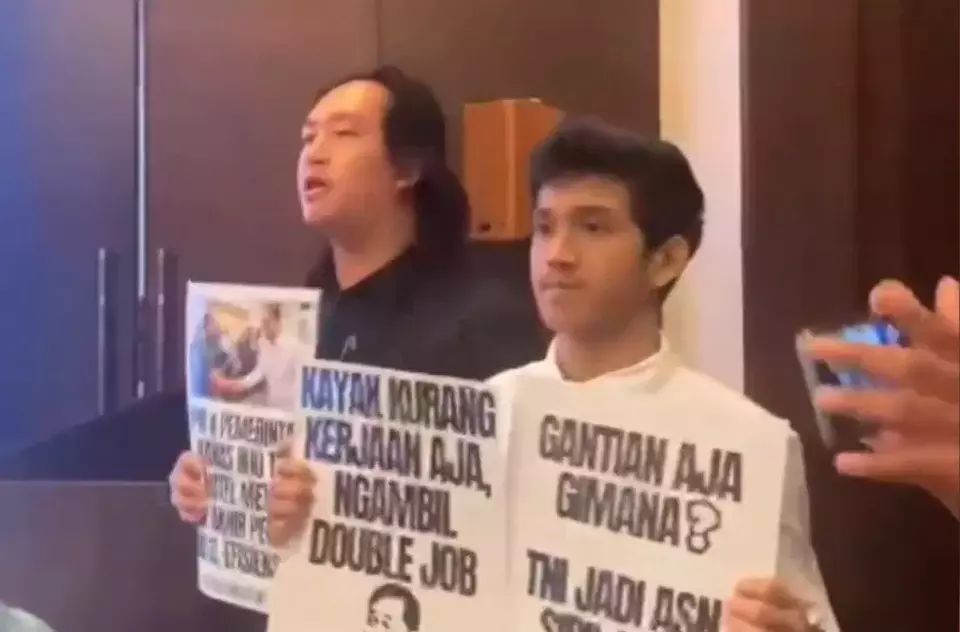
Jakarta. At least three democracy activists stormed into a hotel room in Jakarta on Friday, disrupting a closed-door meeting where lawmakers and government officials were discussing proposed amendments to the military law.
The activists, who took meeting participants by surprise, voiced their opposition to the plan that would allow active military officers to assume civilian positions. They also questioned the secrecy of the discussions.
“Good afternoon, ladies and gentlemen! We represent the Civil Coalition for Security Reform. Please stop this meeting because it is being held behind closed doors,” one activist, Andri Yunus, shouted upon entering the meeting room at the Fairmont Hotel.
As security guards forcibly removed them from the room, Andri continued protesting: “We reject closed-door discussions on this matter! We reject the military’s dual functions! Stop this meeting right now!”
The activists carried banners criticizing the government’s plan, with one sign reading: "What about switching places? Military officers serve as civil servants, and civilians carry the arms?"
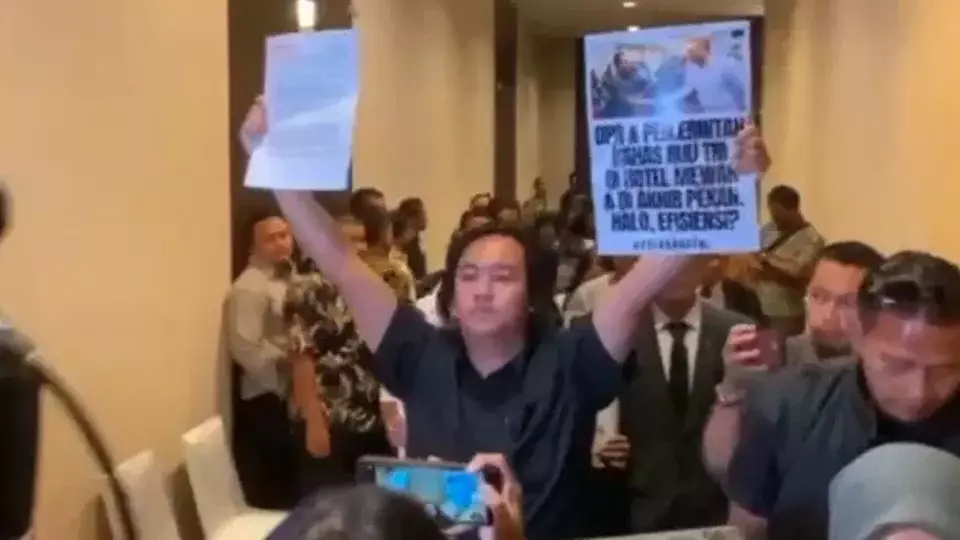
Another banner questioned the choice of a luxury hotel as the venue, highlighting the contradiction between the meeting’s exclusivity and President Prabowo Subianto’s push for austerity measures.
The meeting, which began on Friday, is expected to conclude on Sunday.
Controversial Military Law Amendment
President Prabowo, a retired army general, has requested an amendment to the existing military law to reinstate the practice of placing active-duty officers in certain civilian government positions.
As debates over the proposed amendment intensify, concerns grow that the changes could mark a significant shift in Indonesia’s democratic trajectory.
The proposal has sparked concerns over a potential return to military dominance in civilian affairs, echoing the authoritarian rule of former President Soeharto, who governed Indonesia for over three decades before his resignation in 1998 amid nationwide protests.
During Soeharto’s rule, known as the New Order Era, the military operated under the dual functions doctrine (dwi-fungsi ABRI), which allowed active military officers --primarily from the Army -- to hold key civilian roles. Military officers were appointed as governors, mayors, regents, and ministers, and even occupied executive positions in state-owned enterprises.
Additionally, the military and police were granted seats in the House of Representatives (DPR) and the People’s Consultative Assembly (MPR), cementing their influence in governance.
Soeharto’s downfall ushered in a wave of democratic reforms, leading to Indonesia’s first direct presidential election and the establishment of civilian supremacy over the military.
The current military law, enacted in 2004, reinforces these reforms by requiring military officers to retire before assuming civilian government positions.
Tags: Keywords: as a preferred
The Latest

Chandra Asri Group Receives Trade Finance Excellence Award, Reinforcing Its Role in Indonesia’s Industrial Development
Chandra Asri Group receives the Trade Finance Excellence Award at CIMB Niaga Business Summit 2026.
AEON MALL Deltamas Brings 11 Sports and Creative Competitions to AEONLYMPIC 2026
AEON MALL Deltamas hosts AEONLYMPIC 2026, featuring 11 sports and creative competitions, with more than 3,100 participants.
Indonesian Stocks Extend Losses for Third Day, Fall 3.64% to 4,996
Indonesian stocks fell 3.64% on Monday, extending losses for a third straight session amid MSCI concerns and tighter trading limits.
Prabowo Calls Meeting on Forest Fires as Haze Reaches Jakarta, Singapore
Prabowo summons senior officials to discuss forest fires as smoke reaches Jakarta and Malaysia pushes for regional action.
Jakarta Outranks Amsterdam in Global Public Transport Survey
Jakarta climbs two places to 15th in Time Out's 2026 public transport survey, with its governor citing better network integration.Most Popular
