



Prabowo’s Free Meals Cut Daily Family Costs, Limited Economic Impact: RISED
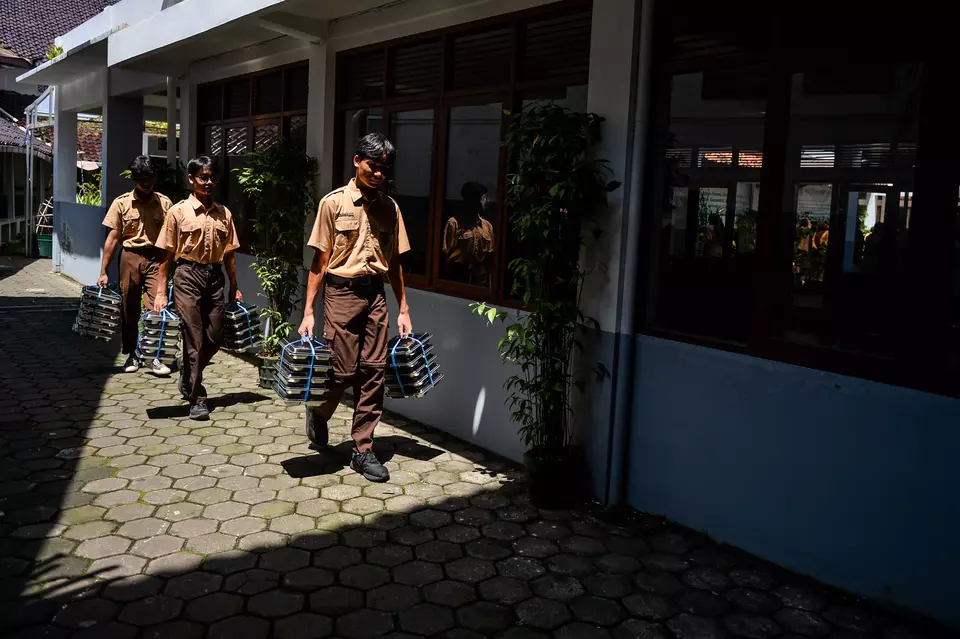
Jakarta. President Prabowo Subianto's flagship Free Nutritious Meals (MBG) program is helping stabilize household spending and improve children’s eating habits but has yet to significantly alter family economic structures, according to early findings from a new study released on Friday.
The study, which surveyed around 1,800 parents, found that 36% of households reported a decline in daily expenses after the program was introduced, mainly due to lower spending on school meals and children’s pocket money. However, 63% of respondents said the savings amounted to less than 10% of their total monthly expenditure.
“This indicates that the program helps maintain routine household spending stability, but has not yet brought meaningful structural economic change,” M. Fajar Rakhmadi, a RISED researcher, said in Jakarta. “At this stage, MBG functions more as a small consumption shock absorber than a broad-based purchasing power booster.”
The government plans to roll out the Free Nutritious Meals (MBG) program to 82.9 million people, including pregnant and breastfeeding women, children under five, and students through senior high school. Designed to curb stunting, the program could cost up to Rp350 trillion ($20.9 billion) a year. As of end-December 2025, spending on the program reached Rp51.5 trillion, or about 72.5% of its Rp71 trillion budget ceiling. The program has so far served 56.13 million beneficiaries across all 38 provinces, supported by 19,343 kitchens.
The meal budget is set at an average of Rp10,000–Rp15,000 (less than $1) per child per day, which includes Rp10,000 for food ingredients, Rp3,000 for operational costs, and Rp2,000 for partner fees.
Despite its modest economic impact, public support for the program remains strong, particularly among vulnerable households. About 81% of parents from at-risk families said they support the continuation of the program.
“Support is not driven solely by financial savings,”Fajar said. “Parents value the sense of security and certainty that their children are receiving nutritious meals at school.”
Most respondents said the program has been implemented consistently, with 84% reporting meals are provided on every school day. Still, 69% of parents said their children have been enrolled for less than six months, limiting the ability to assess longer-term outcomes.
The clearest impact so far has been on children’s eating habits. Some 72% of parents reported that their children now consume nutritious food more regularly, while 55% said their children are more receptive to a wider variety of meals.
RISED cautioned, however, that it is too early to draw conclusions about improvements in objective nutritional status, overall health, or educational performance. Medium- and long-term evaluations are needed to determine whether behavioral changes translate into sustained gains in human capital.
The institute also highlighted several policy challenges, including the need to clearly define the program’s role — whether as a social assistance scheme, a nutrition intervention, or a human capital development tool. Without clarity, success indicators and evaluation frameworks risk becoming inconsistent.
Menu quality, nutritional diversity and timely distribution must also be maintained to prevent the program’s benefits from eroding, RISED said, adding that longitudinal studies will be essential to assess long-term impacts.
Economist Fithra Faisal Hastiadi of the University of Indonesia said the findings show the program can help relieve daily spending pressure on economically vulnerable middle-class families.
“If a family has two children receiving Rp 15,000 per day over roughly 20 school days, that reduces household expenses by about Rp 600,000,” Fithra said.
He added that if the program is sustained, its impact could widen. “Over time, this can create consumer surplus for the middle class. Reduced child-related consumption costs give households more budget flexibility, which can potentially be redirected toward more productive spending, such as education and health.”
RISED positioned the study as a baseline assessment intended to strengthen evidence-based policymaking. While MBG has shown early benefits in stabilizing consumption and improving dietary habits, the institute stressed that ongoing refinement is crucial to ensure short-term gains evolve into lasting improvements in Indonesia’s human capital.
“These initial findings provide a foundation for improving program design, implementation quality and field-level monitoring,” Fajar said. “Longer evaluation periods will be critical to fully measure the program’s contribution to human capital development.”
The next challenge, RISED said, is ensuring that these early effects do not remain temporary, but instead form the basis for sustained improvements in the quality of Indonesia’s future workforce.
Tags: Keywords: as a preferred
Related Articles

Little Economic Progress, Tight Budgets Cloud Prabowo’s Second Year
UGM economists say Indonesia has seen little economic improvement under Prabowo, warning of fiscal risks in flagship programs.
'Indonesia Isn't That Rich': Economists Question Universal Free Meal Program
Economists are urging Indonesia to target free meals at those most in need, arguing a narrower program could cost less than Rp 8 trillion.
Indonesia Spends Almost $7.6 Billion on Free School Lunch
By August 31, Indonesia spent around Rp 134.2 trillion or almost $7.6 billion to keep the program running.
BPOM’s Rp 1.2 Trillion MBG Budget Request Cut to Rp 509 Billion
BPOM will rely on random food sample testing to monitor the MBG program in 2027 after lawmakers cut its Rp 1.2 trillion budget request.
MBG Food Poisoning in Pati: 416 Affected, 63 Hospitalized
Food poisoning symptoms affect 416 MBG recipients in Pati, with 63 hospitalized as authorities investigate the cause.
256 Students Affected by Suspected Free Meal Poisoning
Several Karo students remain under treatment weeks after 256 students fell ill in a suspected free nutritious meal poisoning incident.
Widespread Food Poisoning Cases Hit Indonesia’s Free Meals Program
Hundreds of schoolchildren across Indonesia have fallen ill after consuming meals from the government’s Free Nutritious Meals (MBG) program.
567 Students Fall Ill in Suspected MBG Food Poisoning Case in E. Java
At least 567 students in Sidoarjo have received medical treatment after suspected food poisoning linked to the MBG meal program.
Free Meal Program Gets Lion’s Share of BGN’s $13.6 Billion 2027 Budget
Indonesia’s Nutrition Agency gets Rp 240 trillion for 2027, with 97% earmarked for the government’s free nutritious meal program.
Nutrition Agency Chief Threatens Dismissal for MBG Program SOP Violations
Indonesia’s nutrition agency chief threatens dismissals over violations in Prabowo’s flagship free meal program.The Latest

Prabowo Calls Meeting on Forest Fires as Haze Reaches Jakarta, Singapore
Prabowo summons senior officials to discuss forest fires as smoke reaches Jakarta and Malaysia pushes for regional action.
Jakarta Outranks Amsterdam in Global Public Transport Survey
Jakarta climbs two places to 15th in Time Out's 2026 public transport survey, with its governor citing better network integration.
MSCI Concerns, Tighter IDX Trading Rules Send Indonesian Stocks Down 5% by Midday
Indonesian stocks plunge 5% by midday as MSCI concerns weigh on sentiment and the IDX tightens its daily downside limit to 7%.
Jakarta Prepares 367 Health Facilities as Haze Reaches the Capital
Jakarta prepares 367 health facilities to treat potential haze-related illnesses after smoke from Sumatra and Kalimantan crosses the region.
Jakarta Expands Flood Prevention With New Water Storage Ponds
Jakarta opens two East Jakarta water storage ponds as it expands flood prevention efforts through reservoirs and river normalization.Most Popular
