



China and Philippines Hold Talks after Chaotic Confrontation in Disputed South China Sea
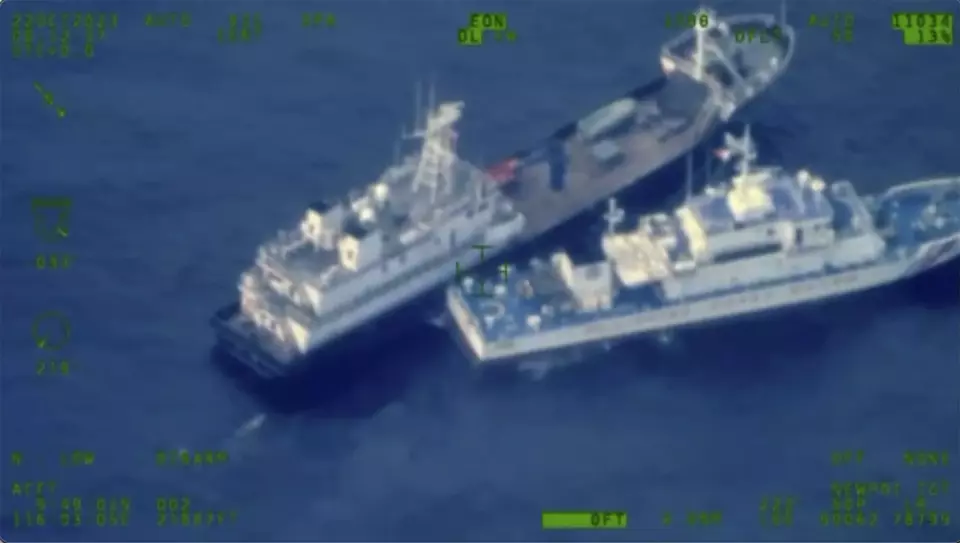
Manila. China and the Philippines held a crucial meeting Tuesday to try to ease escalating tensions following their worst confrontation in the disputed South China Sea that sparked fears of a wider conflict that could involve Manila’s ally the United States.
There was no mention of any major agreement to try to prevent a repeat of the chaotic June 17 clash at Second Thomas Shoal that caused injuries to Filipino navy personnel and damaged two military boats.
The shoal off the northwestern Philippines has emerged as the most dangerous flashpoint in the disputed waters, which China claims virtually in its entirety. Chinese naval and civilian vessels have surrounded the Philippine marines aboard a grounded ship, tried to prevent their resupply and demanded the Philippines pull out.
The Chinese and Philippine delegations “affirmed their commitment to de-escalate tensions without prejudice to their respective positions,” the Department of Foreign Affairs in Manila said in a statement late Tuesday. “There was substantial progress on developing measures to manage the situation at sea, but significant differences remain."
Philippine Foreign Undersecretary Theresa Lazaro told her Chinese counterpart, Vice Foreign Minister Chen Xiaodong, “that the Philippines will be relentless in protecting its interests and upholding its sovereignty, sovereign rights, and jurisdiction” in the South China Sea, according to the Philippine side.
An agreement was signed to improve communications during emergencies at sea and both sides agreed to continue talks on enhancing ties between their coast guards but no details were provided. There was also another confidence-building plan to convene an academic forum among scientists and academics to improve marine scientific cooperation.
Ahead of the meeting, the Philippines planned to formally ask China's delegation to return at least seven rifles that Chinese coast guard personnel seized during the June 17 faceoff at the shoal and pay for damage, a Philippine official told The Associated Press on condition of anonymity for lack of authority to discuss the sensitive matter publicly.
The Asian neighbors agreed to hold what they call the Bicameral Consultative Mechanism meetings, first held in 2017, to peacefully manage their conflicts. But the high-sea confrontations have persisted especially under President Ferdinand Marcos Jr., who, unlike his predecessor, has nurtured closer military and defense ties with the United States as a counterweight to China.
Apart from the Philippines and China, Vietnam, Malaysia, Taiwan and Brunei also lay overlapping claims to the strategic sea, which has rich fishing areas and potentially more deposits of gas than what has been found mostly in the fringes by a few coastal states so far.
Sporadic confrontations have flared between Chinese forces and those of Vietnam, Malaysia, and Indonesia in the past but the Southeast Asian nations have resisted aggressively confronting China for fear of destabilizing their substantial economic ties.
Under Marcos, who took office in 2022, the Philippines launched a campaign to expose aggressive Chinese actions by making public videos and photographs and allowing journalists to join coast guard patrol ships, which have figured in dangerous faceoffs with Beijing’s forces.
The US has no claims to the contested waters, but it has deployed warships and fighter jets for patrols that it says aim to ensure freedom of navigation and overflight and to reassure allies like the Philippines and Japan, which also has territorial disputes with China over islands in the East China Sea.
After last month’s confrontation in Second Thomas Shoal, where Chinese forces were caught on video brandishing machetes, an axe and improvised spears, Washington renewed a warning that it’s obligated to help defend the Philippines under the 1951 Mutual Defense Treaty if Filipino forces, including the coast guard, come under an armed attack, including in the South China Sea.
Marcos said the Chinese actions would not activate the treaty because no shots were fired.
Tags: Keywords: as a preferred
Related Articles

ASEAN Won’t Launch a ‘Bad’ South China Sea Code, Philippines Says
ASEAN chair Philippines doubts Beijing and the group will launch a poorly made code of conduct on the disputed South China Sea.
Indonesia Wants South China Sea Code ASAP as Beijing, Manila Clash
Beijing and the Philippines are now trading accusations over a clash at the South China Sea.
Vice President Sara Duterte Impeached by Majority of Lawmakers
The House, which is dominated by President Ferdinand Marcos Jr.’s allies, voted 257-25 with nine abstentions.
ASEAN to Set Up Maritime Center to Keep South China Sea Orderly
ASEAN has not worked on the details of the maritime center, Manila says, but members have agreed that it will monitor the South China Sea.The Latest

Chandra Asri Group Receives Trade Finance Excellence Award, Reinforcing Its Role in Indonesia’s Industrial Development
Chandra Asri Group receives the Trade Finance Excellence Award at CIMB Niaga Business Summit 2026.
AEON MALL Deltamas Brings 11 Sports and Creative Competitions to AEONLYMPIC 2026
AEON MALL Deltamas hosts AEONLYMPIC 2026, featuring 11 sports and creative competitions, with more than 3,100 participants.
Indonesian Stocks Extend Losses for Third Day, Fall 3.64% to 4,996
Indonesian stocks fell 3.64% on Monday, extending losses for a third straight session amid MSCI concerns and tighter trading limits.
Prabowo Calls Meeting on Forest Fires as Haze Reaches Jakarta, Singapore
Prabowo summons senior officials to discuss forest fires as smoke reaches Jakarta and Malaysia pushes for regional action.
Jakarta Outranks Amsterdam in Global Public Transport Survey
Jakarta climbs two places to 15th in Time Out's 2026 public transport survey, with its governor citing better network integration.Most Popular
