



Change It Up: Latest Electoral System Deemed a Failure
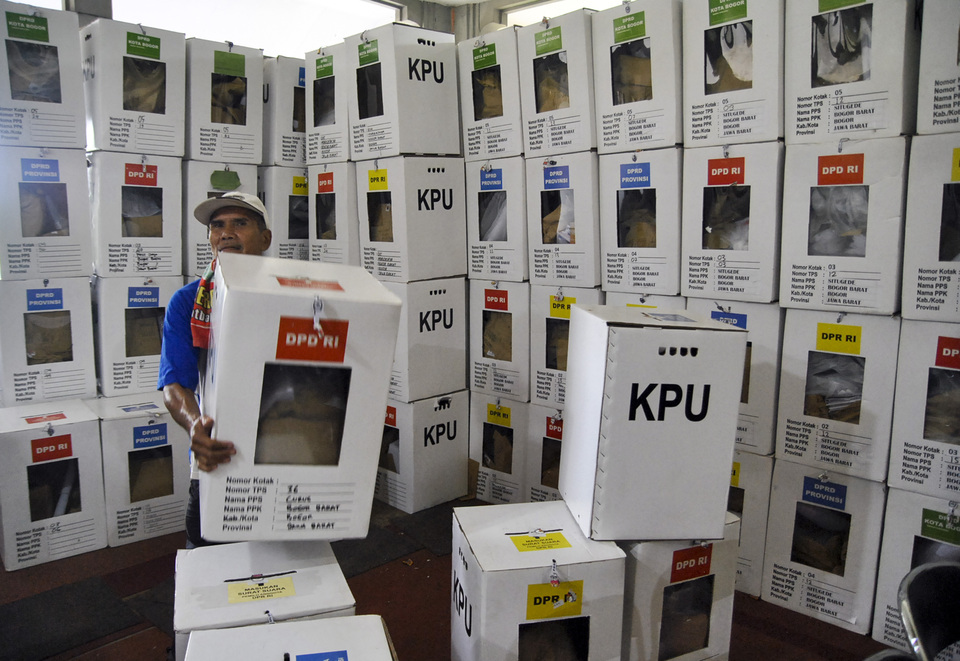
Jakarta. The latest electoral system used in Indonesia in April, in which presidential and legislative elections were held simultaneously, resulted in more downsides and might need to be adjusted, a recent study shows.
Researchers from the Indonesian Institute of Sciences (LIPI) have pointed out at least six major problems with the current electoral system.
One, during and after the last elections in April, more than 300 election officials had died from fatigue since the counting of the votes had to be done manually.
Two, the elections were also deemed overwhelming for voters as they had to cast votes on five separate ballot papers.
According to the current Election Law passed in January 2014 by the Constitutional Court (MK), presidential and legislative elections should be held on the same day.
This resulted in voters having to fill in five separate ballots, one to elect a president and vice president, one to elect members of the House of Representatives (DPR), one to elect members of the Provincial Representative Council (DPRD I), one to elect members of the Regional Representative Council (DPRD II) and another one to elect members of the Regional Legislative Council (DPD) – with the exception of voters in Jakarta who were not required to elect DPRD II members.
Three, there were massive logistical obstacles and a consistently faulty permanent voters list (DPT).
Logistics was a real struggle for reasons to do with Indonesia's geography. In some of the most remote areas in Indonesia, ballot boxes had to be delivered on foot by election officials who were forced to cross rivers and hike up hills.
Four, money politics, which could still affect election results substantially. One day before Election Day on Apr. 17, the Election Supervisory Agency (Bawaslu) announced they had uncovered 25 bribery cases related to the election in 13 provinces in Indonesia.
Five, the increasing number of elected incumbents at the House of Representatives (DPR), suspected to be the end result of years of pork barrel politics – the government spending money to benefit politicians and their constituents in return for their political support.
Lastly, political dynasties. One of the consequences of an open proportional system that allows voters to vote directly for a candidate from a party is that those who already wield a strong influence with the public are way more likely to gain votes.
Bawaslu has warned the current system can turn into the "promised land" for those who deal in money politics.
Speaking at the study's launch in Jakarta on Monday, Titi Anggraini, the executive director of the Association for Elections and Democracy (Perludem) said the current electoral system could be improved by splitting it into two elections: a national election to elect the president and vice president and members of the DPR and DPD, and a regional election to elect regional heads and members of the DPRD I and DPRD II. The two elections should be held at least two years apart.
Titi said splitting the elections would reduce the occurrence of the six problems outlined above and force political parties to work harder since there would only be a short break between the two elections.
Tags: Keywords: as a preferred
Related Articles

Indonesia Debates How Presidential Candidates Should Be Nominated in 2029
The Constitutional Court has abolished the country's longstanding presidential nomination threshold, leaving lawmakers to devise new rules.
Prabowo, Coalition Parties Agree on 5% Parliamentary Threshold for 2029 Election
Prabowo and coalition parties agree to raise Indonesia’s parliamentary threshold to 5% ahead of the 2029 election.The Latest

UN Boss Wants to Fix Security Council as Indonesia Seeks Seat
Outgoing UN chief Guterres says the current permanent member setup at the Security Council fails to reflect today's realities.
Saudi Flagship Investment Conference Pushed to 2027 after Houthi Attacks
The annual Future Investment Initiative (FII), often dubbed "Davos in the Desert", was originally scheduled to take place from October 26-29
Government Sets Aside Rp 1.3 Quadrillion for Final-Quarter Spending
Government spending has reached Rp 2.66 quadrillion, equivalent to 69.2% of the full-year budget target of Rp 3.84 quadrillion.
Indonesia Probes 98 Corporate Wildfire Cases, Including Possible Foreign Links
Police investigate 98 corporate-related wildfire cases, including possible links to investors from neighboring countries.
Students Plan Jakarta Protests to Mark Two Years of Prabowo's Presidency
Police have advised the public to avoid areas around the House of Representatives complex, the National Monument and the State Palace.Most Popular
