



Trump Says 25% Tariffs on Mexico And Canada Start Tuesday With 'No Room' For Delay
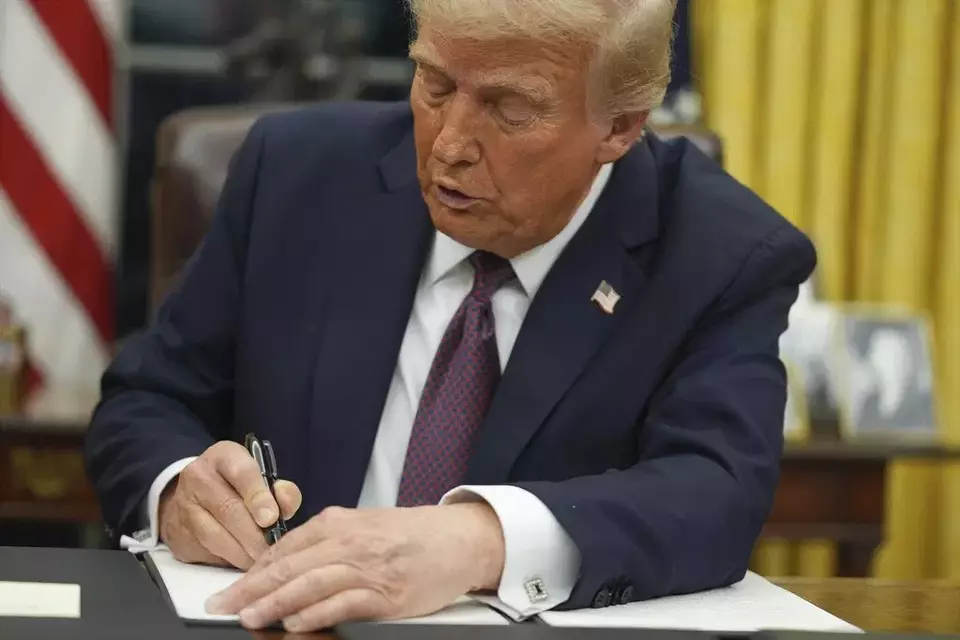
Washington. US President Donald Trump said Monday that 25 percent taxes on imports from Mexico and Canada would start Tuesday, sparking renewed fears of a North American trade war that already showed signs of pushing up inflation and hindering growth.
“Tomorrow -- tariffs 25 percent on Canada and 25 percent on Mexico. And that’ll start,” Trump told reporters in the Roosevelt Room. “They’re going to have to have a tariff.”
Trump has said the tariffs are to force the two US neighbors to step up their fight against fentanyl trafficking and stop illegal immigration. But Trump has also indicated that he wants to even the trade imbalance between both countries as well and push more factories to relocate to the United States.
His comments quickly rattled the US stock market, with the S&P 500 index down 2 percent in Monday afternoon trading. It's a sign of the political and economic risks that Trump feels compelled to take, given the possibility of higher inflation and the possible demise of a decades-long trade partnership with Mexico and Canada.
Yet the Trump administration remains confident that tariffs are the best choice to boost US manufacturing and attract foreign investment. Before Trump's statement on tariffs in response to a question on Tuesday, Commerce Secretary Howard Lutnick said that the computer chipmaker TSMC had expanded its investment in the United States because of the possibility of separate 25 percent tariffs.
In February, Trump put a 10 percent tariff on imports from China and reemphasized on Monday that the rate would be doubling to 20 percent on Tuesday.
Trump provided a one-month delay in February as both Mexico and Canada promised concessions. But Trump said Monday that there was “no room left for Mexico or for Canada” to avoid the steep new tariffs, which were also set to tax Canadian energy products such as oil and electricity at a lower 10 percent rate.
“If Trump is imposing tariffs, we are ready," said Canadian Foreign Minister Mélanie Joly. "We are ready with $155 billion worth of tariffs and we’re ready with the first tranche of tariffs, which is $30 billion.”
Joly said Canada has a very strong border plan and explained that to Trump administration officials last week. She said the diplomatic efforts are continuing. She spoke after Trump made his comments Tuesday.
Mexico President Claudia Sheinbaum went into Monday waiting to see what Trump would say.
“It’s a decision that depends on the United States government, on the United States president,” Sheinbaum said ahead of Trump's statement. “So whatever his decision is, we will make our decisions and there is a plan, there is unity in Mexico.”
Both countries have tried to show action in response to Trump's concerns. Mexico sent 10,000 National Guard troops to their shared border to crack down on drug trafficking and illegal immigration. Canada named a fentanyl czar, even though smuggling of the drug from Canada into the United States appears to be relatively modest.
As late as Sunday, it remained unclear what choice Trump would make on tariff rates. Lutnick told Fox News Channel’s “Sunday Morning Futures” that the decision was “fluid.”
“He’s sort of thinking about right now how exactly he wants to play it with Mexico and Canada,” Lutnick said. “And that is a fluid situation. There are going to be tariffs on Tuesday on Mexico and Canada. Exactly what they are, we’re going to leave that for the president and his team to negotiate.”
Treasury Secretary Scott Bessent said Mexico has also offered to place 20 percent taxes on all imports from China as part of talks with the United States.
Bessent told CBS News on Sunday that China would “eat” the cost of the tariffs, instead of passing them along to the US businesses and consumers that import their products in the form of higher prices.
But companies ranging from Ford to Walmart have warned about the negative impact that tariffs could create for their businesses. Similarly, multiple analyses by the Peterson Institute for International Economics and the Yale University Budget Lab suggest that an average family could face price increases of more than $1,000.
Trump also plans to roll out what he calls “reciprocal” tariffs in April that would match the rate charged by other countries, including any subsidies and value-added taxes charged by those countries.
The US president has already announced the removal of exemptions from his 2018 tariffs on steel and aluminum, in addition to tariffs on autos, computer chips, copper and pharmaceutical drugs.
Tags: Keywords: as a preferred
Related Articles

Trump Orders Lake Ontario to Be Renamed 'Lake America'
The name change mirrors Trump's unilateral alteration of the name of the Gulf of Mexico to the Gulf of America in January 2025.
Canada Unveils Counter-Tariffs of 15-50% on US Goods
Canadian officials said that the retaliatory tariffs match US levels, with impacts on industries including steel, dairy and electronics.
Canada to Unveil Response to Trump's Steep Tariffs
In an earlier phase of the dispute, Ontario imposed a temporary 25% surcharge on electricity exports to three US states.
Trump Says to Double Tariffs on Canadian Autos as Trade Fight Heats Up
The US had alleged "discriminatory treatment" by Canada against US alcohol, automobile and dairy products in rolling out the 50% tariffs.
US, Canada Resume Talks to Finalize Trade Deal as Details Emerge
A new spate of 50% US tariffs was set to take effect on Canadian imports on Wednesday, but Trump said he was delaying enactment.The Latest

Chandra Asri Group Receives Trade Finance Excellence Award, Reinforcing Its Role in Indonesia’s Industrial Development
Chandra Asri Group receives the Trade Finance Excellence Award at CIMB Niaga Business Summit 2026.
AEON MALL Deltamas Brings 11 Sports and Creative Competitions to AEONLYMPIC 2026
AEON MALL Deltamas hosts AEONLYMPIC 2026, featuring 11 sports and creative competitions, with more than 3,100 participants.
Indonesian Stocks Extend Losses for Third Day, Fall 3.64% to 4,996
Indonesian stocks fell 3.64% on Monday, extending losses for a third straight session amid MSCI concerns and tighter trading limits.
Prabowo Calls Meeting on Forest Fires as Haze Reaches Jakarta, Singapore
Prabowo summons senior officials to discuss forest fires as smoke reaches Jakarta and Malaysia pushes for regional action.
Jakarta Outranks Amsterdam in Global Public Transport Survey
Jakarta climbs two places to 15th in Time Out's 2026 public transport survey, with its governor citing better network integration.Most Popular
