



Middle-Class Struggles in Indonesia Highlight the Need for Enhanced Social Support: Economists
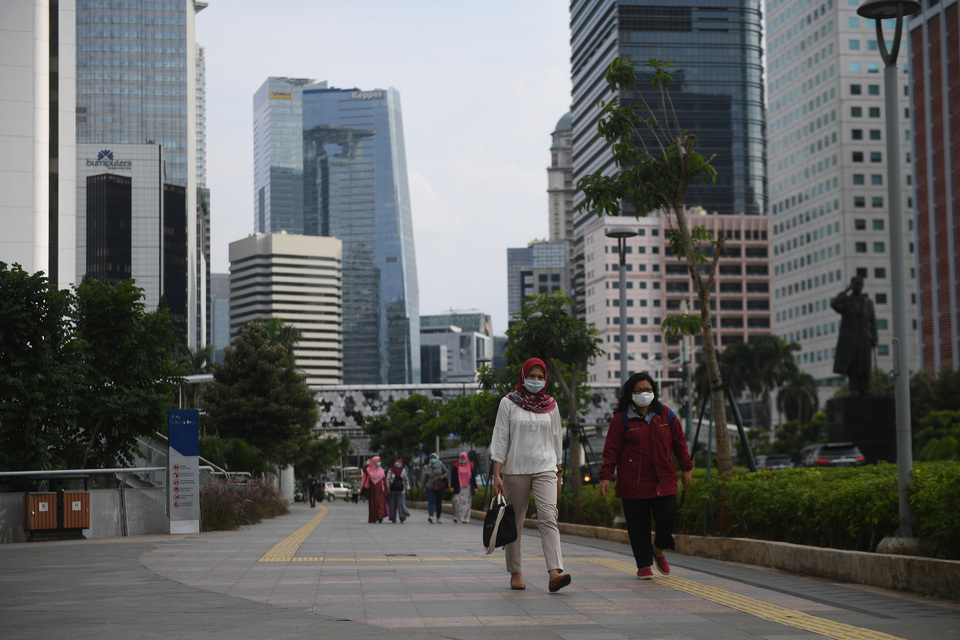
Jakarta. Economists advocate for targeted social support and policy interventions to alleviate the financial vulnerability challenges faced by the middle class, a group that lacks the same social assistance as the poor and struggles with insufficient financial resources for stability.
Tauhid Ahmad, the Executive Director of the Institute for Development of Economics and Finance (Indef), has shed light on the limited social guarantees and protection for Indonesia's middle-income population.
According to Tauhid, financially, Indonesia is not yet capable of providing comprehensive support to meet the needs of the middle class. He acknowledges that while the middle-income population in Indonesia is not vast, it is still substantial enough to warrant attention.
"For a developing country like ours, allocating social assistance for the middle class is not fiscally sustainable. Providing such social aid could erode the state's finances," explained Tauhid in an interview with Beritasatu.com on Tuesday (3/5/2024).
Tauhid suggests that the government should focus on different approaches to address the plight of the middle class. He proposes solutions such as emulating advanced nations by offering support like education subsidies from elementary school to university.
"For instance, state universities could consider exempting tuition fees, which would then be covered by the government. This can help the middle class alleviate their cost of living," Tauhid suggested.
However, he emphasizes the importance of targeted assistance, particularly for middle-income individuals employed in the formal sector, such as those with temporary contracts or freelance positions.
Looking ahead, Tauhid recommends instilling an entrepreneurial spirit in students from primary school to university to enable the middle class to explore both formal and informal sectors, making them more resilient to economic shocks such as layoffs.
In addition, Tauhid stresses the significance of reducing the cost of living for the middle class, including efforts to curb the rise in food prices and inflation, preventing them from falling into poverty.
Nailul Huda, the Director of the Digital Economy Center of Economic and Law Studies (CELIOS), suggests that incentives for the middle class could be allocated through value-added tax (VAT), given their consumption patterns.
"The middle class is consumptive and contributes to state revenue through VAT and income tax. This is where we hope to derive funding for incentives for the middle class," stated Huda on Tuesday.
Huda also proposes incentives in the form of a reduction in taxable income thresholds, enabling middle-class workers to pay less in taxes.
While acknowledging existing government programs, Huda notes that current incentives and social programs primarily focus on the lower-income strata. The middle class in Indonesia often finds themselves financially vulnerable, lacking the social assistance received by the poor while not possessing sufficient wealth for financial security.
"They are caught in a situation where their income does not match the ever-increasing cost of living," expressed Huda.
This predicament leads to prolonged financial pressure, as the middle class continues to struggle to meet daily needs without adequate financial reserves for emergencies or stable financial planning for the future.
Muhammad Chatib Basri, former Finance Minister, highlighted the "Chilean Paradox," a socio-economic phenomenon in Chile where there was still social unrest despite impressive economic performance and a significant reduction in poverty rates.
Chatib pointed out that while economic policies in many countries, including Indonesia, often focus on supporting the poor, the middle class is sometimes overlooked.
"Social protection instruments for the middle class need to be considered. They are not classified as poor, but economic shocks could lead them to become impoverished," stated Muhammad Chatib Basri in his opinion piece published recently.
According to World Bank Data, The middle class in Indonesia has been growing faster than other groups; there are now at least 52 million economically secure Indonesians, or one Indonesian in every five. The Indonesian middle class has been a major driver of economic growth as the group’s consumption has grown by 12 percent annually since 2002 and now represents close to half of all household consumption in Indonesia. Over the past 20 years, the majority of the poor and vulnerable have climbed out of poverty and into the aspiring middle class, where there are approximately 115 million people who belong in this category.
Tags: Keywords: as a preferred
Related Articles

Weak Institutions Keep Asia Stuck in Middle-Income Trap: ADBI Dean
Weak institutions and fragmented policymaking may be a bigger barrier to high-income status than growth itself, ADBI says.
Economic Buffer Under Pressure as Middle Class Continues to Shrink
BI’s surprise rate hike and a 32% fuel price increase are squeezing Indonesia’s middle class, raising risks of economic decline.
Kadin Warns Weak Rupiah is Squeezing Middle-Class Consumers
Indonesia’s middle class faces mounting pressure as the rupiah weakens past Rp 17,700 per dollar.The Latest

Chandra Asri Group Receives Trade Finance Excellence Award, Reinforcing Its Role in Indonesia’s Industrial Development
Chandra Asri Group receives the Trade Finance Excellence Award at CIMB Niaga Business Summit 2026.
AEON MALL Deltamas Brings 11 Sports and Creative Competitions to AEONLYMPIC 2026
AEON MALL Deltamas hosts AEONLYMPIC 2026, featuring 11 sports and creative competitions, with more than 3,100 participants.
Indonesian Stocks Extend Losses for Third Day, Fall 3.64% to 4,996
Indonesian stocks fell 3.64% on Monday, extending losses for a third straight session amid MSCI concerns and tighter trading limits.
Prabowo Calls Meeting on Forest Fires as Haze Reaches Jakarta, Singapore
Prabowo summons senior officials to discuss forest fires as smoke reaches Jakarta and Malaysia pushes for regional action.
Jakarta Outranks Amsterdam in Global Public Transport Survey
Jakarta climbs two places to 15th in Time Out's 2026 public transport survey, with its governor citing better network integration.Most Popular
