



Japan Slips into Recession and Loses Spot as World's 3rd-Largest Economy
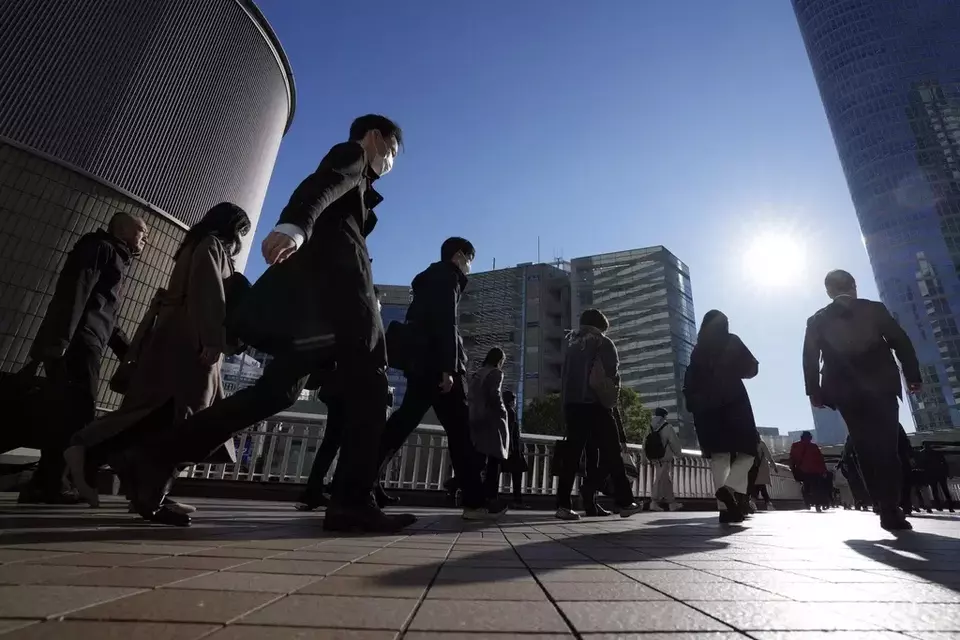
Tokyo. Japan’s economy is now the world’s fourth-largest after it contracted in the last quarter of 2023 and fell behind Germany.
The government reported the economy shrank at an annual rate of 0.4 percent in October to December, according to Cabinet Office data on real GDP released Thursday, though it grew 1.9 percent for all of 2023. It contracted 2.9 percent in July-September. Two straight quarters of contraction are considered an indicator an economy is in a technical recession.
Japan’s economy was the second largest until 2010 when it was overtaken by China’s. Japan’s nominal GDP totaled $4.2 trillion last year, while Germany’s was $4.4 trillion, or $4.5 trillion, depending on the currency conversion.
A weaker Japanese yen was a key factor in the drop to fourth place since comparisons of nominal GDP are in dollar terms. But Japan’s relative weakness also reflects a decline in its population and lagging productivity and competitiveness, economists say.
Real gross domestic product is a measure of the value of a nation’s products and services. The annual rate measures what would have happened if the quarterly rate lasted a year.
Japan was historically touted as “an economic miracle,” rising from the ashes of World War II to become the second-largest economy after the US. It kept that going through the 1970s and 1980s. But for most of the past 30 years, the economy has grown only moderately at times, mainly remaining in the doldrums after the collapse of its financial bubble began in 1990.
Both the Japanese and German economies are powered by strong small and medium-sized businesses with solid productivity.
Like Japan in the 1960s-1980s, for most of this century, Germany roared ahead, dominating global markets for high-end products like luxury cars and industrial machinery, selling so much to the rest of the world that half its economy ran on exports.
But its economy, one of the world's worst performing last year, also contracted in the last quarter, by 0.3 percent.
Britain's likewise contracted late last year. Britain reported Thursday that its economy entered a technical recession in October-December, shrinking 0.3 percent from the previous quarter. The quarterly decline followed a 0.1 percent fall in the previous three-month period.
As an island nation with relatively few foreign residents, Japan's population has been shrinking and aging for years, while Germany’s has grown to nearly 85 million, as immigration helped to make up for a low birth rate.
The latest data reflect the realities of a weakening Japan and will likely result in Japan’s commanding a lesser presence in the world, said Tetsuji Okazaki, professor of economics at the University of Tokyo.
“Several years ago, Japan boasted a powerful auto sector, for instance. But with the advent of electric vehicles, even that advantage is shaken,” he said. Many factors have yet to play out, “But when looking ahead to the next couple of decades, the outlook for Japan is dim.”
The gap between developed countries and emerging nations is shrinking, with India likely to overtake Japan in nominal GDP in a few years.
The U.S. remains the world’s largest economy by far, with a GDP of $27.94 trillion in 2023, while China's was $17.5 trillion. India's is about $3.7 trillion but growing at a sizzling rate of around 7 percent.
Immigration is one option for solving Japan's labor shortage problem, but the country has been relatively unaccepting of foreign labor, except for temporary stays, prompting criticism about discrimination and a lack of diversity.
Robotics, another option, are gradually being deployed but not to the extent they can fully make up for the lack of workers.
Another key factor behind Japan's sluggish growth is stagnating wages that have left households reluctant to spend. At the same time, businesses have been invested heavily in faster-growing economies overseas instead of in the aging and shrinking home market.
Private consumption fell for three straight quarters last year and “growth is set to remain sluggish this year as the household savings rate has turned negative,” Marcel Thieliant of Capital Economics said in a commentary. "Our forecast is that GDP growth will slow from 1.9 percent in 2023 to around 0.5 percent this year."
 as a preferred
The Latest

AEON MALL Deltamas Brings 11 Sports and Creative Competitions to AEONLYMPIC 2026
AEON MALL Deltamas hosts AEONLYMPIC 2026, featuring 11 sports and creative competitions, with more than 3,100 participants.
Indonesian Stocks Extend Losses for Third Day, Fall 3.64% to 4,996
Indonesian stocks fell 3.64% on Monday, extending losses for a third straight session amid MSCI concerns and tighter trading limits.
Prabowo Calls Meeting on Forest Fires as Haze Reaches Jakarta, Singapore
Prabowo summons senior officials to discuss forest fires as smoke reaches Jakarta and Malaysia pushes for regional action.
Jakarta Outranks Amsterdam in Global Public Transport Survey
Jakarta climbs two places to 15th in Time Out's 2026 public transport survey, with its governor citing better network integration.
MSCI Concerns, Tighter IDX Trading Rules Send Indonesian Stocks Down 5% by Midday
Indonesian stocks plunge 5% by midday as MSCI concerns weigh on sentiment and the IDX tightens its daily downside limit to 7%.Most Popular
