



Government’s Playbook for Expensive Oil: Biofuels, Strategic Reserves, and Budget Discipline

Jakarta. Indonesia is responding to rising global oil prices by maintaining fiscal discipline while accelerating efforts to reduce reliance on imported fuel, including expanding biofuel blending, boosting renewable energy development, and building strategic crude reserves to strengthen energy security.
Oil prices have surged in recent weeks as US-Israeli strikes on Iran rattled global energy markets. Crude briefly climbed to $120 per barrel after Iran blocked the Strait of Hormuz — a critical shipping corridor that carries roughly 20% of the world’s oil supply, or about 20 million barrels a day.
Indonesia’s immediate response has been fiscal caution. The Finance Ministry said the Indonesia Crude Price (ICP), the country’s oil benchmark, averaged $68.4 per barrel through March 11, still below the $70 assumption used in the 2026 state budget.
“The year-to-date average already factors in spikes up to $112 per barrel. It remains below our budget assumptions,” Finance Minister Purbaya Yudhi Sadewa said in Jakarta.
For now, the government sees no need to revise the budget. But officials acknowledge that prolonged price spikes could strain public finances, particularly through higher fuel subsidy spending. Finance Ministry simulations suggest the fiscal deficit could widen to 3.6% of gross domestic product if oil prices average $92 per barrel this year, breaching the government’s 3% deficit ceiling unless policy adjustments are made.
Raising subsidized fuel prices remains a last resort. Authorities are monitoring market developments while maintaining key spending commitments, including the flagship Free Nutritious Meals program, which has been allocated Rp 335 trillion ($19.7 billion) this year.
Fabby Tumiwa, executive director of the Institute for Essential Services Reform (IESR), said Indonesia may need tighter controls on domestic fuel consumption to limit pressure on the state budget.
“The government needs to rationalize the distribution of subsidized fuels such as diesel and Pertalite through stricter quota systems,” Fabby said. “Adjusting energy prices to reflect economic costs may become unavoidable to preserve fiscal space.”
Push for Energy Self-Sufficiency
At the same time, President Prabowo Subianto has set an ambitious goal for Indonesia to achieve energy self-sufficiency within four years by accelerating renewable energy deployment and developing domestic fuel alternatives.
“With the resources we have, we are confident we can overcome these challenges,” Prabowo said.

Indonesia is expanding biofuel production using feedstocks such as palm oil, cassava, corn, and sugarcane. Energy and Mineral Resources Minister Bahlil Lahadalia said the government plans to accelerate ethanol blending in gasoline.
“If fossil fuel prices exceed $100 per barrel, blending becomes more economical,” Bahlil said.
The government is also seeking to unlock Indonesia’s vast geothermal potential — among the largest in the world — while rapidly scaling up solar power capacity.
In parallel, Jakarta is strengthening energy security by expanding oil storage capacity. Indonesia currently holds reserves equivalent to only about 25 days of consumption. A planned large-scale storage facility aims to raise that buffer to roughly three months of supply, allowing the country to better withstand global disruptions.
“The president has directed us to immediately build the storage facility. We need this for survival; otherwise we will continue to depend heavily on oil imports,” Bahlil said.
He added that the government is preparing to shift about 25% of Indonesia’s crude imports from the Middle East to the United States.
“Why the United States? Because they have the available volume we can secure,” Bahlil said. “The distance is longer, but we can place long-term orders early so the logistics and supply chain can be arranged in advance.”
Fiscal Risks and Political Calculations
Economists warn that sustained high oil prices could eventually force difficult fiscal trade-offs.
Wijayanto Samirin, a senior economist at Paramadina University, said the government may need to reconsider spending priorities if fiscal pressures intensify.
“At this moment, there may be no option but to temporarily cut the free nutritious meal budget and restore it once fiscal conditions allow,” he said.
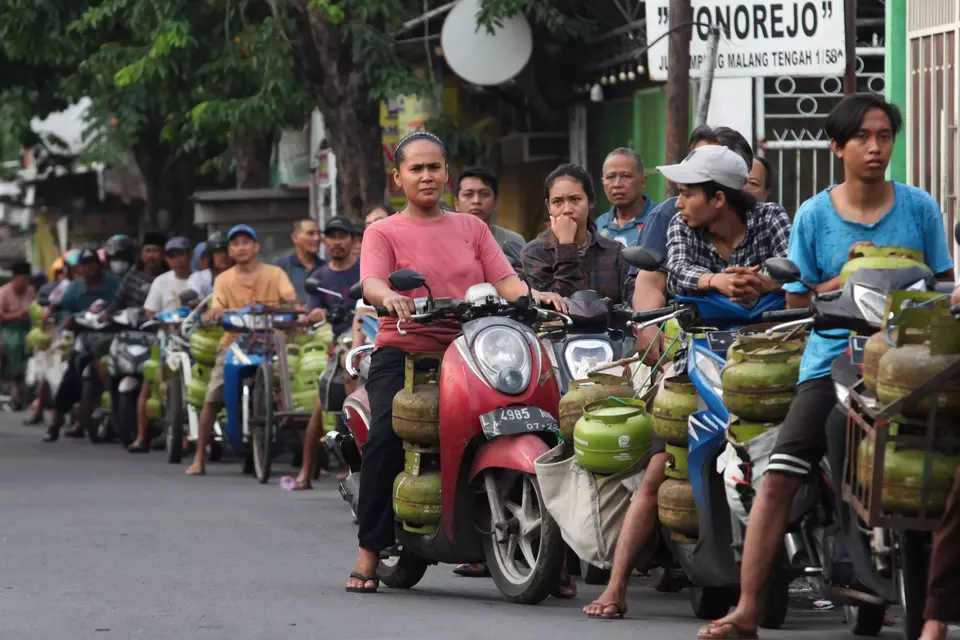
Meanwhile, political considerations may also shape policy choices. Agung Baskoro, a political analyst at Trias Politika Strategis, said the government is unlikely to raise subsidized fuel prices ahead of the Eid holiday, when household spending and travel typically surge.
“Not raising prices of subsidized fuel can help ease the decline in public satisfaction with the government’s economic policies and maintain Prabowo’s electability,” Agung said.
If the government is ultimately forced to choose between cutting populist spending and raising fuel prices, he added, trimming the free-meal program may prove politically less costly.
Tags: Keywords: as a preferred
Related Articles

‘It’s Trump Who Sets Oil Price’: Prabowo’s Brother
Neither the Indonesian government nor OPEC sets the oil price, Hashim Djojohadikusumo says.
Singapore Works with Indonesia to Keep Malacca Strait Open
Singapore says it is also working with other users of the Strait of Malacca to keep the waterway "open, secure, and accessible".
Iran Stands Firm on Hormuz Plan after US Rejection
Tehran demands the release of frozen Iranian assets, the lifting of sanctions on Iranian oil and an end to the US naval blockade.
Trump Rejects Iran Proposal for Deal to Reopen Hormuz
"They want to make a deal where they open the Strait immediately because they're losing so badly," said Trump.
Masoud Tells Trump that Iran Will Never 'Bend at the Knee'
Pezeshkian accused Washington of "terrorism" for assassinating former supreme leader Ayatollah Ali Khamenei at the start of the conflict.
Suahasil Inherits Fiscal Credibility Test as Investor Confidence Wavers
Suahasil Nazara faces pressure to restore fiscal credibility as investors seek consistent policies, clearer signals and market confidence.
Indonesia’s Tax Chief Flags Irregularities in Purbaya’s Staff Reshuffle
Indonesia’s tax chief flags irregularities in Purbaya’s staff reshuffle over merit-based appointments.
US Investors Not Worried by Indonesia’s Finance Minister Switch
US-ASEAN Business Council says that American investors are more concerned about the policy changes rather than who is helming the ministry.
Suahasil’s Return Puts Fiscal Discipline at Center of Prabowo’s Economic Policy
Suahasil Nazara takes over as finance minister, with policy consistency and fiscal discipline emerging as key challenges.
Suahasil Told to Avoid Business Cost Hikes, Tax Refund Delays
Businesses have laid out their wishlist for the newly appointed Finance Minister Suahasil Nazara.The Latest

Chandra Asri Group Receives Trade Finance Excellence Award, Reinforcing Its Role in Indonesia’s Industrial Development
Chandra Asri Group receives the Trade Finance Excellence Award at CIMB Niaga Business Summit 2026.
AEON MALL Deltamas Brings 11 Sports and Creative Competitions to AEONLYMPIC 2026
AEON MALL Deltamas hosts AEONLYMPIC 2026, featuring 11 sports and creative competitions, with more than 3,100 participants.
Indonesian Stocks Extend Losses for Third Day, Fall 3.64% to 4,996
Indonesian stocks fell 3.64% on Monday, extending losses for a third straight session amid MSCI concerns and tighter trading limits.
Prabowo Calls Meeting on Forest Fires as Haze Reaches Jakarta, Singapore
Prabowo summons senior officials to discuss forest fires as smoke reaches Jakarta and Malaysia pushes for regional action.
Jakarta Outranks Amsterdam in Global Public Transport Survey
Jakarta climbs two places to 15th in Time Out's 2026 public transport survey, with its governor citing better network integration.Most Popular
