



Indonesia’s Internet Users More than Double Over Past Decade

Jakarta. More Indonesians are now connected to the internet as the country's outgoing leader Joko "Jokowi" Widodo pushed for better connectivity over the past decade.
Internet connectivity offers people countless possibilities. Not only can they interact with one another remotely, the internet enables people to access remote learning. Indonesia’s micro, small and medium enterprises -- the country’s economic backbone -- can also promote their products online, thus letting them sell their goods to other parts of the archipelago.
Jokowi first assumed office in 2014. According to a survey by the internet providers association APJII and think-tank Puskakom UI, Indonesia was home to 88.1 million internet users at the time. Fast forward to 2024, APJII reported that the country had nearly 221.6 million internet users. This means that the internet penetration rate has reached 79.5 percent. It also shows that the number of internet users had more than doubled during Jokowi’s decade-long presidency.
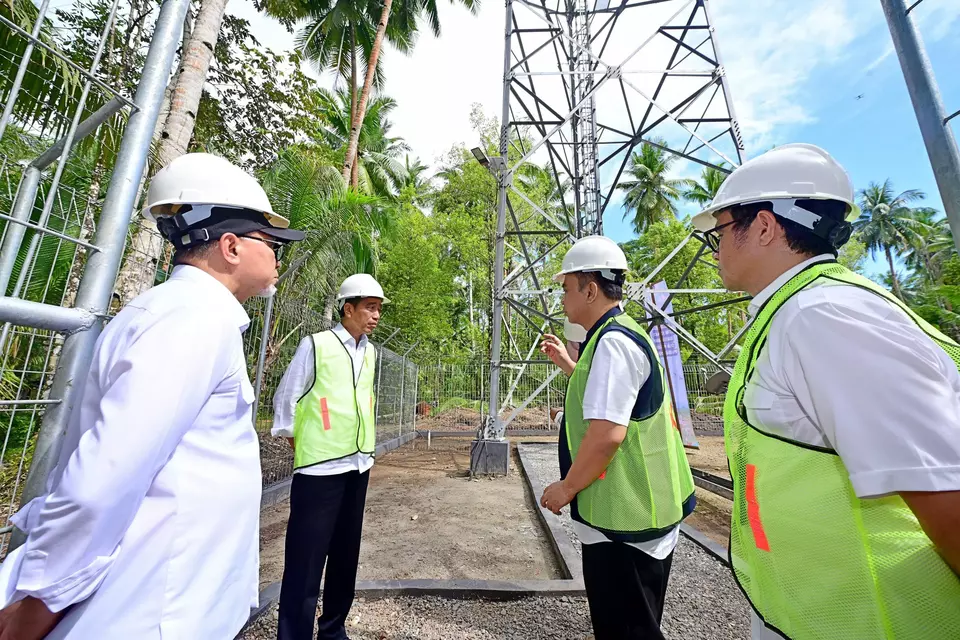
Over the years, the government has made efforts to get more people connected to the internet. This includes constructing around 7,000 base transceiver stations to deliver 4G technology to remote areas. Indonesia has also launched the Satria-1 satellite to provide internet access to approximately 50,000 public institutions. Not to mention the Palapa Ring project, which sees the development of the national fiber optic backbone network that can even facilitate the networks in Indonesia’s most outlying regions, according to Deputy Communications Minister Nezar Patria.
“The rate of internet penetration has soared from 34 percent of the population in 2014 to 79 percent today. When measured by inhabited regions, the coverage has already reached 97 percent nationwide,” Nezar said at the BNI Investor Daily Summit in Jakarta, earlier this month.
Amidst the growing netizen population, Indonesia is heading to become a digital economy giant, according to Jokowi, who will retire this weekend. Indonesia’s digital economy is forecast to grow fourfold to $360 billion by 2030. Digital payment transactions are expected to jump more than twofold.
“Digital payments will grow 2.5 times and reach $760 billion in 2030. … Indonesia has 354 million units of active mobile phones, far exceeding our population size of 287 million people. So the average Indonesian can have more than one mobile phone,” Jokowi said back in August.
The Indonesian startup ecosystem is also thriving. The government revealed that Indonesia hosted about 2,562 active startups as of September. This includes 2 of the so-called “decacorns” and 13 “unicorn”-level startups. For reference, decacorns refer to start-ups whose value exceeds $10 billion. Unicorns are private start-ups whose valuations already reach $1 billion.
Tags: Keywords: as a preferred
Related Articles

Indonesia Ramps Up Digital Economy Push
Indonesia continues its push to grow its digital economy and financial technologies.
Shopee's Courier Algorithm Still Raises Competition Concerns in Indonesia
Indonesia's antitrust regulator says Shopee's courier algorithm still favors SPX despite reforms aimed at restoring competition.
Indonesia Collects $3.05 Billion in Digital Economy Taxes Through June
Indonesia collected Rp 54.7 trillion in digital economy taxes through June, led by Rp 42.01 trillion in VAT on e-commerce.
Indonesia Targets 100 Mbps Nationwide Internet Speed Within Two Years
Indonesia aims to raise nationwide internet speeds to 100 Mbps within two years through broadband expansion and digital investment.
Indonesia Data Center Boom Draws Fresh $500 Million Investment
Indonesia's data center industry attracts fresh investment as AI and cloud demand drive rapid expansion across Greater Jakarta.
China Products, Rising Fees Hit Indonesian Online Sellers
Indonesian MSMEs face shrinking margins as rising marketplace fees collide with a flood of low-cost Chinese products.
Rising Seller Fees Mark New Phase for Indonesia’s E-Commerce Industry
Indonesian online sellers are reassessing marketplace dependence as rising platform fees pressure margins.The Latest

AEON MALL Deltamas Brings 11 Sports and Creative Competitions to AEONLYMPIC 2026
AEON MALL Deltamas hosts AEONLYMPIC 2026, featuring 11 sports and creative competitions, with more than 3,100 participants.
Indonesian Stocks Extend Losses for Third Day, Fall 3.64% to 4,996
Indonesian stocks fell 3.64% on Monday, extending losses for a third straight session amid MSCI concerns and tighter trading limits.
Prabowo Calls Meeting on Forest Fires as Haze Reaches Jakarta, Singapore
Prabowo summons senior officials to discuss forest fires as smoke reaches Jakarta and Malaysia pushes for regional action.
Jakarta Outranks Amsterdam in Global Public Transport Survey
Jakarta climbs two places to 15th in Time Out's 2026 public transport survey, with its governor citing better network integration.
MSCI Concerns, Tighter IDX Trading Rules Send Indonesian Stocks Down 5% by Midday
Indonesian stocks plunge 5% by midday as MSCI concerns weigh on sentiment and the IDX tightens its daily downside limit to 7%.Most Popular
