



Sustainable Business Innovation Helps Indonesia Achieve NDC Climate Targets
Jakarta. The private sector plays a strategic role in accelerating the achievement of Indonesia's Nationally Determined Contribution (NDC) targets to reduce carbon emissions through the implementation of sustainable business practices with a focus on innovation.
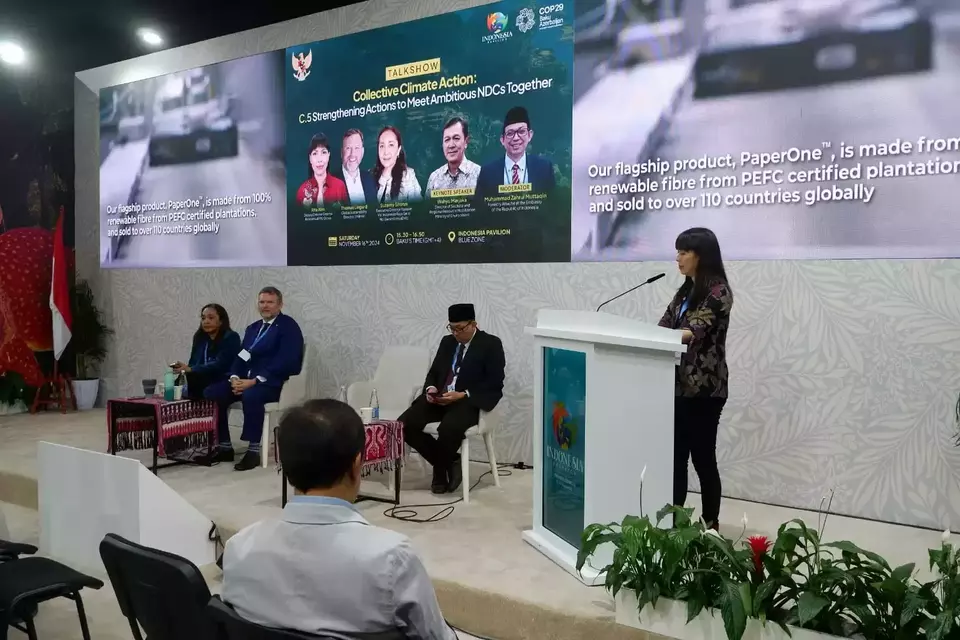
This topic was discussed at the COP29 UNFCCC Climate Change Conference held in Baku, Azerbaijan, on Nov. 16, during the session titled Collective Climate Action: Strengthening Actions to Meet Ambitious NDCs Together.
According to Wahyu Marjaka, Director of Sectoral and Regional Mobilization and Resources at the Environment and Forestry Ministry, carbon emission reduction efforts must involve all parties, including the private sector, and that adaptation and innovation are needed to achieve these targets.
"Companies must adapt and implement sustainable business practices. The private sector’s ability to scale up global climate solutions, leverage capital supply chains, and develop technology makes it uniquely positioned to drive significant change," Wahyu said in his keynote speech.
Wahyu explained that Indonesia has set an ambitious target for reducing greenhouse gas (GHG) emissions—31.89 percent domestically and up to 43.2 percent with international support. Indonesia also plans to submit its second NDC to the UNFCCC by the end of 2024, which will include commitments to limit global average temperature rise to 1.5 degrees Celsius and achieve net-zero emissions by 2060. This target will also cover new sectors, including the maritime and upstream oil and gas sectors.
Given the commitment to achieving both global and national climate targets, Wahyu said that the government, private sector, and philanthropy must align their actions, mobilize resources, and create partnerships to meet these targets.
"When businesses align with the Paris Agreement, they not only drive innovation but also create demand for clean technologies," Wahyu said.
The role of the private sector in accelerating decarbonization efforts is also reflected through various innovations applied by companies in Indonesia. One such example was shared by APRIL Group, the producer of "PaperOne" paper, during a panel at the conference.
APRIL Group introduced the concept of "Waste to Value," which aims to transform industrial waste into valuable resources, such as energy, fertilizers, and road construction materials.
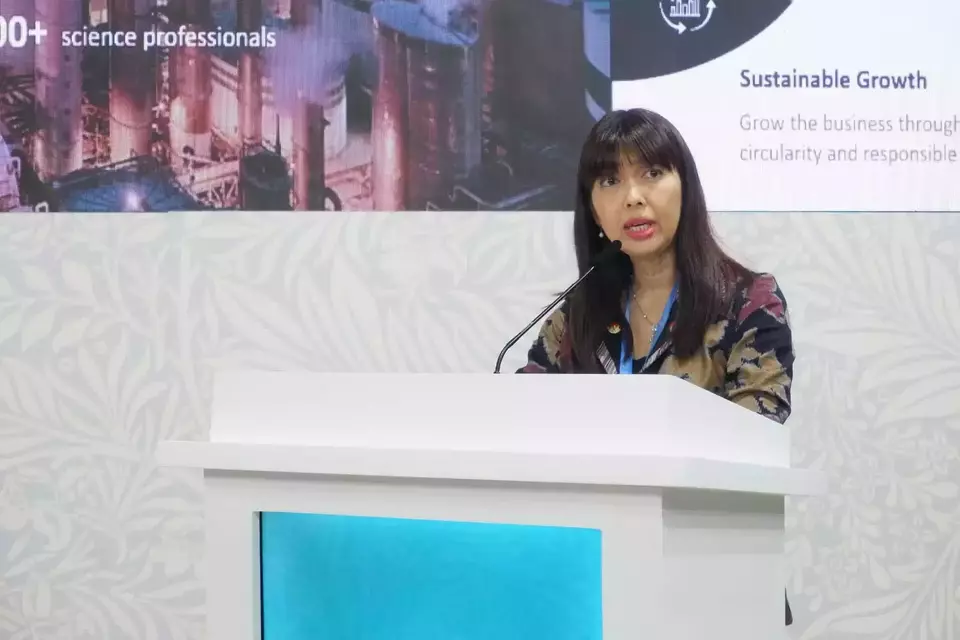
"With government approval, we are able to use sludge as fuel for production. This is our commitment to supporting sustainable waste management and reducing emissions from landfill waste," said Rita Alim, Deputy Director of External Relations at APRIL Group, during the panel.
Sludge consists of fibers and solid materials produced from wastewater treatment in the pulp and paper production process. APRIL Group utilizes this waste through its recovery boiler technology to generate energy used in the production process.
"In 2023, we reused more than 323,000 tons of non-hazardous waste, which not only reduced the waste sent to landfills but also saved operational costs," Rita added.
This initiative aligns with the company’s sustainability vision, APRIL2030, which aims to achieve a Positive Climate target by implementing science-based solutions to drastically reduce carbon emissions. Furthermore, this step supports the company’s sustainable growth targets, focusing on the application of circular business practices and responsible production.
In line with this commitment, APRIL Group continues to increase the utilization of renewable energy, one of which is biomass, largely derived from by-products and residuals generated during production activities.
"We are targeting 90 percent of our factory’s energy needs to come from renewable energy, and by 2024, we have already achieved 88 percent of this target," Rita said.
In addition to biomass, energy is also sourced from a solar power plant, with the current installed capacity of 26 MW, which will be further increased to 50 MW by 2030.
Tags: Keywords: as a preferred
The Latest

Prabowo Calls Meeting on Forest Fires as Haze Reaches Jakarta, Singapore
Prabowo summons senior officials to discuss forest fires as smoke reaches Jakarta and Malaysia pushes for regional action.
Jakarta Outranks Amsterdam in Global Public Transport Survey
Jakarta climbs two places to 15th in Time Out's 2026 public transport survey, with its governor citing better network integration.
MSCI Concerns, Tighter IDX Trading Rules Send Indonesian Stocks Down 5% by Midday
Indonesian stocks plunge 5% by midday as MSCI concerns weigh on sentiment and the IDX tightens its daily downside limit to 7%.
Jakarta Prepares 367 Health Facilities as Haze Reaches the Capital
Jakarta prepares 367 health facilities to treat potential haze-related illnesses after smoke from Sumatra and Kalimantan crosses the region.
Jakarta Expands Flood Prevention With New Water Storage Ponds
Jakarta opens two East Jakarta water storage ponds as it expands flood prevention efforts through reservoirs and river normalization.Most Popular
