



What Is a Conclave? A Step-by-Step Guide to Picking the Next Pope
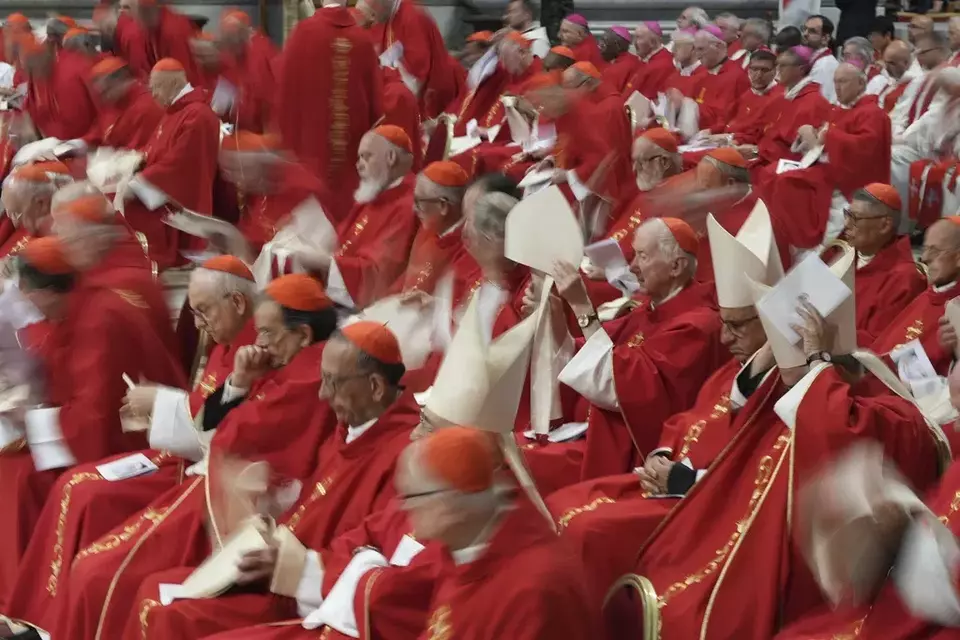
Vatican City. A conclave is the centuries-old election of a pope that derives its name from the Italian “con clave” (with a key) to underscore that cardinals are sequestered until they find a winner.
Cardinals are cut off from all outside communication once the master of liturgical ceremonies utters "Extra Omnes" -- Latin for “all out” -- clearing the Sistine Chapel of all but the cardinal-electors to begin the voting process.
During the conclave, cardinals will stay at the Domus Santa Marta hotel inside Vatican City, and possibly at another nearby Vatican residence, as the number of eligible electors exceeds the hotel’s capacity.
How Will It Work?
The conclave begins on the afternoon of May 7. The day starts with a Mass celebrated by Cardinal Giovanni Battista Re, the dean of the College of Cardinals. In the afternoon, the cardinals process into the Sistine Chapel, listen to a meditation, and take an oath.
After "Extra Omnes," voting begins. If no pope is elected in the first ballot, the cardinals adjourn for the evening and return the next day. From then on, they may vote up to four times a day, two in the morning and two in the afternoon, until a two-thirds majority is reached.
Who Can Vote?
Only cardinals under the age of 80 are eligible to vote. While official regulations cap the number of electors at 120, recent popes have exceeded that. Currently, 135 cardinals are eligible.
Cardinals over 80 cannot vote but may take part in pre-conclave meetings, known as general congregations, to discuss Church matters. It was during these meetings in 2013 that Cardinal Jorge Mario Bergoglio spoke movingly about the Church reaching the “existential peripheries,” a moment seen as pivotal in his eventual election as Pope Francis.
What’s New This Time?
The basic rules of the conclave were set out in 1996 by St. John Paul II. Pope Benedict XVI made two amendments, including eliminating the possibility of electing a pope by a simple majority after a deadlock. He decreed that a two-thirds majority must always be achieved, no matter how long it takes.
If a conclave lasts 12 days without a result, the top two vote-getters enter a runoff, but still require a two-thirds majority. These two candidates are not allowed to vote in the runoff.
Pope Francis has not altered the conclave rules but has significantly shaped its outcome by appointing 108 of the 135 eligible voters.
Who Can Be Elected Pope?
Technically, any baptized Catholic male can be elected pope. However, since 1378, only cardinals have been chosen. Even cardinals over 80, while ineligible to vote, can still be elected.
Why Don’t Women Participate?
The Catholic Church does not ordain women as priests, citing Jesus’ selection of only male apostles. As the papacy is reserved for ordained clergy, women are excluded. This teaching is considered divinely inspired and infallible.
Is the Voting Process Secret?
Yes. Benedict XVI reinforced the secrecy oath. Anyone who reveals conclave details faces automatic excommunication. Assistants and secretaries must swear to uphold “absolute and perpetual secrecy” and abstain from using recording devices.
Their oath concludes: “I take this oath fully aware that an infraction thereof will incur the penalty of automatic excommunication reserved to the Apostolic See.”
How Is the New Pope Announced?
After each vote, ballots are burned in a special stove. Black smoke signals no decision; white smoke means a pope has been elected and has accepted. To avoid confusion, chemical cartridges are used: black smoke comes from a mix including potassium perchlorate and sulfur; white smoke from a mixture including potassium chlorate and lactose. Bells are also rung when a new pope is chosen.
The announcement is made from the loggia of St. Peter’s Basilica with the traditional Latin phrase “Habemus Papam!” (“We have a pope!”), followed by the new pope’s chosen name and his first public blessing.
Tags: Keywords: as a preferred
The Latest

Christiane Amanpour to Leave CNN After 43 Years
Her announcement came weeks after media corporation Paramount Skydance formally took over Warner Bros. Discovery, the parent company of CNN.
Indonesia Records Rp 1.54 Quadrillion in Investment Through September
Cumulative investment since President Prabowo Subianto took office on Oct. 20, 2024, had reached approximately Rp 3.92 quadrillion.
UN Boss Wants to Fix Security Council as Indonesia Seeks Seat
Outgoing UN chief Guterres says the current permanent member setup at the Security Council fails to reflect today's realities.
Saudi Flagship Investment Conference Pushed to 2027 after Houthi Attacks
The annual Future Investment Initiative (FII), often dubbed "Davos in the Desert", was originally scheduled to take place from October 26-29
Government Sets Aside Rp 1.3 Quadrillion for Final-Quarter Spending
Government spending has reached Rp 2.66 quadrillion, equivalent to 69.2% of the full-year budget target of Rp 3.84 quadrillion.Most Popular
