





Kalimantan’s Samboja Lestari Forest Proves Large-Scale Reforestation is Achievable
Kutai Kartanegara. Building a forest in just one year is not impossible, as proven by the successful reforestation of Samboja Lestari forest in Kalimantan, which regrew in the year following a devastating fire in 2015.
Hashim Djojohadikusumo, President Prabowo Subianto’s Special Envoy for Climate Change, announced that the government plans to undertake large-scale reforestation efforts to restore 12.7 million hectares of damaged forest across Indonesia. These forests have been severely affected by factors such as forest fires dating back to the 1990s and mid-2010s.
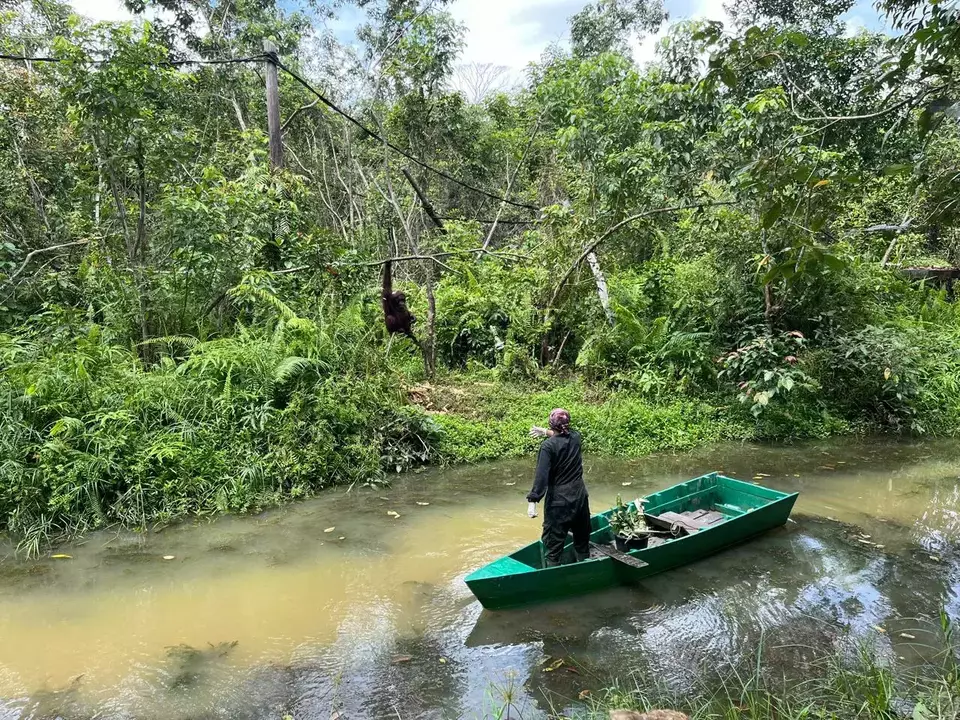
Reforestation efforts will focus on transforming damaged land into green spaces populated by resilient plants and fruit-bearing trees. One successful example of this approach is Samboja Lestari, located in Kutai Kartanegara Regency, East Kalimantan. Established by the Borneo Orangutan Survival Foundation (BOSF), this forest has been transformed into an orangutan rehabilitation center and a forest school.
BOSF CEO Jamartin Sihite explained that Samboja Lestari’s reforestation utilized an accelerated forest evolution technique, which was crucial because the land was once barren scrubland after a large-scale fire.
“Building a forest is not impossible. Samboja Lestari was once scrubland, covered in tall grass that was highly combustible. BOSF managed to build the forest using an accelerated forest evolution technique,” Jamartin said.
The first step in transforming the barren land was planting strong pioneer species like sengon (silk tree) and meranti (Shorea) trees. These trees helped outcompete the alang-alang (wild grass), a fire-prone plant, turning the area into fire-resistant land.
“The alang-alang is highly susceptible to fire, especially during the dry season. By planting strong pioneer species, we can suppress the grass and restore the land,” Jamartin said, adding that once the pioneer plants were established, BOSF continued planting fruit trees and rattan to complete the transformation into a secondary forest.
Jamartin said that forest restoration in Kalimantan, which is home to 40.8 million hectares of forest, is feasible, as demonstrated by the rapid regrowth of Samboja Lestari, which was restored just one year after being burned down in 2015.
While Samboja Lestari serves as an orangutan rehabilitation area, it is not the orangutans' natural habitat. Once the animals have completed their rehabilitation, they are released into forests like Kehje Sewen, where they can live in their natural environment.
“Building a forest is not impossible. It starts as a plantation forest and can develop into a thriving secondary forest,” he said.
Samboja Lestari was established in 1998 with an area of 1,853 hectares of scrubland. Today, it serves as a model for successful reforestation in Indonesia, particularly in the region overlapping with the area designated for the new capital city, Nusantara.
Tags: Keywords:Related Articles

An Orangutan Love Story Bridges Indonesia and Japan
Jennifer, a Bornean orangutan from Indonesia, makes her public debut in Japan alongside Hayato in a conservation program.The Latest

Prabowo Orders Up to 50 Ethanol Plants to Support E20 Fuel Program
Indonesia plans E20 gasoline within years, backed by up to 50 new ethanol plants and a nationwide sugarcane replanting drive.
US, Canada, Mexico Claim Success as World Cup Co-Hosts
US, Canada, Mexico have claimed success as host countries for the World Cup as enthusiasm soars for the final match.
China’s WAICO or US-Led Pax Silica? Indonesia Stays Neutral
Indonesia says that it is taking part in the two AI-related initiatives proposed by the rivalring major powers China and the US.
JCI Posts Strongest Weekly Gain in Months on Debt Confidence
Indonesia's benchmark index climbed 4.24% this week as healthy external debt data lifted sentiment despite global uncertainties.
Febrie Adriansyah Denies All Allegations After 11-Hour AGO Questioning
Former prosecutor Febrie Adriansyah denied all allegations, including claims he received Rp 50 billion, after an 11-hour AGO questioning.Most Popular
