



Bandung Land Sinking Faster Than 5 Centimeters Annually, Geology Agency Warns
Bandung. Land in the Greater Bandung area is sinking at a rate exceeding five centimeters per year, a trend that has also been recorded in several coastal cities across Java, Indonesia’s Badan Geologi said on Sunday.
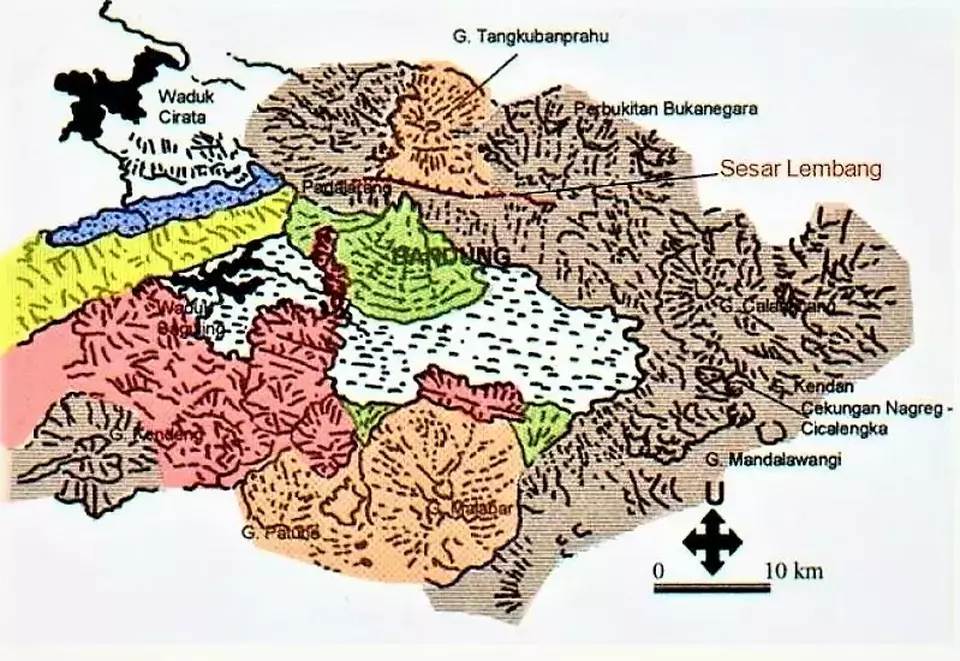
The phenomenon has drawn particular concern in Bandung, which sits in a highland basin, as land subsidence is more commonly associated with coastal regions.
Agus Cahyono Adi, head of the Center for Groundwater and Environmental Geology at the Geology Agency, said the subsidence in Bandung was driven by a combination of natural and human factors.
“In Bandung, aside from extensive industrial activity, the causes include soft soils from young sediment deposits, rapid urbanization, building loads, and excessive groundwater extraction,” he said at a seminar in Bandung.
Agus explained that geologically, the Bandung basin was formed from an ancient lake, leaving behind sediment deposits that are less stable than areas formed by igneous rock such as lava. “Regions with young sediments are indeed more vulnerable to land subsidence,” he said.
While some drivers of subsidence are beyond human control, particularly those linked to natural geological conditions, Agus said human-induced factors could still be mitigated. “Natural factors cannot be controlled, but what we can do is limit groundwater exploitation,” he said.
Beyond Bandung, areas experiencing land subsidence of more than five centimeters per year include parts of North Jakarta, coastal zones of Semarang such as Genuk, Tanjung Mas, and Kaligawe, as well as Demak, Pekalongan, and eastern and northern Surabaya.

Geology Agency head Lana Saria said soft soil conditions and young sediment layers were the primary underlying factors, compounded by human activities including rapid urbanization, large-scale construction, and groundwater extraction.
“When land subsidence is combined with sea level rise due to global warming, the risks increase significantly, ranging from permanent coastal flooding and infrastructure damage to declining quality of life,” Lana said. “The impacts are not only environmental but also economic, as repair costs rise and land area is lost.”
The agency noted that along Java’s northern coast, including Jakarta and Semarang, land subsidence has caused some areas to fall to sea level or below, triggering the loss of residential zones and the expansion of coastal flooding.
In Jakarta, however, the Geology Agency has observed a slowdown in subsidence. GPS measurements from 2015 to 2023 show sinking rates ranging from 0.05 to 5.17 centimeters per year, with the trend appearing relatively negligible since 2020.
By contrast, a report published by the World Economic Forum in November 2025 said parts of Jakarta had experienced land subsidence of up to 28 centimeters, and identified Jakarta and Semarang as cities sinking faster than the pace of sea level rise.

Land subsidence is the gradual sinking of the ground surface, often occurring over years or decades. It happens when underground materials that support the land—such as soil, clay, sand, or rock—compact or collapse. This process can be driven by natural factors and human activity.
Naturally, areas formed from young sediments, former lakes, or soft alluvial soils are more prone to subsidence because these materials compress easily. Human activities often accelerate the process, especially excessive groundwater extraction.
When groundwater is pumped out faster than it can be replenished, underground pore spaces collapse, causing the land above to sink. Rapid urbanization, heavy building loads, and large-scale construction can further increase pressure on unstable soils.
Land subsidence poses serious risks. It can damage buildings and roads, disrupt drainage systems, worsen flooding, and, in coastal areas, intensify the impact of sea level rise. In extreme cases, land subsidence can permanently inundate neighborhoods and reduce livable land, creating long-term environmental and economic costs.
Reducing groundwater use and improving urban planning are key to slowing the process.
 as a preferred
Related Articles

The Last Resident: Elderly Woman Refuses to Leave a Sinking Central Java Village
As rising seas engulf her village, a 65-year-old woman remains alone in the last habitable house.
Indonesia Fast-Tracks 575 km Sea Wall to Safeguard 55 Million Residents
Indonesia accelerates 575 km sea wall project to protect millions and key economic hubs from flooding and land subsidence.The Latest

Jakarta Outranks Amsterdam in Global Public Transport Survey
Jakarta climbs two places to 15th in Time Out's 2026 public transport survey, with its governor citing better network integration.
MSCI Concerns, Tighter IDX Trading Rules Send Indonesian Stocks Down 5% by Midday
Indonesian stocks plunge 5% by midday as MSCI concerns weigh on sentiment and the IDX tightens its daily downside limit to 7%.
Jakarta Prepares 367 Health Facilities as Haze Reaches the Capital
Jakarta prepares 367 health facilities to treat potential haze-related illnesses after smoke from Sumatra and Kalimantan crosses the region.
Jakarta Expands Flood Prevention With New Water Storage Ponds
Jakarta opens two East Jakarta water storage ponds as it expands flood prevention efforts through reservoirs and river normalization.
Press Council Highlights AI Ethics at United Tractors Journalist Workshop
United Tractors’ 2026 journalist workshop highlights ethical AI use and the importance of trust and credibility in journalism.Most Popular
