



Peking University Professor Draws Parallels Between Growth Strategies in Indonesia and China
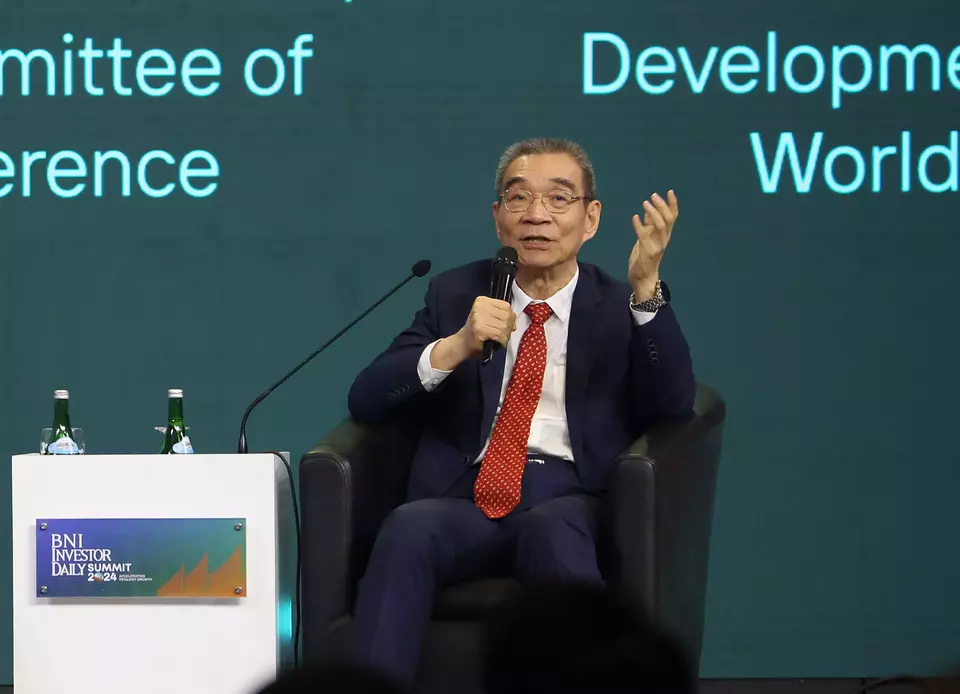
Jakarta. Professor Justin Yifu Lin, renowned for his accurate predictions about China’s economy, said on Tuesday that Indonesia and China share several commonalities in their quest for accelerated economic growth and prosperity.
Speaking at the BNI Investor Daily Summit in Jakarta, Justin pointed out that both countries have outlined ambitious timelines for becoming developed nations by their respective centennial anniversaries.
"In Indonesia, you have the 'Golden Indonesia 2045' vision -- the aim to become a developed country by 2045," Justin said.
"China has similar goals. We have two targets: the first is to double our GDP from its 2010 level by 2035. The second is to become an advanced, modern nation by 2049, which marks the 100th anniversary of the founding of the People's Republic of China," he added.
Justin, who is the dean of Peking University’s Institute of New Structural Economics, expressed confidence that China is on track to achieve these ambitions even sooner than expected, despite skepticism due to the many challenges the country currently faces.
He said any assessment of Indonesia’s role in the new global order would be incomplete without considering China.
The prominent economist highlighted China's status as the largest economy in the world, measured by purchasing power parity (PPP), contributing roughly 20 percent to global economic growth each year.
"Just as important, China is Indonesia's largest trading partner and the second-largest source of foreign direct investment," he said.
Without China's involvement, the full picture of Indonesia’s economic trajectory "would be incomplete."
Both Indonesia and China are in a "catch-up" phase, Justin explained, which offers them a significant advantage with ample room for economic growth.
He reflected on China’s transformation from one of the poorest countries in the world just 30 years ago. In his book, Justin famously predicted that China would surpass the United States to become the world’s largest economy by PPP by 2015.
"No one believed me, but in fact, China overtook the US in 2014, a year earlier than my prediction," he said.
"For the past 30 years, I have often been invited to speak at forums like this, and my message has always been optimistic about China. Some accused me of being too optimistic, but looking retrospectively, I was always right."
According to Justin, many remain pessimistic about China because they focus solely on the country’s problems.
He noted that other countries, such as Germany, Japan, and South Korea, faced similar challenges early on but eventually caught up with the US in terms of per capita GDP and technological advancement.
These nations had per capita GDPs around 22-23 percent of that of the US but managed to achieve annual GDP growth rates of 8-9 percent over 16-year periods -- from 1946-62 in Germany, 1956-72 in Japan, and 1985-2001 in South Korea -- enabling them to close the gap with the US economy, he explained.
Justin believes China is poised to repeat this success. In 2019, China’s per capita GDP, measured by PPP, was 22.6 percent of that of the US.
He pointed to China’s comparative advantages, including its vast population of 1.4 billion people, which creates a massive talent pool.
"China has many geniuses, engineers, scientists, and more -- this is our human capital advantage," Justin said.
Additionally, China boasts the largest unified domestic market and the world’s most comprehensive manufacturing ecosystem.
"China’s supply chain is the best in the world," he said.
Given these factors, Justin expressed confidence that China has the potential to sustain a per capita GDP growth rate of 8 percent from 2019 to 2035, over another 16-year period.
Understanding a nation's aspirations -- such as the desire to become a developed country -- and identifying its growth potential and unique challenges are crucial to maintaining optimism and making accurate economic predictions, he concluded.
Tags: Keywords: as a preferred
Related Articles

Chinese Ship Sets Off for Europe Through Arctic, Halving Travel Time
The "Dubai Tower" will pass through the Bering Strait, then turn west through the frigid waters along Russia's northern coast.
East Asia’s Next Growth Model: How to Grow Better, Not Just Faster
While East Asia still outpaces the global average, slower growth is exposing persistent vulnerabilities.
China's Exports and Imports Surge in July
China's shipments to the United States rose 17% year-on-year last month as the countries remain locked in a trade war.
China's Economy Slows 4.3% Annual Growth, Weakest Since Late 2022
Exports of high-tech products such as electric vehicles, computer chips and other electronic equipment have risen sharply.
China's Rise: What Indonesia Can Learn
China’s experience suggests that the debate between the state and the market is rarely black-and-white.The Latest

Prabowo Calls Meeting on Forest Fires as Haze Reaches Jakarta, Singapore
Prabowo summons senior officials to discuss forest fires as smoke reaches Jakarta and Malaysia pushes for regional action.
Jakarta Outranks Amsterdam in Global Public Transport Survey
Jakarta climbs two places to 15th in Time Out's 2026 public transport survey, with its governor citing better network integration.
MSCI Concerns, Tighter IDX Trading Rules Send Indonesian Stocks Down 5% by Midday
Indonesian stocks plunge 5% by midday as MSCI concerns weigh on sentiment and the IDX tightens its daily downside limit to 7%.
Jakarta Prepares 367 Health Facilities as Haze Reaches the Capital
Jakarta prepares 367 health facilities to treat potential haze-related illnesses after smoke from Sumatra and Kalimantan crosses the region.
Jakarta Expands Flood Prevention With New Water Storage Ponds
Jakarta opens two East Jakarta water storage ponds as it expands flood prevention efforts through reservoirs and river normalization.Most Popular
