



Mari Elka Pangestu: Indonesia Must Navigate US-China Trade Tensions
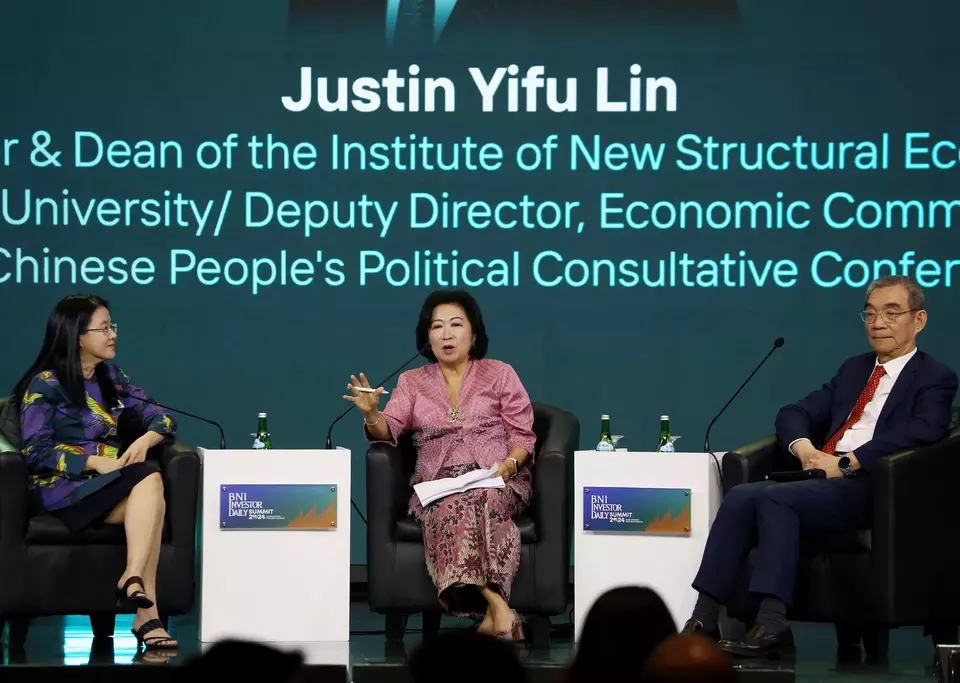
Jakarta. Mari Elka Pangestu, former trade minister and World Bank managing director, emphasized the importance of Indonesia maintaining trade relations with both the US and China amidst the ongoing decoupling between the two largest economies.
"US-China tensions will persist regardless of who wins the upcoming election," she said at the BNI Investor Daily Summit 2024 at the Jakarta Convention Center on Tuesday.
The 2024 US presidential election, featuring candidates Kamala Harris and Donald Trump, is set for November 5, with both sides accusing each other of being indecisive on China.
Since 2018, tariffs between the US and China have risen on various products, including electronics and automobiles. Mari noted that while imports from China to the US and vice versa have decreased, imports from other countries to both nations have increased.
She pointed out that Indonesia must engage with both countries, as the trade decoupling presents opportunities for relocation.
"The US and China have not fully decoupled; only sectors with high tariffs are affected. Full decoupling could cost around 7 percent of GDP according to IMF estimates, but current decoupling is limited," she explained.
As of June 2024, Indonesia experienced a trade deficit of $693 million with China and a surplus of $1.22 billion with the US.
Speaking at the same forum, Justin Yi Fu Lin, former World Bank Chief Economist and Dean of the Institute of New Structural Economics at Peking University, expressed optimism about China's ability to maintain stability and achieve an average growth rate of around 4.5 percent as it aims to become a high-income country by 2034.
"If China can grow well, it's good news for the world; if it performs poorly, it can be a headache," he warned.
"China will be the best companion to realize Indonesia's vision of becoming a developed nation by 2045," he added.
Despite predictions of a potential collapse of the Chinese economy, Lin pointed out that China remains the only major country that has not experienced a significant crisis in recent decades.
In 1994, China was one of the poorest countries in the world, but by 2011, Lin predicted it would surpass the US in purchasing power parity (PPP) by 2015. This prediction came true, as data from the International Monetary Fund (IMF) and the World Bank indicate that China's economy overtook the US in PPP terms around 2014.
Tags: Keywords: as a preferred
Related Articles

DEN Says Policy Coordination Crucial Amid Rupiah Weakness, Global Volatility
DEN says coordinated fiscal and monetary policies are crucial to safeguard macroeconomic stability and investor confidence.The Latest

Chandra Asri Group Receives Trade Finance Excellence Award, Reinforcing Its Role in Indonesia’s Industrial Development
Chandra Asri Group receives the Trade Finance Excellence Award at CIMB Niaga Business Summit 2026.
AEON MALL Deltamas Brings 11 Sports and Creative Competitions to AEONLYMPIC 2026
AEON MALL Deltamas hosts AEONLYMPIC 2026, featuring 11 sports and creative competitions, with more than 3,100 participants.
Indonesian Stocks Extend Losses for Third Day, Fall 3.64% to 4,996
Indonesian stocks fell 3.64% on Monday, extending losses for a third straight session amid MSCI concerns and tighter trading limits.
Prabowo Calls Meeting on Forest Fires as Haze Reaches Jakarta, Singapore
Prabowo summons senior officials to discuss forest fires as smoke reaches Jakarta and Malaysia pushes for regional action.
Jakarta Outranks Amsterdam in Global Public Transport Survey
Jakarta climbs two places to 15th in Time Out's 2026 public transport survey, with its governor citing better network integration.Most Popular
