



Indonesia-EU Trade Pact to Take Effect in 2027, Removes 98% Tariffs
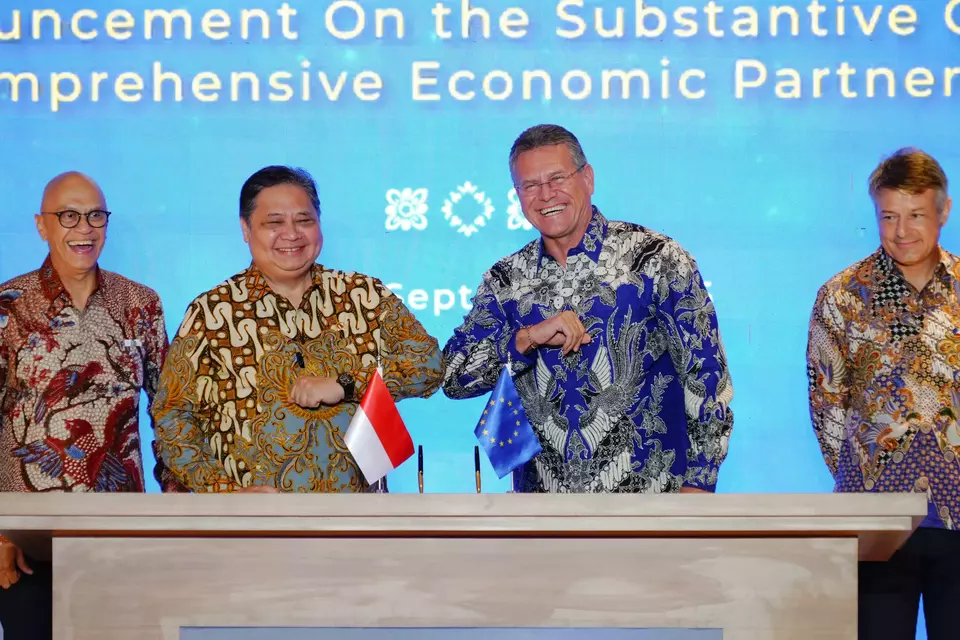
Jakarta. The trade pact between Indonesia and the European Union (EU) is set for entry into force at the beginning of 2027, as their senior officials inked the accord’s substantive conclusion on Tuesday.
EU Trade Commissioner Maroš Šefčovič had flown to the Indonesian tourist haven of Bali in hopes of closing the deal. The same goes for senior minister Airlangga Hartarto. Shortly after the signing, Airlangga said that the much-anticipated Indonesia-EU Comprehensive Economic Partnership Agreement (CEPA) could come into effect as early as 2027.
“We look ahead to the next stage, [namely] the legal scrubbing, translation, and ratification. We reaffirm the determination to bring the CEPA into force at the earliest opportunity. The target should be Jan. 1, 2027,” Airlangga said.
Under the pact, both sides have agreed to eliminate over 98 percent of their tariffs when trading with one another. The import duty elimination will start at 90.4 percent for Europe-bound Indonesian goods before it expands in stages. According to Airlangga, the CEPA could catapult exports by Indonesia’s labor-intensive industries, including footwear and textile producers.
Indonesian palm oil -- which has put the bilateral ties to the test over deforestation concerns -- is expected to benefit from the trade pact. A press statement issued by the EU wrote that the accord could set a platform for cooperation, dialogue, and trade facilitation on an array of commerce-related environmental and climate issues, including in the palm oil sector. Airlangga previously claimed that Europe would allow 1 million tons of Indonesian crude palm oil enter its market duty-free each year. Any imports exceeding the quota will be subject to a 3 percent tariff.
Meanwhile, the bloc is banking on the pact to boost Indonesians’ appetite for its agrifood products, even calling the CEPA a “major win” for European farmers. The CEPA will remove tariffs on European dairy products, meats, fruits, vegetables, as well as a wide range of processed foods.
Indonesia is set to be the third ASEAN member to strike a trade agreement with the EU after Singapore and Vietnam. According to Šefčovič’s estimates, goods trade totaled 27 billion euros ($31.9 billion) last year, with Indonesia enjoying a surplus. The 27-member grouping, however, had a lead in services trade, which amounted to almost 9 billion euros. Europe is also expecting that some of its companies will be more keen on investing in Indonesia’s strategic sectors such as electric vehicles, electronics, and pharmaceuticals, following the agreement.
“By the end of 2023, European investment stocks in Indonesia exceeded 25 billion euros. … Our agreement will foster even greater investment flows,” Šefčovič said.
The texts will now go through legal revision and translation to all EU official languages. The European Commission will submit the document to the Council for signature. Once adopted by the council, both sides can sign the agreement before it goes to their respective parliaments to be passed into law. Once the ratification is complete, the CEPA will come into effect.
The signing came after European Commission President Ursula von der Leyen and Indonesian leader Prabowo Subianto reached a political agreement to expedite the trade pact in July. Official negotiations kicked off in 2016, but the sluggish talks finally gained speed after both sides eyed diversifying their exports following the US reciprocal tariff salvo.
Tags: Keywords: as a preferred
Related Articles

Indonesia, Russia Seek Deeper Trade and Industrial Ties
Indonesia and Russia are seeking deeper trade, investment and industrial ties as bilateral trade rises 21.6% to $4.84 billion in 2025.
'MSCI is Not Always Right’: Indonesia Tells Investors to Calm Down
Senior deputy economy minister says "not everything that MSCI does is beneficial for investors" as Indonesian stocks plunge.
Indonesian Stocks End at 2026 Low After Losing 11.57% on MSCI Warning
Indonesian stocks lost 11.57% to hit a new 2026 low as MSCI's reclassification warning rattled investor confidence.
Indonesia Surprised by MSCI Downgrade Despite Bangkok Talks
Senior minister Airlangga Hartarto admitted that the Indonesian government was taken aback by MSCI’s latest announcement.
Indonesia Waives Import Duties on Plastic Raw Materials for Six Months
Indonesia cuts import duties on selected plastic raw materials to 0% for six months as global prices surge.
Airlangga Urges Indonesia to Catch Up With Vietnam in Digital, AI Industries
Indonesia needs to accelerate digital, semiconductor and AI industries to catch up with Vietnam and achieve its 8% growth target.
EU Tariff Deal to Make German Cars in Indonesia More Affordable
Senior minister Airlangga Hartarto says the upcoming trade deal will cut tariffs on European car imports to "close to 0%".
Prabowo Adds 6% Mortgages, Expands Worker Tax Relief in 2027
Indonesia will offer 6% mortgages to salaried workers and expand tax relief as the government extends economic incentives into 2027.
Airlangga Highlights Market Diversification, Global Competitiveness for Furniture Industry
Airlangga urges Indonesia’s furniture industry to diversify export markets, strengthen global competitiveness and tap international demand.
Airlangga Says Indonesia Won’t Face US Tariffs Over Russian Oil
Airlangga says Indonesia won’t face US tariffs over Russian oil bought within an allowed window.The Latest

Students Plan Jakarta Protests to Mark Two Years of Prabowo's Presidency
Police have advised the public to avoid areas around the House of Representatives complex, the National Monument and the State Palace.
UN Boss Commends Indonesian Forest Protection Despite Persistent Haze Problem
Outgoing UN boss António Guterres' comment comes at an ironic time amid Indonesia's struggle with forest fires.
Indonesia Must Benefit Most From Its Minerals: UN Chief
Outgoing UN chief António Guterres says that Indonesia must "retain a far greater share of the economic value" from its minerals.
Chandra Asri Group Receives Trade Finance Excellence Award, Reinforcing Its Role in Indonesia’s Industrial Development
Chandra Asri Group receives the Trade Finance Excellence Award at CIMB Niaga Business Summit 2026.
AEON MALL Deltamas Brings 11 Sports and Creative Competitions to AEONLYMPIC 2026
AEON MALL Deltamas hosts AEONLYMPIC 2026, featuring 11 sports and creative competitions, with more than 3,100 participants.Most Popular
