



Indonesia Walks Tightrope Between Wage Growth and ASEAN Competitiveness

Jakarta. Indonesia plans to raise minimum wages by about 5% to 7% in 2026 under a new formula signed into law by President Prabowo Subianto, a move that could test the country’s cost competitiveness in Southeast Asia.
The revised regulation retains the existing framework for calculating provincial minimum wages, which ties annual increases to inflation and economic growth, but significantly raises a coefficient known as alpha. The coefficient, which determines how much economic expansion is passed on to workers, has been lifted to a range of 0.5 to 0.9 from 0.1 to 0.3 previously, giving regional wage councils greater room to recommend higher pay.
Manpower Minister Yassierli said Wednesday the rule was finalized after months of consultations, including with labor unions, and is designed to protect purchasing power while allowing flexibility across regions. Final wage levels will be set by provincial governors based on recommendations from local wage councils, expected to be announced by Dec. 24.
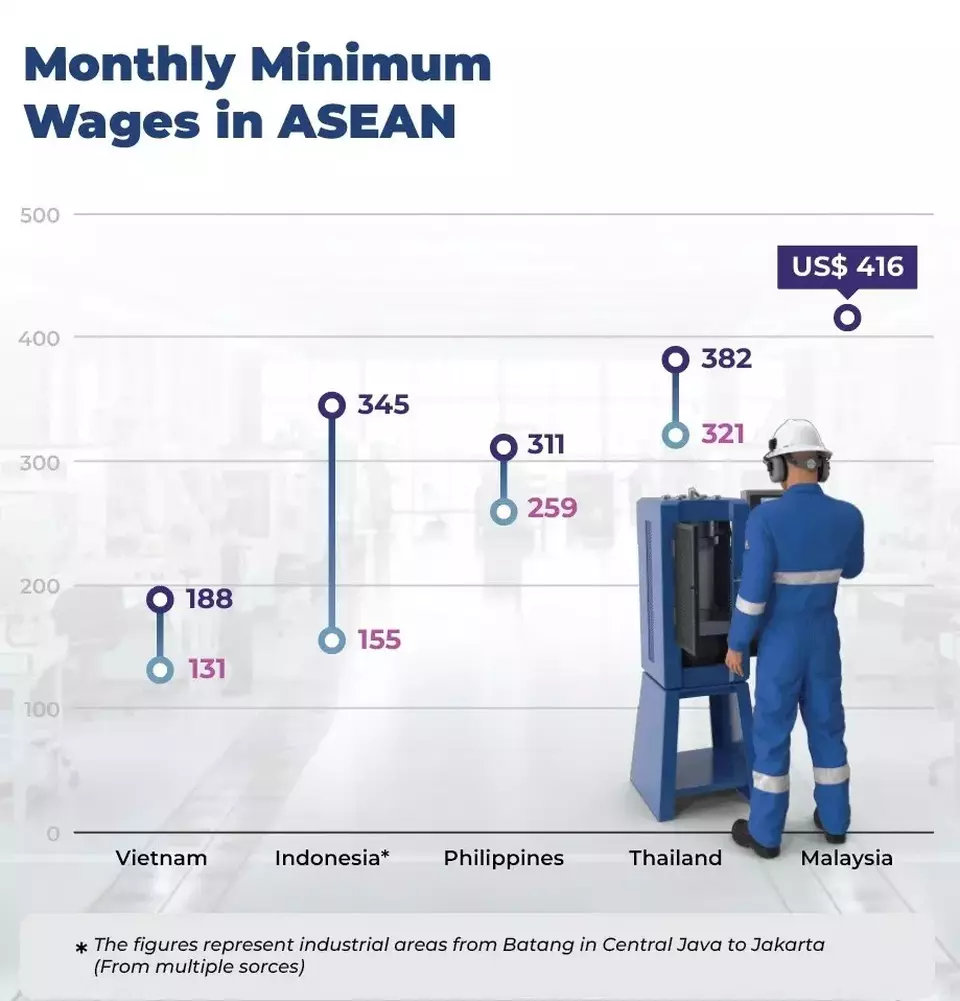
Jakarta offers an early indication of how the policy may play out. With the capital’s current minimum wage at about Rp 5.4 million ($323) a month, the new formula would lift Jakarta’s 2026 minimum wage to roughly Rp 5.68 million to Rp 5.77 million.
Even after the increase, Southeast Asia's largest economy's minimum wage remains in the middle of the pack — below Malaysia and far behind Singapore, but comparable with Vietnam, Thailand, and the Philippines.
“Global investors are becoming more selective as they rebalance supply chains, weighing not just wages but policy consistency, infrastructure quality, ease of doing business and long-term investment certainty,” Shinta Widjaja Kamdani, chairwoman of the Indonesian Employers Association (Apindo) told the Jakarta Globe.
Wages alone do not determine competitiveness, she said, pointing instead to productivity. Over the past five years, Indonesia’s labor productivity has grown by about 1.5% to 2% annually, while minimum wages rose between 6.5% and 10% a year.
“The mismatch risks creating structural pressure on companies and influencing investment decisions, particularly if higher pay is not matched by gains in efficiency,” Shinta said.
Apindo warns that higher wages could squeeze margins in labor-intensive industries such as textiles, garments and footwear, where profitability is already thin. In footwear, for example, average margins hover around 5%, leaving limited room to absorb rising costs. The group cautioned that job cuts could become a risk, especially as many labor-intensive sectors remain in recovery and face weak domestic demand, high operating costs, illegal imports and reliance on imported raw materials, alongside external pressures such as shifting global trade policies.
Data from the Central Statistics Agency (BPS) show that in the third quarter of 2025 several labor-intensive subsectors underperformed the national average or contracted, including textiles and apparel, footwear, furniture, tobacco processing, and rubber and plastics.
Labor unions, however, say the planned increases still fall short. Said Iqbal, president of the Confederation of Indonesian Trade Unions, said the formula fails to reflect the real cost of living. Monthly living expenses in Jakarta can reach around Rp 15 million, covering housing, food, transport, education and healthcare, he said.
“It is unrealistic to claim that people can live decently in Jakarta on a salary of around Rp 5 million a month,” Iqbal said.
Tags: Keywords: as a preferred
Related Articles

Apindo Warns Labor Bill Could Stall Investment, Job Creation
Apindo warns Indonesia’s proposed labor bill could deter investment and business expansion, slowing formal job creation.
Businesses Back Mandatory Halal Rules, Warn of Rising Compliance Costs
Businesses support Indonesia’s mandatory halal rules but urge simpler certification and lower compliance costs to protect MSMEs and consumer
Suahasil Told to Avoid Business Cost Hikes, Tax Refund Delays
Businesses have laid out their wishlist for the newly appointed Finance Minister Suahasil Nazara.
Businesses Seek Predictable Rupiah as Prabowo Sets 2027 Economic Targets
Indonesian businesses urge the government to keep the rupiah stable in 2027 to support investment, costs and business expansion.
Indonesia’s Economy Grows 5.29%, But Businesses Still Feel the Squeeze
Indonesia’s economy grew 5.29% in Q2, but employers warn high costs and weak demand are keeping businesses on the defensive.
Business Group Calls for Deregulation to Stem Job Cuts
Apindo says deregulation and lower business costs are needed to address the root causes of layoffs and support economic recovery.
Data Leak Fears Plague Indonesian Firm Annual Reporting Rule
Limited liability companies must submit their annual reports to a ministry-run system, sparking fears over data leaks.
Exporters Endorse State Export Agency DSI, Seek Gradual Rollout
Indonesia’s leading business groups backed Prabowo’s export reform plan while calling for a gradual and transparent rollout.
Rupiah Slide Pushes Indonesian Firms Into Cost-Cutting Mode
Companies boost hedging, cut spending, and seek local suppliers as rupiah weakness hits operations.
Weakening Rupiah Forces Indonesian Businesses to Delay Expansion Plans
Around 70% of manufacturing raw materials in Indonesia are still imported, while raw materials account for roughly 55% of production costs.The Latest

UN Boss Wants to Fix Security Council as Indonesia Seeks Seat
Outgoing UN chief Guterres says the current permanent member setup at the Security Council fails to reflect today's realities.
Saudi Flagship Investment Conference Pushed to 2027 after Houthi Attacks
The annual Future Investment Initiative (FII), often dubbed "Davos in the Desert", was originally scheduled to take place from October 26-29
Government Sets Aside Rp 1.3 Quadrillion for Final-Quarter Spending
Government spending has reached Rp 2.66 quadrillion, equivalent to 69.2% of the full-year budget target of Rp 3.84 quadrillion.
Indonesia Probes 98 Corporate Wildfire Cases, Including Possible Foreign Links
Police investigate 98 corporate-related wildfire cases, including possible links to investors from neighboring countries.
Students Plan Jakarta Protests to Mark Two Years of Prabowo's Presidency
Police have advised the public to avoid areas around the House of Representatives complex, the National Monument and the State Palace.Most Popular
