



Indonesia Targets Garlic Self-Sufficiency to Cut Reliance on Chinese Imports
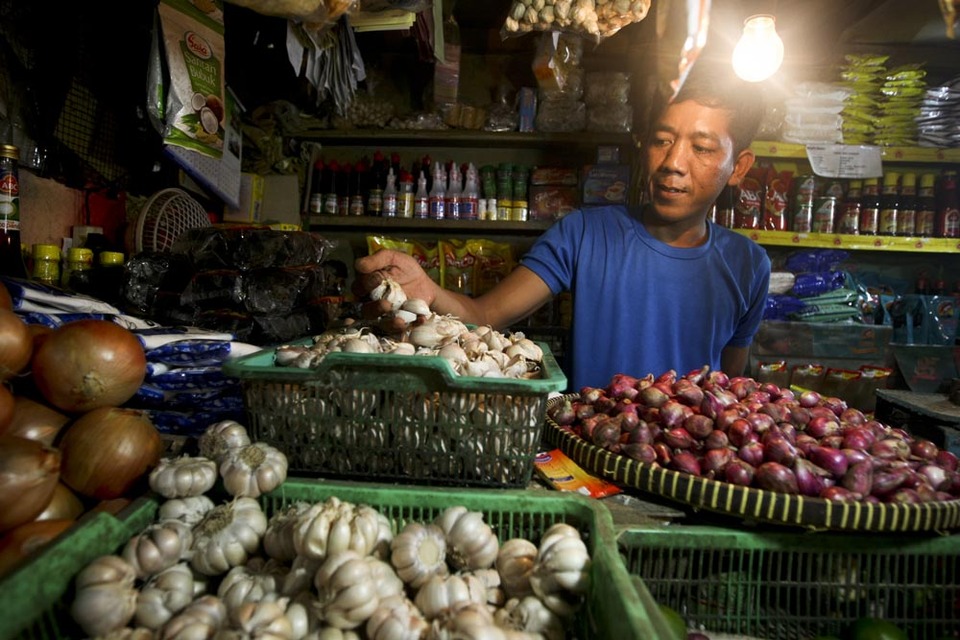
Jakarta. Indonesia is preparing a major push to achieve self-sufficiency in garlic production, aiming to reduce its heavy reliance on imports of one of the country's staple food commodities, a senior government official said on Wednesday.
More than 90% of Indonesia's garlic supply is currently imported, largely from China, with domestic production meeting only 5 to 10% of national demand.
"The president's major objective is for garlic, an essential commodity, to eventually become self-sufficient," Deputy Agriculture Minister Sudaryono said in Jakarta. "At the moment, more than 90% of our garlic supply is still imported."
Indonesia imports around 600,000 metric tons of garlic annually.
Sudaryono said achieving garlic self-sufficiency would be more feasible than attaining rice self-sufficiency from a land-use perspective. While rice cultivation requires millions of hectares of farmland, garlic production is estimated to need around 100,000 hectares.
The challenge, however, lies in finding suitable land and developing a reliable seed supply.
Garlic can only be cultivated in specific highland areas with suitable climatic conditions. Existing production centers are located in Sembalun in West Nusa Tenggara, Temanggung in Central Java, and Humbang Hasundutan in North Sumatra.
The government is searching for additional locations with similar agroclimatic characteristics to expand cultivation areas.
"The biggest challenge is actually seed availability," Sudaryono said. "To achieve self-sufficiency, we first need to build a strong seed production system."
The Agriculture Ministry estimates that Indonesia could achieve garlic self-sufficiency within three to four years. During the transition period, imports will continue while domestic production capacity is gradually expanded.
The government is involving multiple state-owned enterprises and industry groups in the program, including the farmers' association, state food procurement agency Bulog, food holding company ID Food, and plantation company PTPN.
Bulog and ID Food are expected to act as off-takers for garlic production and seed development programs, while PTPN will help provide land for cultivation.
One option under consideration is converting underutilized tea plantation land in West Java into garlic farming areas.
"We have been discussing this with various stakeholders, including regional governments. There are several plantation areas that have the potential to be used for garlic development," Sudaryono said.
The government has identified a need for roughly 100,000 hectares of land to support the self-sufficiency target. However, success will depend on the availability of quality seeds and the development of garlic varieties suited to local growing conditions.
Import quotas will continue to be reviewed and gradually reduced as domestic production increases, Sudaryono said.
Tags: Keywords: as a preferred
Related Articles

Indonesia Targets Garlic Self-Sufficiency to Cut Reliance on Chinese Imports
Indonesia aims to achieve garlic self-sufficiency within four years as imports still account for over 90% of supply.The Latest

Chandra Asri Group Receives Trade Finance Excellence Award, Reinforcing Its Role in Indonesia’s Industrial Development
Chandra Asri Group receives the Trade Finance Excellence Award at CIMB Niaga Business Summit 2026.
AEON MALL Deltamas Brings 11 Sports and Creative Competitions to AEONLYMPIC 2026
AEON MALL Deltamas hosts AEONLYMPIC 2026, featuring 11 sports and creative competitions, with more than 3,100 participants.
Indonesian Stocks Extend Losses for Third Day, Fall 3.64% to 4,996
Indonesian stocks fell 3.64% on Monday, extending losses for a third straight session amid MSCI concerns and tighter trading limits.
Prabowo Calls Meeting on Forest Fires as Haze Reaches Jakarta, Singapore
Prabowo summons senior officials to discuss forest fires as smoke reaches Jakarta and Malaysia pushes for regional action.
Jakarta Outranks Amsterdam in Global Public Transport Survey
Jakarta climbs two places to 15th in Time Out's 2026 public transport survey, with its governor citing better network integration.Most Popular
