



Indonesia Pushes Energy Self-Reliance as Fuel Imports Seen Falling by 2027: Bahlil
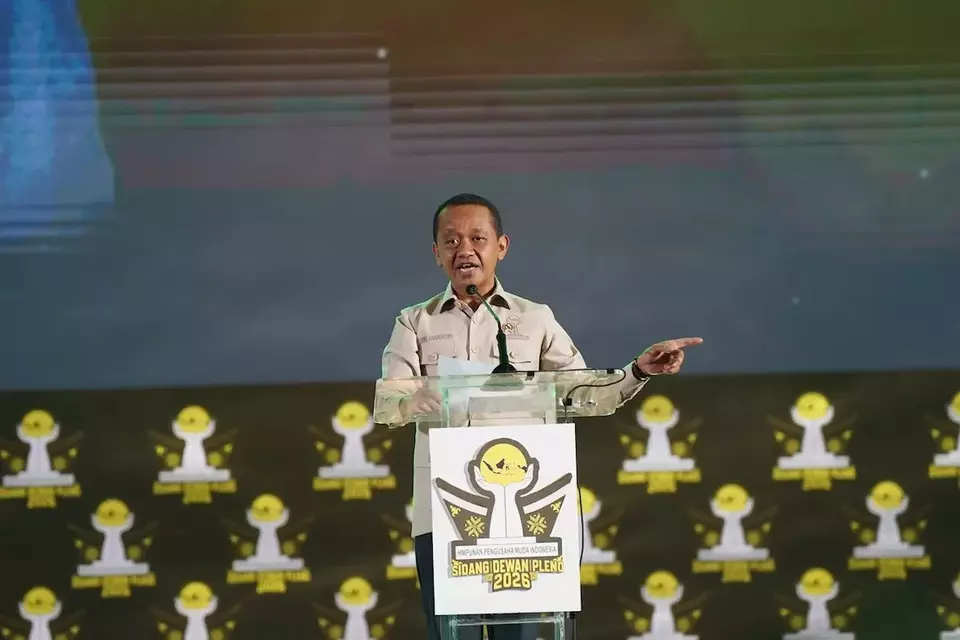
Makassar. Energy and Mineral Resources Minister Bahlil Lahadalia outlined the government’s strategy to curb fuel imports while strengthening the role of regional businesses in managing natural resources during the Hipmi Plenary Council session in Makassar, South Sulawesi, on Sunday.
Bahlil said national gasoline consumption in 2026–2027 is projected to reach around 40 million kiloliters annually, while domestic production capacity stands at only about 14.5 million kiloliters, leaving Indonesia reliant on imports of roughly 25–26 million kiloliters.
To reduce dependence on imports, the government is pursuing several strategic measures, including the Refinery Development Master Plan (RDMP) Balikpapan project aimed at boosting Pertamina’s refining capacity.
“The operation of RDMP Balikpapan produces 5 million kiloliters of gasoline and 3.9 million kiloliters of diesel. This year, with the B40 program, we will no longer import diesel, and this is the first time in our nation’s history,” he said.
He emphasized the importance of expanding domestic processing capacity, citing the RDMP Balikpapan project inaugurated by Prabowo Subianto on Jan. 12, 2026, as a concrete example.
Bahlil also highlighted key technical challenges in the energy sector, particularly aging oil wells that limit optimal oil and gas lifting. “These aging wells must inevitably be intervened in through technology. Of the total of 39,000 to 40,000 wells, only about 17,000 to 18,000 are operational, while the rest are idle because they are old. This is where we are pursuing cooperation,” he explained.
Another breakthrough measure involves accelerating the development of wells already included in approved plans of development. In addition, the Energy Ministry will soon open tenders for 110 new oil and gas blocks to strengthen energy supply resilience. Bahlil stressed that faster execution, technological investment, and strategic partnerships between the government and private sector must move in tandem.
The government will also implement mandatory bioenergy blending policies, namely E10 and E20, which he said could cut import needs by up to 9 million kiloliters, reducing total fuel imports to around 11 million kiloliters.
“With mandatory E10 and E20, imports can be reduced by around nine million kiloliters. That would leave our imports at roughly eleven million kiloliters,” he said.
He added that by 2027, Indonesia is expected to produce several strategic fuel types domestically, including RON 92, RON 95, and RON 98 gasoline, as well as certain aviation fuel and diesel products, allowing future imports to focus more narrowly on crude oil with smaller volumes.
“This is our strategy to ensure there are no longer issues related to fuel imports being scrutinized by law enforcement,” he said.
Beyond energy, Bahlil also pointed to changes in mining business permit policies, with the government prioritizing the involvement of micro, small, and medium enterprises (MSMEs) and regional cooperatives in mining management.
For instance, if a mining area is located in Luwu, South Sulawesi, MSMEs domiciled and operating in that region will receive top priority.
The policy is expected to promote more equitable economic distribution and ensure that local communities directly feel the benefits of natural resources.
Read More:
Indonesia Targets Diesel Self-Sufficiency by 2026 as Balikpapan Refinery Nears Full Operation as a preferred
Related Articles

Indonesia Says Subsidized Fuel Stocks Cover 16–18 Days
Indonesia says fuel reserves remain adequate, with Pertalite stocks covering 16–18 days as Pertamina boosts deliveries.
Indonesia Opens New LPG Plant in West Java to Reduce Import Dependence
Bahlil said the plant was expected to supply around 15% of LPG demand in Jakarta and West Java.
Indonesia Aims $45 Billion Nickel Exports in 2026
Indonesia's nickel exports neared $34 billion in 2024, government data showed.
Bahlil Says B50 Program Shields Indonesia from Diesel Import Disruptions
Indonesia says its B50 biodiesel program has ended diesel imports, even as Middle East tensions threaten global oil supplies.
‘It’s Trump Who Sets Oil Price’: Prabowo’s Brother
Neither the Indonesian government nor OPEC sets the oil price, Hashim Djojohadikusumo says.
Indonesia Rewrites Its Economic Model to Power Faster Growth
Indonesia bets on investment, downstream industries and clean energy to achieve 8% economic growth.
Indonesia Insists on Deciding Singapore Power Export Price
Senior minister Bahlil Lahadalia says that Indonesia doesn't want to sell its electricity cheaply.
Indonesia’s 1M-Bpd Oil Import Gap Is ‘Miserable’, Bahlil Says
Indonesia’s oil lifting meets the 2025 target, but Bahlil calls the 1M-bpd import gap “miserable” as demand hits 1.6M bpd.
Bahlil Signals More Ministries May Join New Downstream Coordination
Bahlil signals one or two more ministries could join the new downstream coordination, with the Industry Ministry among those considered.
Bahlil: Coal Quotas Needed to Protect Indonesia’s Pricing Power
Bahlil says tighter coal quotas are needed to control supply, prevent oversupply and strengthen Indonesia’s influence over coal prices.The Latest

Prabowo Calls Meeting on Forest Fires as Haze Reaches Jakarta, Singapore
Prabowo summons senior officials to discuss forest fires as smoke reaches Jakarta and Malaysia pushes for regional action.
Jakarta Outranks Amsterdam in Global Public Transport Survey
Jakarta climbs two places to 15th in Time Out's 2026 public transport survey, with its governor citing better network integration.
MSCI Concerns, Tighter IDX Trading Rules Send Indonesian Stocks Down 5% by Midday
Indonesian stocks plunge 5% by midday as MSCI concerns weigh on sentiment and the IDX tightens its daily downside limit to 7%.
Jakarta Prepares 367 Health Facilities as Haze Reaches the Capital
Jakarta prepares 367 health facilities to treat potential haze-related illnesses after smoke from Sumatra and Kalimantan crosses the region.
Jakarta Expands Flood Prevention With New Water Storage Ponds
Jakarta opens two East Jakarta water storage ponds as it expands flood prevention efforts through reservoirs and river normalization.Most Popular
