



China Upgrades Trade Pact with ASEAN, Warns Bloc of US ‘Economic Bullying’
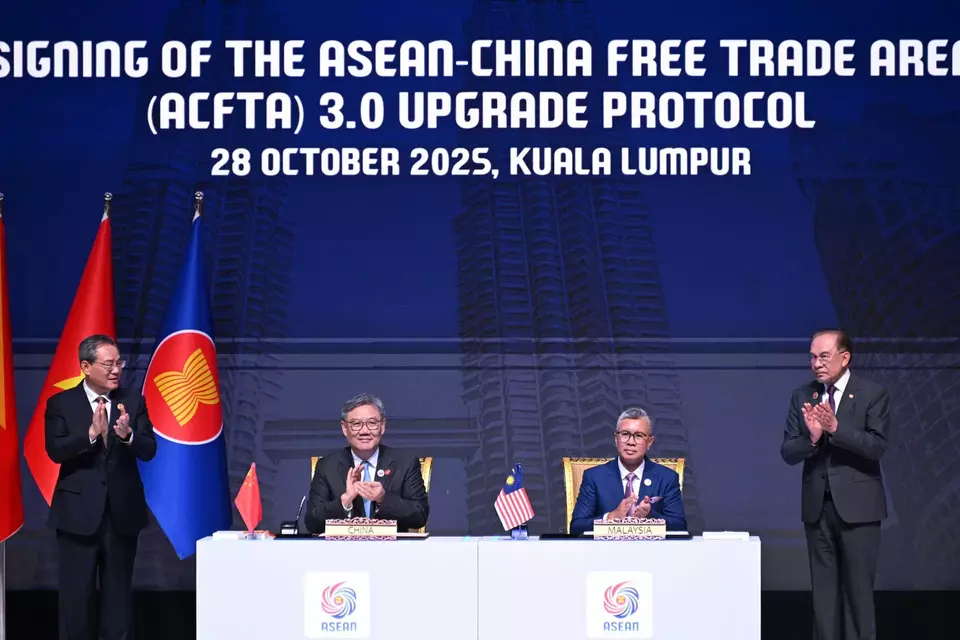
Jakarta. China officially upgraded its trade deal with ASEAN on Tuesday as Beijing warned the Southeast Asian bloc of the economic coercion by the United States.
The ASEAN-China Free Trade Area, also known as ACFTA, came into effect in 2010. It has seen some upgrades since then, with the latest update being the second one. The ACFTA 3.0 is expected to encompass green and digital economies, consumer protection, and greater inclusivity for smaller businesses. Under the revised agreement, Southeast Asian firms will enjoy simplified customs procedures when exporting to China and vice versa.
ACFTA 3.0 became one of the major outcomes of the Malaysia-chaired 47th ASEAN Summit that had been going on over the past three days. Chinese President Xi Jinping sent his premier Li Qiang for the closely watched gathering with the Southeast Asian economies.
While the new version of the pact could breathe new life into cooperation, Li reminded ASEAN to close ranks to defend their rights amidst external disturbances in the region, alluding to the tariff assault launched by US President Donald Trump.
“External interference in our region is on the rise. Many countries are slapped with unwarranted high tariffs. Development today faces greater risks and challenges,” Li said in the opening session of the ASEAN-China talks.
“In the face of power politics and economic bullying, we will gain nothing from disunity and confrontation, and will only end up divided and conquered by external forces. The more challenging the situation, the more resolute we should be in maintaining unity and self-reliance.”
Malaysian Prime Minister Anwar Ibrahim called the pact a “spectacular feat”. He also pointed out that the ACFTA was the first trade deal that ASEAN struck with a country outside the bloc.
Chinese data showed that ASEAN-China trade totaled 5.57 trillion yuan (around $785 billion) in the first three quarters of 2025. This marks a 9.6 percent year-on-year increase.
The Indonesian government reported that bilateral trade with China amounted to nearly $97.2 billion from January to August 2025. However, Jakarta ran a deficit of almost $13.1 billion within that time frame.
The rest of the meeting was not open to press coverage.
Li, however, had repeatedly called the ASEAN economies to oppose protectionism during his time in Kuala Lumpur, although the Chinese politician did not specifically mention Trump’s tariff hikes.
Trump had come to the first day of the ASEAN Summit for Washington’s working session with the 11-strong group before departing for Japan. Despite Trump’s tariff hikes casting a shadow over his ties with the Southeast Asian economies, the joint statement published after the meeting shied away from mentioning the import duties.
Trump’s tariffs on ASEAN members range between 10 percent for Singapore to a whopping 40 percent for Myanmar and Laos. Indonesian goods face 19 percent tariffs when they wish to enter the American market. The Central Statistics Agency (BPS) reported that Indonesia’s US-bound exports had dropped 12.39 percent month-on-month in August. The new import duties officially kicked in on Aug. 7.
China and the US have been on a back-and-forth tariff war, although the two world’s largest economies are currently on a fragile truce. Both governments are gearing up for the historic Trump-Xi meeting in South Korea this week.
Tags: Keywords: as a preferred
Related Articles

US Defends Tariffs on ASEAN Amid $327.4 Billion Deficit
US says it wants to "bring reciprocity and balance" to its ASEAN trade ties amid double-digit tariff hikes.
Indonesia’s Palm Oil Export to China Rises by Double Digits
Indonesia's monthly palm oil shipments to China rose by 67% in June, Gapki reported.
Indonesia Expects More Chinese Investments in Wang Yi’s Visit
China has been a major source of foreign direct investment to Indonesia.
Indonesia Denies US Accusation of Chinese Transshipment Scam
Senior minister Airlangga Hartarto says "Indonesia has never done transshipment", when asked about the US report.
US Accuses Indonesia of Helping China Dodge Trump Tariffs
The US accuses Indonesia and dozens of other countries of being part of "China's shadow transshipment network".
China Vows Mutual Benefit with Indonesia
In an Independence Day congratulatory message, China says that it wants to "deepen mutually beneficial cooperation in all fields".
ASEAN is No Arena for US-China Rivalry
Indonesia says that ASEAN has made it clear that it "must never become an arena for great power rivalry", alluding to the US-China rifts.
ASEAN Hopes for Predictability on Trump’s Tariffs
ASEAN says the region's businesspeople wish for a predictability and certainty as Trump launches a fresh round of tariff hikes.
Indonesia Banks On EU as Trump's 10% Tariff Kicks In
Indonesia wants to fast-track its European Union (EU) trade deal as Jakarta tries to find alternatives to the tariff-agressive US.
US Slaps 10% Tariff on Indonesia over Forced Labor
A new 10% tariff on Indonesia following a forced labor probe will take effect on Friday before noon.The Latest

MSCI Concerns, Tighter IDX Trading Rules Send Indonesian Stocks Down 5% by Midday
Indonesian stocks plunge 5% by midday as MSCI concerns weigh on sentiment and the IDX tightens its daily downside limit to 7%.
Jakarta Prepares 367 Health Facilities as Haze Reaches the Capital
Jakarta prepares 367 health facilities to treat potential haze-related illnesses after smoke from Sumatra and Kalimantan crosses the region.
Jakarta Expands Flood Prevention With New Water Storage Ponds
Jakarta opens two East Jakarta water storage ponds as it expands flood prevention efforts through reservoirs and river normalization.
Press Council Highlights AI Ethics at United Tractors Journalist Workshop
United Tractors’ 2026 journalist workshop highlights ethical AI use and the importance of trust and credibility in journalism.
How Indonesia Can Make Forest Protection Pay
Indonesia can make forest protection pay by channeling international climate funds through ecological fiscal transfers to local governments.Most Popular
