



SUN Energy Offers Solar Plants with No Upfront Costs
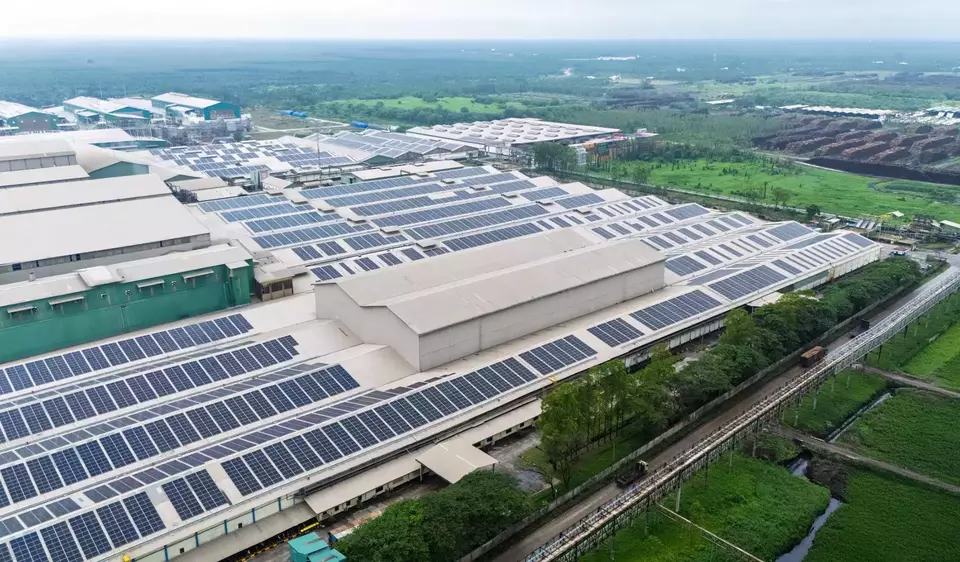
Jakarta. SUN Energy is offering a wide range of solar power solutions with no upfront costs.
The solar energy giant has prepared an innovative financing model for the industries that wish to set up solar plants. This rental system, also known as Build, Own, Transfer (BOT), allows companies to switch to clean energy without having to pay upfront costs, while reducing electricity costs by up to 30 percent and 40 percent annually, depending on the system capacity and energy consumption patterns.
The state-run electricity firm PLN reported that the electricity tariff per kilowatt-hour (kWh) for large industrial customers (category I-4) stands at around Rp 996.74 ($0.06) per kWh. The tariff for medium-sized industrial customers (category I-3) ranges from Rp1,035-1,114 per kWh, depending on the region and time of use. With ever-increasing energy needs, these costs can burden companies with billions of rupiah per year.
Most industrial activities also take place during the day. This is where solar plants become a strategic solution. It can generate electricity at the same time as energy consumption peaks. The cost of installing a solar power plant varies and can differ for each company, depending on the region and energy consumption patterns. Installation costs for a capacity of 1,150 Watts peak in a residential area reach Rp 25 million (approximately $1,494). This is equivalent to around Rp 21.7 million per kilowatt peak (kWp). If converted to an industrial scale with a capacity of 1 MegaWatt peak (1,000 kWp), setting up a plant requires an investment of around Rp 20 billion.
However, installation costs for industrial plants are relatively smaller than this calculation. This figure reflects the estimated capital a company needs to prepare before switching to solar energy, a factor often a primary consideration for industrial players, despite the significant long-term efficiency benefits.
SUN Energy's Zero-Investment Solar Power Plant Solution
SUN Energy offers a Zero Investment scheme, a solar power plant financing model that allows industrial customers to utilize solar power without incurring any upfront installation costs.
Under this scheme, all investment, operations, and maintenance are covered by SUN Energy. Partners only have to pay a monthly rental fee. The solar power plant generates electricity at a lower rate per kWh than electricity from the national grid. Through this scheme, companies have the opportunity to save up to 30-40 percent on energy costs, depending on the system capacity and daily electricity consumption patterns.
The solar plant developed by SUN Energy is designed to flexibly meet industrial operational needs, with on-grid, off-grid, and hybrid configurations.
On-grid systems connect directly to the national electricity grid to ensure a stable power supply. Off-grid systems are suitable for industrial sites that rely on diesel generators, as they can operate independently with the support of energy storage batteries.
Hybrid systems combine the advantages of both, optimally utilizing solar energy during the day and automatically switching to the national grid or batteries during cloudy weather or at night.
This approach provides industries with high flexibility to transition to clean energy without changing existing electricity systems and without risking operational disruptions.
Contribution to National Efficiency and Decarbonization
Solar plants do not only improve industrial energy efficiency, but they can also support the national energy transition.
By utilizing solar energy during peak daytime hours, industries can reduce electricity consumption from the main grid and reduce national peak loads. According to a report by the International Renewable Energy Agency (IRENA), the cost of generating utility-scale solar power has fallen by approximately 90 percent since 2010, making it one of the world's most affordable energy sources.
The use of solar power plants also aligns with the direction of the national energy transition policy. According to an analysis by the Institute for Energy Economics and Financial Analysis (IEEFA), Indonesia is targeting an additional 75 GW of renewable energy capacity by 2040, the majority of which will be driven by solar power plants.
With its Zero Investment business model, flexible technology systems, and implementation experience in hundreds of industrial locations, SUN Energy affirms its position as a strategic partner for the manufacturing, logistics, and industrial estate sectors on their journey towards more efficient and sustainable operations.
 as a preferred
The Latest

Chandra Asri Group Receives Trade Finance Excellence Award, Reinforcing Its Role in Indonesia’s Industrial Development
Chandra Asri Group receives the Trade Finance Excellence Award at CIMB Niaga Business Summit 2026.
AEON MALL Deltamas Brings 11 Sports and Creative Competitions to AEONLYMPIC 2026
AEON MALL Deltamas hosts AEONLYMPIC 2026, featuring 11 sports and creative competitions, with more than 3,100 participants.
Indonesian Stocks Extend Losses for Third Day, Fall 3.64% to 4,996
Indonesian stocks fell 3.64% on Monday, extending losses for a third straight session amid MSCI concerns and tighter trading limits.
Prabowo Calls Meeting on Forest Fires as Haze Reaches Jakarta, Singapore
Prabowo summons senior officials to discuss forest fires as smoke reaches Jakarta and Malaysia pushes for regional action.
Jakarta Outranks Amsterdam in Global Public Transport Survey
Jakarta climbs two places to 15th in Time Out's 2026 public transport survey, with its governor citing better network integration.Most Popular
