



Asia Rising, ASEAN Waiting, Indonesia Must Lead
For nearly eight decades, the global economy and world trade have operated under the shadow of the West. The United States and its allies built the post–World War II architecture through the IMF, the World Bank, and GATT/WTO. That system brought order, yes—but also inequality. Advanced economies reaped the dividends of technology and capital, while developing countries were left as production bases and consumption markets.
A Changing Map
The world no longer revolves around the Atlantic. The axis of global economic and political power is shifting eastward—to Asia. This shift did not happen overnight, but its direction is becoming ever clearer and faster. The surge of populism and protectionism across the United States and Europe signals that the old system is losing its legitimacy. Globalization—once preached as the engine of shared prosperity—is now seen by its own strongest supporters as a threat. The US, once the champion of free trade, has become the pioneer of high tariffs and industrial protectionism in the name of national economic sovereignty.
Asian nations, meanwhile, have not stood still. They are building new networks and frameworks—on their own terms. Asia’s rise is not merely economic; it is also a rise of strategic autonomy—a growing awareness that the region can chart its own course on the global stage. In concrete terms, Asia has become the world’s growth epicenter. The region now accounts for more than half of global GDP (in purchasing power parity) and about 60 percent of global economic growth. More than half of humanity lives in Asia—and this is where technology, consumption, and investment are expanding most rapidly. What’s striking is how pragmatic and interconnected relationships among Asian countries have become. India and China—two giants long locked in border tension—have quietly moved to de-escalate in the name of peace and shared prosperity. Japan and South Korea—longtime US allies—are recalibrating by engaging more intensively with Beijing and ASEAN, not out of defection from Washington, but because their economic and geopolitical interests now orbit this region.
From Vision to Reality
More than a decade ago, ASEAN and its partners had already foreseen this shift when they launched the idea of the Regional Comprehensive Economic Partnership (RCEP). Even after India withdrew at the final stage in 2019, RCEP remains the largest free trade area in the world—linking 15 Asia-Pacific economies into one integrated network.
Connectivity infrastructure is expanding rapidly, cross-border investment is deepening, and regional financial initiatives are slowly reducing dependence on the US dollar. In short, Asia is no longer merely following the current of Western-shaped globalization—it is starting to set the current itself. Ironically, America’s own protectionist turn has accelerated Asia’s awakening. US tariffs and subsidies aimed at reshoring industry have pushed Asian nations to strengthen their intra-regional supply chains. Many technology producers—from semiconductors to electric vehicles—are now focusing on the intra-Asia market. As a result, cross-border Asian investments are surging, especially in clean energy, batteries, and high-tech manufacturing. Asia today is not only the world’s factory but also its fastest-growing consumer and innovation market. With this momentum, Asia is rewriting the map of world trade—and Washington knows it, even if it can no longer stop it.
Still, the road ahead is far from simple. Old rivalries persist—India versus China, Japan versus Korea, even tensions between China and some ASEAN members in the South China Sea. The region also remains tied to Western markets and financial systems for high-value exports and global financing. Thus, Asia’s rise is not a simple handover of dominance from West to East. The world is moving toward a new multipolarity—more complex, more competitive, and possibly more uncertain. In this turbulence, every Asian country needs both agility and a clear long-term vision to avoid being swept away by great-power rivalry.
Indonesia’s Regional Responsibility
Indonesia stands at the strategic heart of all these shifts—geographically in the Indo-Pacific core, economically in the evolving global supply chain, and politically between major powers competing for influence. Unfortunately, much of the nation’s energy remains consumed by domestic politics—tugged between entrenched interests and a younger generation eager to move faster, more openly, and more globally. As a result, attention to foreign policy and regional leadership has faded.
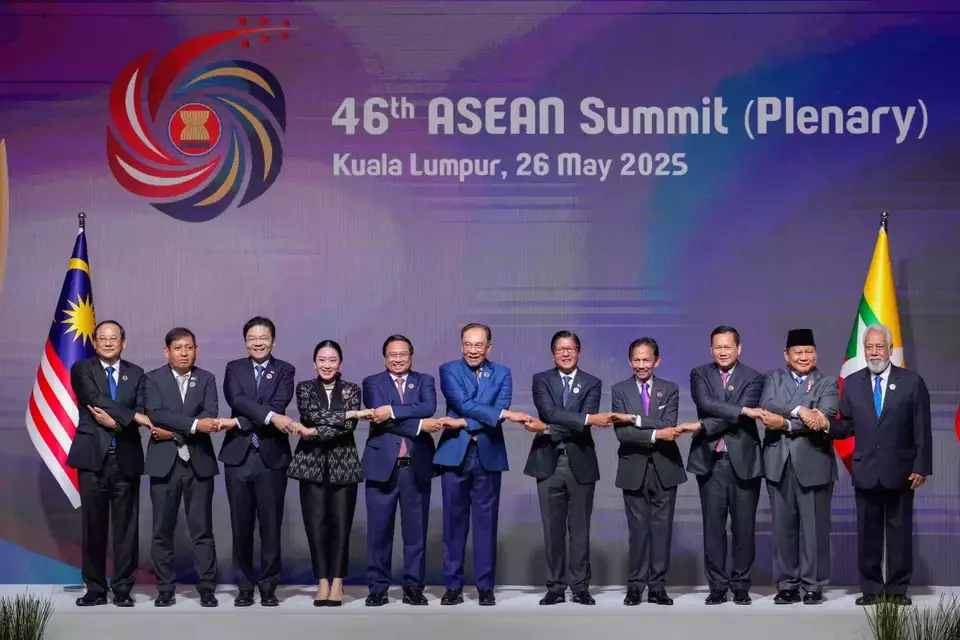
Yet history shows that the stability and progress of Southeast Asia have always rested on ASEAN—and behind ASEAN’s cohesion lies Indonesia’s leadership. Indeed, ASEAN needs Indonesia, and Indonesia needs ASEAN. For decades, ASEAN has served as the anchor of political and security stability in the region. The world respects ASEAN not for its military power, but for its collective voice. From the Cambodian peace process to the creation of RCEP, ASEAN once spoke with one voice—and that was possible because Indonesia played the role of honest broker and agenda-setter.
That voice, however, has grown faint in recent years. ASEAN appears adrift, mired in the pursuit of consensus amid fragmented interests. The Myanmar crisis is the clearest example: ASEAN has lost traction, while major powers interpret its silence as weakness. The absence of strong leadership from Jakarta has left ASEAN without the “soul” that once made it respected. Yet amid the U.S.–China rivalry, ASEAN needs Indonesia’s leadership more than ever—as an anchor of stability and a rational voice in the region. If Indonesia truly aims to be a credible middle power in the Indo-Pacific, leadership within ASEAN is not optional—it is essential.
Becoming a Player, Not a Spectator
Asia’s rise is not only about economic data; it marks a fundamental shift in political orientation. If the 20th century was the “Atlantic century,” the 21st is fast becoming the “Indo-Pacific century.” History tells us that nations slow to read the winds of change are doomed to watch from the sidelines.
Indonesia holds all the ingredients to become a key player: strategic geography, a young population, a large economy, and proven diplomatic credibility. But these assets must be activated by vision and political courage. We cannot wait for “perfect domestic stability” before acting—true leadership is tested precisely amid global turbulence. Indonesia must step out of the mirror—stop gazing inward—and look outward again. It must reclaim its role as ASEAN’s driver, Asia’s bridge to the world, and the Indo-Pacific’s stabilizer. The world is changing fast—and history does not wait for the hesitant.
----
Iman Pambagyo is former DG for International Trade Negotiations (2012-2014 & 2016-2020); Ambassador to WTO (2014-2015).
This is his personal views
Tags: Keywords: as a preferred
Related Articles

IMF Upgrades Indonesia’s 2026 Growth Forecast to 5.1%
Indonesia has yet to beat Vietnam as the fastest-growing ASEAN economy.
ASEAN Digital Pact to Drive Cross-Border Payments
ASEAN is set to sign its digital economy pact, which Standard Chartered believes will change how the members do business with each other.
Indonesia Races with ASEAN Neighbors for Investments
Indonesia and its ASEAN neighbors are pursuing aggressive reforms to attract foreign investors, according to Investment Minister Rosan.
ADB to Inject Another $3 Billion to ASEAN Tourism
Between 2015 and 2025, ADB has deployed over $3.7 billion to turn ASEAN into better tourist magnets.
‘ASEAN Members Don’t Always Agree, But We Stay Together’: Indonesia
Indonesia says ASEAN members “choose to keep talking, even when agreement is difficult”.
Indonesia Wants to Link QR Payment with Timor-Leste
In ASEAN, Indonesia's QRIS payment system is already available in Singapore, Thailand, and Malaysia.
Hong Kong Investors Gain Equal Treatment in New ASEAN Deal
ASEAN has promised not to treat Hong Kong investors differently under a freshly inked deal.
Indonesia Says Still No Protests from ASEAN Neighbors over Haze
Indonesia maintains "good relations" with its ASEAN neighbors on tackling the transboundary haze, according to the Foreign Ministry.
Vietnam’s $80 Billion EU Trade Shows Indonesia’s Untapped Potential: Ambassador
Indonesia-EU trade remains below its potential, with the bloc's ambassador pointing to Vietnam's $80 billion trade benchmark.
ASEAN Has a Haze Agreement But Regional Action Is Still Limited
ASEAN mechanism might be a realistic way to combat the region’s haze, although it comes with limitations, according to experts.The Latest

Ye Concert, Other Events to Draw 130,000 to GBK, Here’s What to Know
Around 130,000 visitors are expected at Jakarta’s GBK on Saturday as Ye’s concert and several major events take place.
Indonesia Allocates Rp 722 Billion for Year-End Flight Ticket Tax Relief
Indonesia allocates Rp 722 billion to cover domestic flight ticket VAT during the 2026/2027 Christmas and New Year holidays.
Greece Floats Shipbuilding Partnership with Indonesia
Greece says that it possesses “extensive expertise” as it woos Indonesia in shipbuilding partnership.
Indonesian Stocks Rally 4.9%, but Foreign Investors Keep Selling
Indonesia’s JCI rose 4.9% last week, but foreign selling and MSCI downgrade risks continue to cloud the market outlook.
Ye Concert in Jakarta to Deploy 2,000 Security Personnel
More than 2,000 personnel will secure Ye’s Jakarta concert on Saturday, as organizers urge fans to use public transport.Most Popular
