



Japan Braces for Economic Fallout as China Tightens Travel Curbs
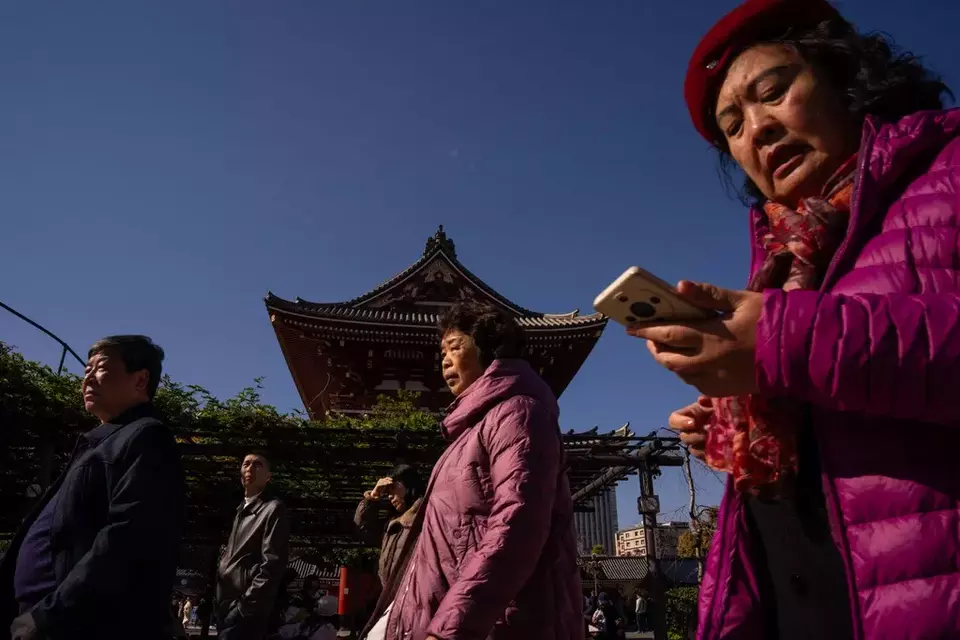
Tokyo/Beijing. Just days after China issued an advisory against traveling to Japan, the cancellations began.
About 3,000 Chinese tourists visit Rie Takeda’s tearoom in a Tokyo alley each year. But some 200 have already canceled bookings for her tea ceremony classes, stretching as far ahead as January.
“I just hope the Chinese tourists return by Chinese New Year,” she said, referring to the major holiday in February. Past experience suggests the wait could be much longer.
China is again turning to a familiar playbook to signal its displeasure with Japan for refusing to retract a statement by its new prime minister on the highly sensitive issue of Taiwan.
As it did with tariffs on Australian wine in 2020 and restrictions on Philippine bananas in 2012, Beijing is leveraging its economic influence while unleashing a barrage of criticism at Tokyo. The only question is how severe the measures will become and how long they will last.
“China’s countermeasures are kept secret and will be rolled out one by one,” said Liu Jiangyong, an international relations professor at Tsinghua University in Beijing. “Anything is possible because this involves the nation’s core interests.”
Disputes Can Drag On for More Than a Year
China was angered by Prime Minister Sanae Takaichi’s recent statement suggesting Japan’s military could intervene if China took action against Taiwan, the self-ruled island Beijing claims as its own.
Japan is trying to prevent the feud from escalating but shows no sign of backing down, mirroring how other governments have responded to China’s pressure in recent years: hold firm, take the economic hit, and wait. Some of these disputes have stretched on until new political leadership arrives.
Australia’s trade ties with China have gradually normalized since Prime Minister Anthony Albanese took office in 2022. Canada is also beginning to repair ties under Prime Minister Mark Carney.
Travel Advisory Begins to Bite
Japan has faced China’s economic backlash before. In 2012, after a dispute over uninhabited islands claimed by both countries, Chinese protesters attacked Japanese businesses and boycotted their goods. Tour groups to Japan were canceled.
Using that episode as a reference, Nomura Research Institute economist Takahide Kiuchi estimated the current advisory could cost Japan 1.8 trillion yen ($11.5 billion) and shave 0.3 percentage points off its already weak annual growth.
Tour cancellations are mounting again. Gamagori Hotel in Aichi prefecture has lost more than 2,000 guests. Nichu Syomu, a Japan-based travel company serving Chinese tourists, said 300 bookings had been canceled, a loss comparable to 2012.
China had been on track this year to reclaim its pre-pandemic status as Japan’s largest tourist source. More than 8 million Chinese visited in the first 10 months of the year, accounting for 23 percent of all arrivals, according to the Japan National Tourism Organization.
“It’s a shame,” said Nana Enomoto of Nichu Syomu, noting that Chinese tourism had only just begun to recover.
Some Chinese Tourists Cancel, Others Don’t
Kyren Zhu, who had never visited Japan, struggled with the decision. Her parents urged her not to go. She ultimately canceled a planned trip to see fall foliage, only to learn from her traveling companion that nothing unusual had happened.
“If I’d known, I probably would’ve gone,” she said. “But it’s hard to say. The situation is really beyond our control.”
In northern Japan, Beijing resident Livia Du, who opened a ski lodge last year, received two cancellations. They were quickly replaced by other Chinese visitors. But some customers told her they had to follow Beijing’s stance. One said government employees had been instructed not to travel to Japan for now.
Guests appear to be in wait-and-see mode, Du said. She and her husband invested more than 2 million yuan ($280,000) in the lodge, and she worries the situation might deteriorate.
China Signals It May Take Further Steps
The pressure appears to be extending beyond tourism. Chinese releases of two Japanese films — the comedy Cells at Work! and the animated Crayon Shin-chan the Movie: Super Hot! The Spicy Kasukabe Dancers were abruptly postponed.
A comedy festival in Shanghai canceled shows by a Japanese entertainment company. A book editor said her boss told her to halt work on importing a Japanese comic book.
Meanwhile, the outlook for seafood exports remains murky. Tokyo denied reports that China would lift its two-year ban on Japanese seafood, and China’s Foreign Ministry said Japan had failed to submit the technical documents required to resume trade.
Beijing could also target rare earth exports, crucial to auto manufacturing and other industries, which it weaponized against the United States earlier this year.
“Japan should retract its erroneous remarks and take concrete actions to maintain the political foundation of China-Japan relations,” Foreign Ministry spokesperson Mao Ning said. “Otherwise, China will have to take further measures.”
 as a preferred
The Latest

Chandra Asri Group Receives Trade Finance Excellence Award, Reinforcing Its Role in Indonesia’s Industrial Development
Chandra Asri Group receives the Trade Finance Excellence Award at CIMB Niaga Business Summit 2026.
AEON MALL Deltamas Brings 11 Sports and Creative Competitions to AEONLYMPIC 2026
AEON MALL Deltamas hosts AEONLYMPIC 2026, featuring 11 sports and creative competitions, with more than 3,100 participants.
Indonesian Stocks Extend Losses for Third Day, Fall 3.64% to 4,996
Indonesian stocks fell 3.64% on Monday, extending losses for a third straight session amid MSCI concerns and tighter trading limits.
Prabowo Calls Meeting on Forest Fires as Haze Reaches Jakarta, Singapore
Prabowo summons senior officials to discuss forest fires as smoke reaches Jakarta and Malaysia pushes for regional action.
Jakarta Outranks Amsterdam in Global Public Transport Survey
Jakarta climbs two places to 15th in Time Out's 2026 public transport survey, with its governor citing better network integration.Most Popular
