



Germany’s Next Leader? Friedrich Merz Prepares for Chancellorship
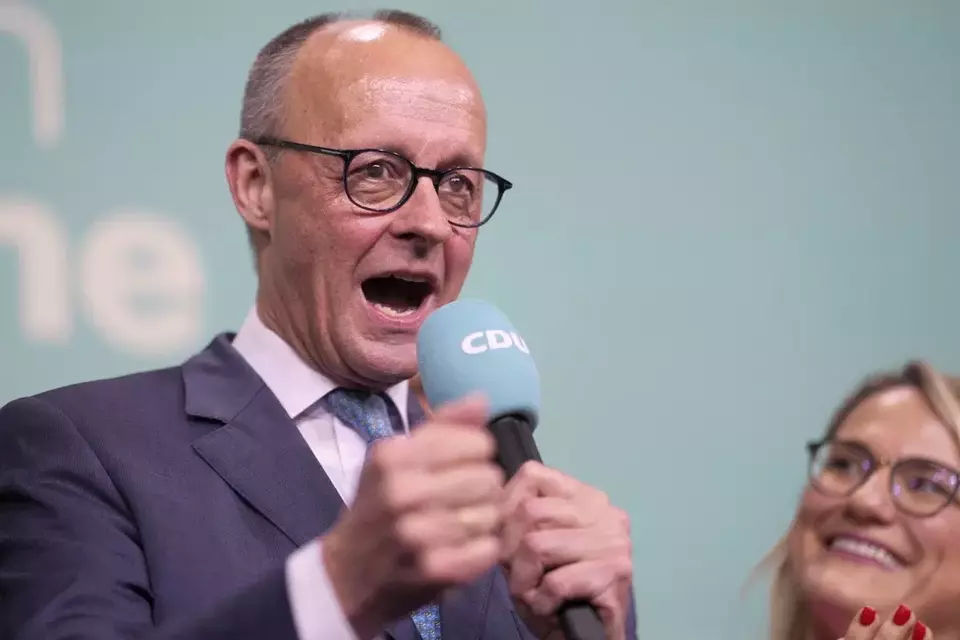
Berlin. Friedrich Merz, set to become post-World War II Germany's 10th chancellor following the country’s election, has vowed to prioritize European unity and security amid the challenges posed by a new Trump administration and Russia’s war on Ukraine.
Unifying a divided Europe will be difficult, especially as many leaders are preoccupied with domestic issues. However, expectations will be high for Merz to help fill the leadership void and craft a cohesive response to shifting US policies that have strained transatlantic ties.
His task will be further complicated by the need to form a coalition with the center-left Social Democrats of outgoing Chancellor Olaf Scholz. Merz has repeatedly pledged not to collaborate with the far-right Alternative for Germany (AfD) despite its second-place finish.
The 69-year-old conservative leads the center-right Union bloc, which won the national election with 28.5 percent of the vote.
“I am aware of the scale of the task ahead,” he told supporters after his victory Sunday night. “The world won’t wait for us, and it won’t wait for drawn-out coalition negotiations.”
A Rivalry With Merkel
Merz’s path to power has been long. A lawyer by profession, his rise was derailed in the early 2000s by former Chancellor Angela Merkel, who consolidated her grip on Germany’s center-right after the Union bloc narrowly lost the 2002 election. She sidelined Merz as leader of its parliamentary group and took the position herself, eventually leading Germany from 2005 to 2021.
Merkel once described Merz as a brilliant speaker and commended his leadership ambition but acknowledged their rivalry.
“We are almost the same age… We grew up completely differently, which was more of an opportunity than an obstacle,” she wrote in her memoir Freedom.
“But there was one problem from the start: We both wanted to be the boss.”
A Break From Politics
After leaving parliament in 2009, Merz stepped away from politics, practicing law and serving as the chairman of investment giant BlackRock’s German branch. During that time, he frequently traveled to the US and China for business but never lived abroad.
“Friedrich Merz is perhaps the most international chancellor Germany has had since the war—if he becomes chancellor,” said Volker Resing, author of a recent biography on Merz.
Resing describes Merz as a leader who values individual initiative, creativity, and motivation over state intervention.
Political Comeback
Merz returned to politics after Merkel stepped down as CDU leader in 2018, though he lost two bids for party leadership before securing the position in 2021. He strengthened his influence by also leading the Union’s parliamentary group.
According to Resing, Merz does not shy away from confrontation. “He believes a certain level of provocation can spark real debate and drive meaningful change.”
During the election campaign, Merz pledged to revitalize Germany’s struggling economy and tighten immigration policies.
With Donald Trump returning to the White House and tensions rising over Ukraine, Merz, a long-time advocate for strong transatlantic ties, said his top priority is to unify Europe against challenges from both the US and Russia.
“I have no illusions about what’s coming from America,” he told supporters. “We are under massive pressure… My absolute priority is to create unity in Europe.”
A Tough Immigration Stance
Merz put immigration at the center of his campaign after a migrant fatally stabbed two people in the Bavarian city of Aschaffenburg last month. He introduced a nonbinding parliamentary motion to increase migrant deportations, which narrowly passed with votes from AfD lawmakers.
The move sparked accusations that Merz was breaking a long-standing political taboo by aligning with the far-right. Merkel publicly rebuked him, and critics cited it as an example of his impulsive decision-making.
In response, tens of thousands protested against both Merz’s motion and the rising influence of the far right. Merz has denied any collaboration with AfD and has repeatedly pledged never to work with the party.
Rooted in Rural Germany
Merz represents a rural district in western Germany’s Sauerland region, where people are “down-to-earth and reserved,” according to Resing. “That shaped him: rural life.”
A lifelong advocate for conservative values, Merz has emphasized the importance of family. He met his wife, Charlotte, now a judge, while studying law. They have three adult children.
Merz joined the CDU in 1972 and was elected to the European Parliament in 1989 before entering the German Bundestag in 1994.
Passion for Flying
An avid pilot, Merz often flies his small plane from his Sauerland home to Berlin on Monday mornings.
Despite criticism that it is a rich man’s hobby, he has continued flying while serving as opposition leader.
“When you talk to him about flying, his eyes light up,” Resing said. “He says that when you’re above the clouds, that’s freedom.”
Tags: Keywords: as a preferred
The Latest

Prabowo Calls Meeting on Forest Fires as Haze Reaches Jakarta, Singapore
Prabowo summons senior officials to discuss forest fires as smoke reaches Jakarta and Malaysia pushes for regional action.
Jakarta Outranks Amsterdam in Global Public Transport Survey
Jakarta climbs two places to 15th in Time Out's 2026 public transport survey, with its governor citing better network integration.
MSCI Concerns, Tighter IDX Trading Rules Send Indonesian Stocks Down 5% by Midday
Indonesian stocks plunge 5% by midday as MSCI concerns weigh on sentiment and the IDX tightens its daily downside limit to 7%.
Jakarta Prepares 367 Health Facilities as Haze Reaches the Capital
Jakarta prepares 367 health facilities to treat potential haze-related illnesses after smoke from Sumatra and Kalimantan crosses the region.
Jakarta Expands Flood Prevention With New Water Storage Ponds
Jakarta opens two East Jakarta water storage ponds as it expands flood prevention efforts through reservoirs and river normalization.Most Popular
