



Gerindra's Budisatrio Explains TNI Law Revision Amid Fears of New Order Revival
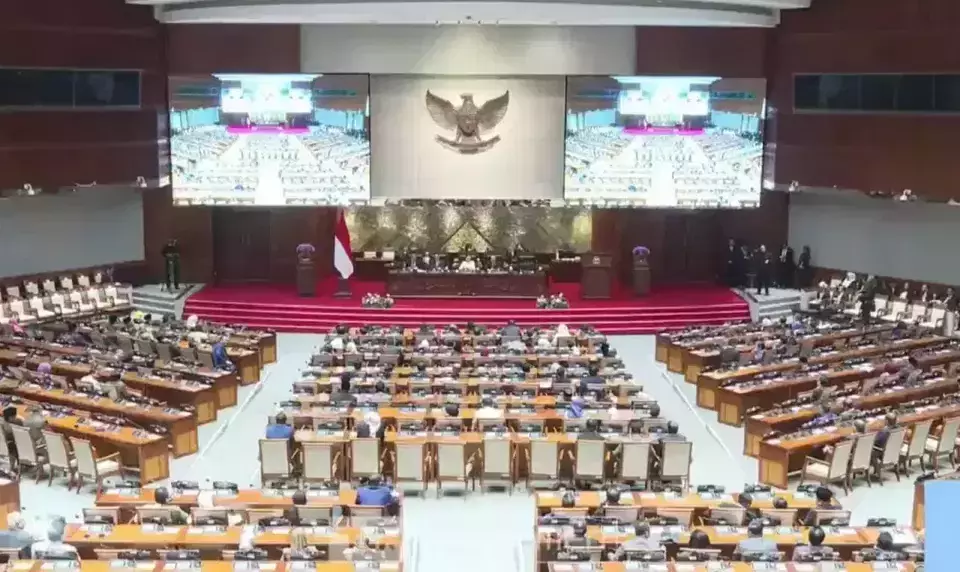
Jakarta. The People’s Representative Council (DPR) approved revisions to the Indonesian National Armed Forces (TNI) Law on Thursday, defending the changes as necessary for national defense despite facing public backlash.
Gerindra Party lawmaker Budisatrio Djiwandono argued that the amendments align with modern security challenges and do not undermine democratic principles. Key revisions include expanded non-war military operations, an increase in active-duty soldier placements in ministries, and raising the retirement age of TNI personnel.
Critics fear the changes could blur civilian-military boundaries and a revival of the authoritarian New Order era under former President Suharto, but DPR insists the reforms are essential for adapting to evolving threats.
"This revision is not a step backward in TNI reform, but rather a form of adaptation to the dynamics of modern defense. We ensure that civil supremacy remains intact, and there is no effort to dominate the civil and political spheres with the military. Additionally, the oversight function will still be carried out by the DPR in accordance with its authority," said Budisatrio.
According to him, there has been a lot of misinformation, such as the issue of TNI's dual function, which led to widespread public objections.
"There is no attempt to reinstate the TNI's dual function in this revision of the TNI Law. The Gerindra faction guarantees that this revision is in line with the spirit of reform," he said.
Budisatrio outlined four key revisions in the newly passed TNI Law, which have drawn public criticism.
1. TNI’s Position in National Defense
The revised Article 3 reaffirms that the Indonesian National Armed Forces (TNI) operates under the Ministry of Defense but is not subordinate to it. The TNI retains authority over defense matters while maintaining existing command structures.
Budisatrio explained that coordination with the ministry is limited to policy, defense strategies, and administrative support, while operational decisions remain with the TNI. He emphasized that this aligns with Article 10 of the 1945 Constitution, which designates the president as the Commander-in-Chief of the military.
2. Expansion of Non-War Military Operations (OMSP)
The amended Article 7 broadens the scope of OMSP to include cyber defense and the protection of Indonesian citizens abroad. The TNI is now tasked with assisting the government in countering cyber threats, a growing concern in national security.
Additionally, the TNI is mandated to protect Indonesian nationals and national interests in crisis situations overseas. Any OMSP operation involving combat, such as addressing separatism, must be regulated by government decree and reported to the DPR. If the DPR objects, the operation must cease.
"This is not about the TNI taking over law enforcement duties but ensuring national defense remains strong against modern threats," Budisatrio stated.
3. Placement of Active-Duty Soldiers in Civilian Institutions
Article 47 expands the number of ministries and agencies where active-duty soldiers can serve from 10 to 15. New additions include the National Disaster Management Agency (BNPB), the National Counterterrorism Agency (BNPT), the Maritime Security Agency (Bakamla), the National Border Management Agency (BNPP), and the Attorney General’s Office.
"Beyond these 15 institutions, no active-duty soldiers will be assigned elsewhere, including state-owned enterprises (BUMN). The rule that active-duty soldiers cannot engage in business remains unchanged. If any soldier wishes to serve outside the designated institutions, they must retire first," Budisatrio asserted.
4. Extension of Retirement Age
One of the most debated changes is Article 53, which raises the retirement age for TNI personnel. Currently, enlisted personnel and non-commissioned officers must retire at 53, while officers retire at 58. The revised law extends the age limits to:
- 55 for enlisted personnel and non-commissioned officers,
- 58 for colonels,
- 60-62 for senior officers,
- 63 for four-star generals, with possible extensions up to 65.
"We found that many soldiers retire while still in their prime and with children in school. This revision ensures the state acknowledges their sacrifices," Budisatrio concluded.
Tags: Keywords: as a preferred
The Latest

UN Boss Wants to Fix Security Council as Indonesia Seeks Seat
Outgoing UN chief Guterres says the current permanent member setup at the Security Council fails to reflect today's realities.
Saudi Flagship Investment Conference Pushed to 2027 after Houthi Attacks
The annual Future Investment Initiative (FII), often dubbed "Davos in the Desert", was originally scheduled to take place from October 26-29
Government Sets Aside Rp 1.3 Quadrillion for Final-Quarter Spending
Government spending has reached Rp 2.66 quadrillion, equivalent to 69.2% of the full-year budget target of Rp 3.84 quadrillion.
Indonesia Probes 98 Corporate Wildfire Cases, Including Possible Foreign Links
Police investigate 98 corporate-related wildfire cases, including possible links to investors from neighboring countries.
Students Plan Jakarta Protests to Mark Two Years of Prabowo's Presidency
Police have advised the public to avoid areas around the House of Representatives complex, the National Monument and the State Palace.Most Popular
