



Delta Jet Overturns on Toronto Runway, All 80 Aboard Survive
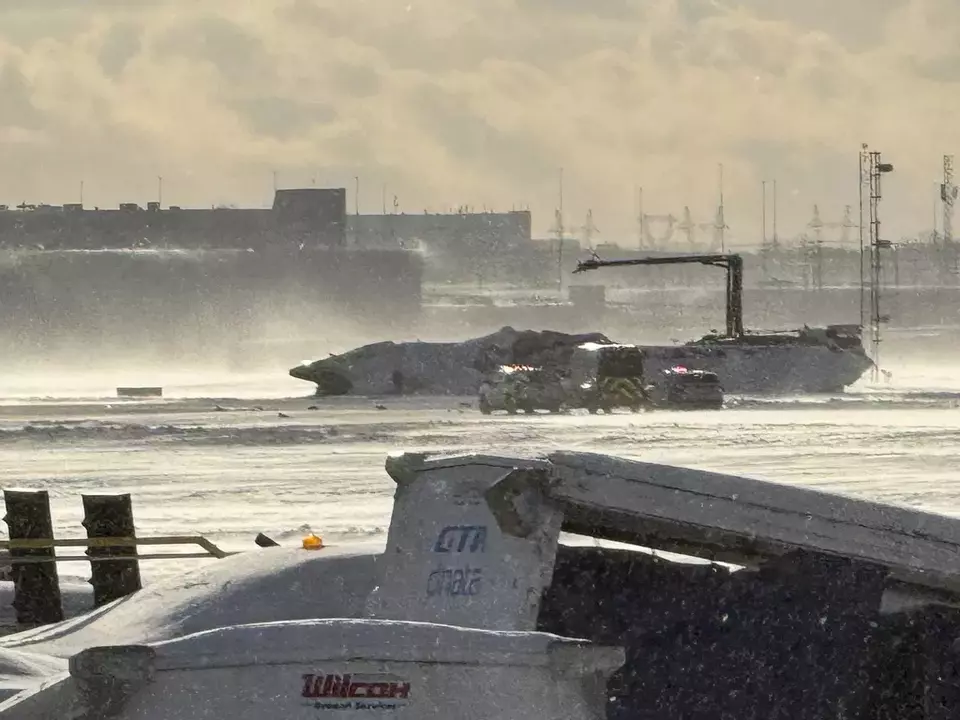
Jakarta. A Delta Air Lines jet flipped onto its roof while landing at Toronto’s Pearson Airport on Monday, but all 80 people aboard survived, and those injured sustained only minor injuries, the airport’s chief executive said.
The flight from Minneapolis, carrying 76 passengers and four crew members, was attempting to land around 2:15 p.m. when snow was being blown by winds gusting to 40 mph (65 kph). Communications between the tower and the pilot were normal during the approach, but it remains unclear what caused the drastic incident upon touchdown.
Canadian authorities held two brief news conferences but provided no further details on the crash. Videos posted on social media showed the aftermath, with the Mitsubishi CRJ-900LR overturned. The fuselage appeared intact as firefighters extinguished the remaining flames while passengers climbed out and walked across the tarmac.
“We are very grateful there was no loss of life, and that the injuries were relatively minor,” said Deborah Flint, CEO of the Greater Toronto Airports Authority.
Toronto Pearson Fire Chief Todd Aitken confirmed that 18 passengers were taken to the hospital. Earlier, Ornge air ambulance reported transporting one pediatric patient to Toronto’s SickKids hospital, along with two injured adults to other city hospitals.
Emergency personnel arrived on the scene within minutes. Aitken confirmed the response “went as planned,” and said, “The runway was dry, and there were no cross-wind conditions.”
This crash marks the fourth major aviation accident in North America in the past three weeks. On Jan. 29, a commercial jetliner and an Army helicopter collided near Reagan National Airport in Washington, DC, killing 67 people. A medical transport plane crashed in Philadelphia on Jan. 31, killing six onboard and one person on the ground. Additionally, a plane crash in Alaska on Feb. 6 claimed the lives of 10 people.
The last major crash at Pearson occurred on Aug. 2, 2005, when an Airbus A340 from Paris skidded off the runway and burst into flames amid stormy weather. All 309 passengers and crew members on Air France Flight 358 survived.
On Monday, Pearson was experiencing blowing snow with winds of 32 mph (51 kph) gusting to 40 mph (65 kph), according to the Meteorological Service of Canada. The temperature was around 16.5 degrees Fahrenheit (minus 8.6 degrees Celsius).
The Delta flight was cleared for landing at approximately 2:10 p.m. Audio recordings revealed that the control tower had warned pilots of a potential airflow “bump” on approach.
“It sounds to me like a controller trying to be helpful, suggesting that the wind might cause a bumpy ride,” said John Cox, CEO of aviation safety consulting firm Safety Operating Systems in St. Petersburg, Florida. “The planes are designed and certified to handle such conditions, and the pilots are well-trained and experienced in managing them.”
The plane came to rest at the intersection of Runways 23 and 15L, near the beginning of the runway. Moments after the crash, tower controllers spoke with the crew of a medical helicopter that had just departed Pearson and was returning to assist.
“Just so you’re aware, there are people outside walking around the aircraft,” a controller said.
“Yeah, we’ve got it. The aircraft is upside down and burning,” the medical helicopter pilot responded.
Cox, who flew for US Air for 25 years and has worked on US National Transportation Safety Board (NTSB) investigations, noted that the CRJ-900 is a reliable aircraft, well-suited to handle inclement weather.
“It’s rare for a plane to end up on its roof,” Cox said. “We’ve seen a few takeoffs where planes have ended inverted, but it’s unusual.”
Cox also raised the question of why the plane was missing its right wing. “If one wing is missing, the aircraft tends to roll over,” he explained. “These will be key questions for investigators, who will examine the flight data recorder and cockpit voice recorder to piece together what happened.”
The US. Federal Aviation Administration (FAA) stated that the Transportation Safety Board of Canada would lead the investigation and provide updates. The NTSB said it would assist the Canadian team.
Delta CEO Ed Bastian expressed his support, saying, “The hearts of the entire global Delta family are with those affected by today’s incident at Toronto Pearson International Airport.”
Minnesota Governor Tim Walz confirmed he has been in contact with Delta regarding the crash.
Endeavor Air, based in Minneapolis, is a subsidiary of Delta Air Lines and the world’s largest operator of CRJ-900 aircraft. The airline operates 130 regional jets on 700 daily flights to more than 126 cities in the US, Canada, and the Caribbean.
The CRJ-900, a popular regional jet, was developed by Canadian aerospace company Bombardier. It is part of the same aircraft family as the CRJ-700, involved in the midair collision near Reagan National Airport on Jan. 29.
Tags: Keywords: as a preferred
The Latest

Chandra Asri Group Receives Trade Finance Excellence Award, Reinforcing Its Role in Indonesia’s Industrial Development
Chandra Asri Group receives the Trade Finance Excellence Award at CIMB Niaga Business Summit 2026.
AEON MALL Deltamas Brings 11 Sports and Creative Competitions to AEONLYMPIC 2026
AEON MALL Deltamas hosts AEONLYMPIC 2026, featuring 11 sports and creative competitions, with more than 3,100 participants.
Indonesian Stocks Extend Losses for Third Day, Fall 3.64% to 4,996
Indonesian stocks fell 3.64% on Monday, extending losses for a third straight session amid MSCI concerns and tighter trading limits.
Prabowo Calls Meeting on Forest Fires as Haze Reaches Jakarta, Singapore
Prabowo summons senior officials to discuss forest fires as smoke reaches Jakarta and Malaysia pushes for regional action.
Jakarta Outranks Amsterdam in Global Public Transport Survey
Jakarta climbs two places to 15th in Time Out's 2026 public transport survey, with its governor citing better network integration.Most Popular
