



Code of Conduct Won't Solve Root Problems in South China Sea
Jakarta. An ASEAN deputy secretary-general recently tried to deal with the unrealistic expectations that people had for the code of conduct on the South China Sea.
The South China Sea, which accounts for at least a third of the global maritime trade, has Beijing and some ASEAN members claiming over parts of the strategic waterway. To prevent conflict, ASEAN and China are negotiating a code of conduct: a set of defined rules that outline how they should behave in the South China Sea.
Both sides have agreed to finish the negotiations within three years’ time, and more rounds of talks are expected to take place by then. They have also adopted a guideline aimed to speed up the talks.
According to Robert Matheus Michael Tene, the deputy secretary-general for ASEAN's Political-Security Community, people have the "wrong expectations" if they believe the code of conduct can resolve the overlapping maritime borders or exclusive economic zones (EEZ).
The code of conduct is more of a non-aggression pact. In other words, it focuses on urging countries to exercise self-restraint and undertake peaceful means if conflict ever arises. The same goes for the “Declaration on Conduct”: a non-binding document that ASEAN-China had already adopted in 2002.
“Maritime boundary issues [are something] that you have to negotiate bilaterally. They cannot be solved through the code of conduct,” Michael said at a Foreign Policy Community of Indonesia (FPCI) forum in Jakarta on Friday.
“The declaration and code of conduct are not meant to solve the root causes of the issues in the South China Sea, which are the maritime borders and EEZs," he said.
Michael Tene added: "[The documents] are only meant to create the environment that is conducive for all parties to have friendly negotiations. It is meant to help prevent conflicts and manage the situation if it ever erupts."
The code of conduct also needs more rounds of negotiations before it could see the light of the day.
“There are many rounds. This year, under Indonesia's [ASEAN] chairmanship, negotiations are only scheduled for the second round,” Michael Tene said.
“Expecting us to conclude the code of conduct in 2023, in just the second round, is an unreasonable expectation,” he told the conference.
He added: “I’m not belittling the seriousness of the incidents that had happened in the South China Sea in the past years. Some were very serious. … But the incidents have not led to open conflicts. This shows the declaration on conduct --as well as the code of conduct process-- actually work.”
Beijing and four ASEAN members -- Brunei Darussalam, Malaysia, the Philippines, and Vietnam -- hold overlapping claims in the South China Sea.
China recently introduced a new national map that expanded its territorial claims, just ahead of the 43rd ASEAN Summit in Jakarta. Other claimants, including the Philippines, immediately lodged protests against Beijing’s new map. The controversial map also came not long after Manila accused China of using a water cannon against a Philippine military supply boat in the South China Sea.
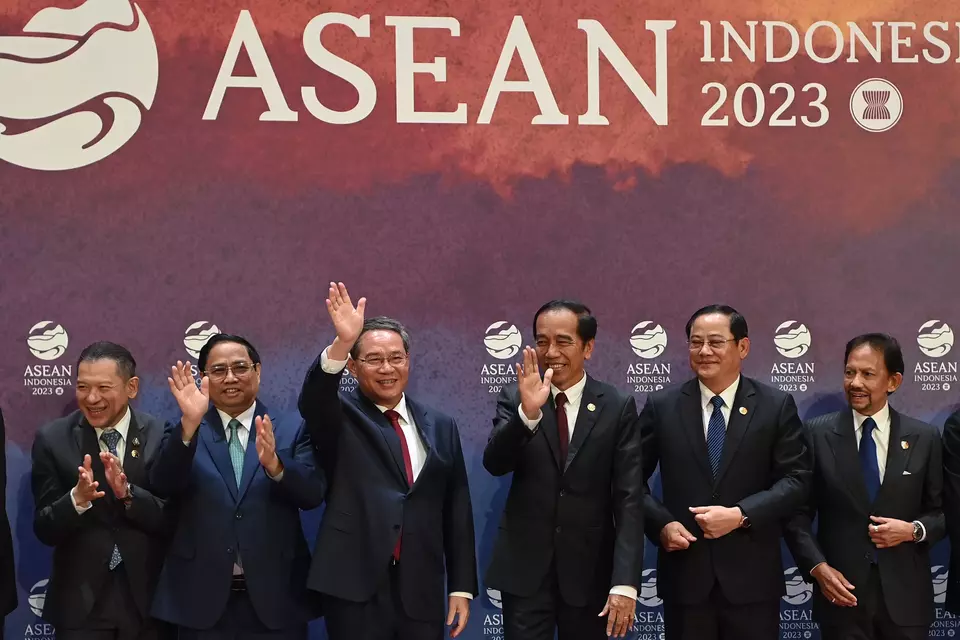
Just last week, ASEAN leaders and Chinese Premier Li Qiang assembled in Jakarta for an annual summit. As expected, the South China Sea was on the agenda.
The chair’s statement on the summit wrote that some members expressed concerns over the land reclamations and serious incidents in the area, including damage to the marine environment. The members also welcomed the “positive momentum” of the code negotiations, marked by the completion of the second reading of the single draft negotiating texts, among others.
In 1992, ASEAN issued a declaration that called for a peaceful dispute resolution in the South China Sea. A decade later, China and ASEAN issued the Declaration on Conduct document that mandated the establishment of the code.
Read More: Li Qiang Brings ASEAN’s Attention to Skyrocketing Trade Amid Map Controversy
Tags: Keywords: as a preferred
Related Articles

Global Town Hall Urges Global ‘U-Turn’ as International Order Faces Strain
Global Town Hall 2026 brings 8,300 participants from 120 countries together to debate development, justice and global challenges.
Indonesia Net-Zero Summit 2026 Draws Nearly 10,000 Participants to Push Climate Action
Nearly 10,000 participants joined Indonesia Net-Zero Summit 2026 as leaders called for turning climate commitments into concrete action.
ASEAN Won’t Launch a ‘Bad’ South China Sea Code, Philippines Says
ASEAN chair Philippines doubts Beijing and the group will launch a poorly made code of conduct on the disputed South China Sea.
Indonesia Wants South China Sea Code ASAP as Beijing, Manila Clash
Beijing and the Philippines are now trading accusations over a clash at the South China Sea.
Dear Mr. President, Don’t Skip ASEAN Summits
Despite calls for Prabowo to stay home, the Indonesian leader still needs to attend ASEAN summits.
ASEAN to Set Up Maritime Center to Keep South China Sea Orderly
ASEAN has not worked on the details of the maritime center, Manila says, but members have agreed that it will monitor the South China Sea.The Latest

Prabowo Calls Meeting on Forest Fires as Haze Reaches Jakarta, Singapore
Prabowo summons senior officials to discuss forest fires as smoke reaches Jakarta and Malaysia pushes for regional action.
Jakarta Outranks Amsterdam in Global Public Transport Survey
Jakarta climbs two places to 15th in Time Out's 2026 public transport survey, with its governor citing better network integration.
MSCI Concerns, Tighter IDX Trading Rules Send Indonesian Stocks Down 5% by Midday
Indonesian stocks plunge 5% by midday as MSCI concerns weigh on sentiment and the IDX tightens its daily downside limit to 7%.
Jakarta Prepares 367 Health Facilities as Haze Reaches the Capital
Jakarta prepares 367 health facilities to treat potential haze-related illnesses after smoke from Sumatra and Kalimantan crosses the region.
Jakarta Expands Flood Prevention With New Water Storage Ponds
Jakarta opens two East Jakarta water storage ponds as it expands flood prevention efforts through reservoirs and river normalization.Most Popular
