



Overlapping Deforestation Laws in EU, Indonesia Hurt Furniture Exports
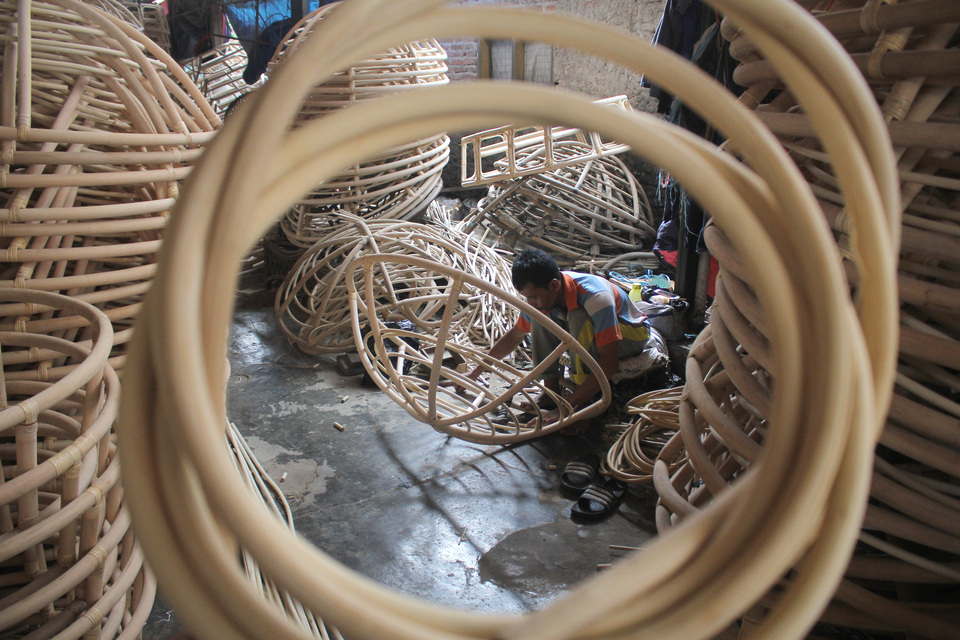
Jakarta. Overlapping regulations are adding pressure on the national furniture export already suffering from declining orders from a number of major markets. The European Union's Deforestation Regulation (EUDR) and the Indonesian government's Wood Legality Verification System (SVLK) could potentially hurt the domestic furniture industry and erode Indonesia's furniture export competitiveness.
The EUDR and the SVLK policy actually carry similar regulations, that furniture products sold to overseas countries do not fuel deforestation.
"The EUDR carries regulations more thoroughly and it's not easy to challenge an internal policy there. It possibly requires certification not just for trees and timbers, but also the forests themselves," Abdul Sobur, the chairman of the Presidium of the Indonesian Furniture and Handicraft Industry Association (Himki), told Investor Daily in a recent interview.
"Because of its wholistic nature, the EUDR should have overridden other regulations such as the SLVK," Abdul added.
The EUDR came into force on May 16 to make sure that all 27 EU member countries do not buy products that have led to deforestation and forest degradation since 2021.
Meanwhile, the SLVK is an initiative by the Indonesian government to push the implementation of regulations on the legal use of forest products in Indonesia.
If regulations similar to the EUDR are also implemented, they will only add costs and eventually weaken Indonesia's competitiveness in the industry, Abdul said.
"Basically we want the ease in [furniture] exports. Unnecessary costs must be eliminated to boost our competitiveness," he said.
He said demands from the U.S. and European -- Indonesia's two biggest furniture export destinations -- are weakening. The European market shares around $1 billion or around 35 percent of Indonesia's total national furniture exports every year.
Restrictive regulations could hamper the target to achieve $5 billion in furniture export next year. Indonesia's overall furniture exports stood at $3.5 billion last year and are expected to grow by 8 percent to around $ 3.78 billion this year.
Governmental Support
Shinta Kamdani, Vice Chairman of the Indonesian Chamber of Commerce and Industry (Kadin), said businesses need government support to boost export by focusing on "policies that minimize bureaucracy."
One of the ways, she mentioned, is by reducing unnecessary export restrictions and procedures that are not requested by the destination countries.
The government is also expected to create new export financing programs that cover export supply chain financing and lowering export duties, she added.
"In fact, there can be further expansion in strategies to increase exports through other means such as facilitating the distribution of productive/business loans, enhancing affordability and efficiency, as well as using incentive funds for productive economic activities," she explained.
Looking ahead, according to Shinta, businesses particularly Micro, Small, and Medium Enterprises need interest rates to be affordable.
"If it is not possible to lower the interest rates, at least there should be assistance schemes such as guarantees or graduated interest rate schemes based on the loan amounts, relaxation of credit terms, and others. This includes providing financial literacy education to MSMEs to make them more bankable," she added.
Tags: Keywords: as a preferred
Related Articles

Indonesia’s Sustainable Cocoa is Not Only for EU
The EU will soon only accept imported cocoa that is proven to not come from deforested land.The Latest

Chandra Asri Group Receives Trade Finance Excellence Award, Reinforcing Its Role in Indonesia’s Industrial Development
Chandra Asri Group receives the Trade Finance Excellence Award at CIMB Niaga Business Summit 2026.
AEON MALL Deltamas Brings 11 Sports and Creative Competitions to AEONLYMPIC 2026
AEON MALL Deltamas hosts AEONLYMPIC 2026, featuring 11 sports and creative competitions, with more than 3,100 participants.
Indonesian Stocks Extend Losses for Third Day, Fall 3.64% to 4,996
Indonesian stocks fell 3.64% on Monday, extending losses for a third straight session amid MSCI concerns and tighter trading limits.
Prabowo Calls Meeting on Forest Fires as Haze Reaches Jakarta, Singapore
Prabowo summons senior officials to discuss forest fires as smoke reaches Jakarta and Malaysia pushes for regional action.
Jakarta Outranks Amsterdam in Global Public Transport Survey
Jakarta climbs two places to 15th in Time Out's 2026 public transport survey, with its governor citing better network integration.Most Popular
