



Market Credibility Tested as Global Index Decisions Weigh on Indonesia
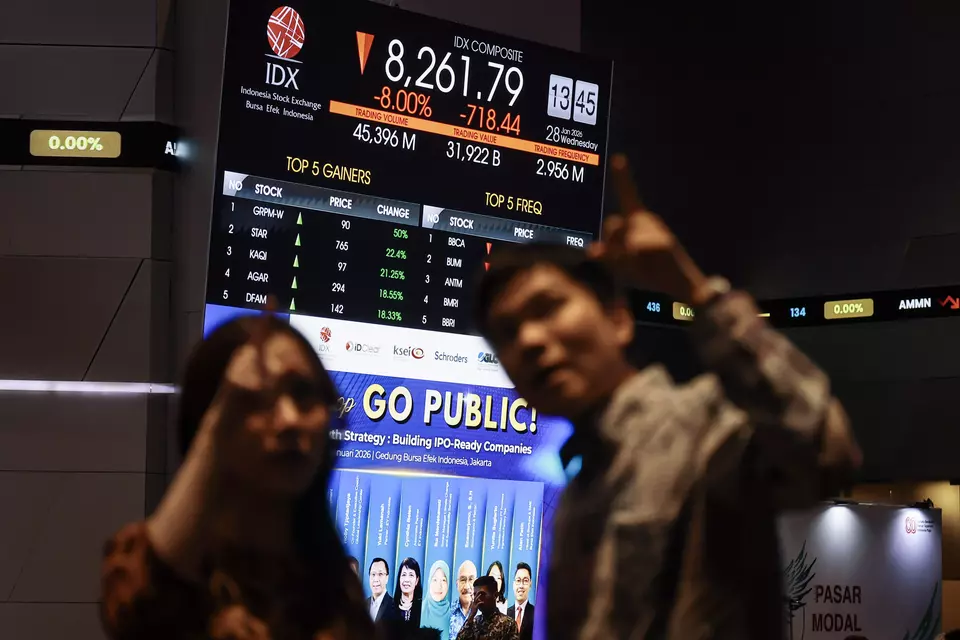
Jakarta. Global scrutiny over Indonesia’s capital market has intensified as a series of index review suspensions and rating concerns threaten foreign passive inflows and raise the risk of capital flight.
After earlier pressure from MSCI Inc. that triggered a temporary trading halt and Moody’s Ratings’ outlook downgrade that weighed on the bond market, credibility concerns resurfaced when FTSE Russell postponed its planned March review of Indonesian equities.
The delay is closely tied to rising risk and lingering uncertainty over public share ownership, or free float, which remains central to Indonesia’s capital market reform agenda. “FTSE will continue to monitor reform developments and will announce updates in the quarterly review of the FTSE Global Equity Index Series 2026 on Friday, May 22, 2026,” the index provider said in an official document cited Tuesday.
The postponement carries significant implications. No stocks will be added or removed, and there will be no classification or weighting adjustments, removing a key catalyst for foreign passive inflows that typically accompany index rebalancing. With both FTSE and MSCI delaying reviews, the expected liquidity boost has effectively stalled.
Hendra Wardana, founder of Republik Investor and a market observer, said the FTSE delay could postpone fresh inflows into stocks previously seen as index inclusion candidates. “This condition encourages market participants to adopt a defensive stance and triggers sentiment-driven volatility rather than fundamentals,” he said Tuesday.
Shrinking liquidity risks may deepen if passive funds shift toward markets viewed as more credible and globally aligned. The concern has been reinforced by two global investment banks: Goldman Sachs downgraded Indonesia equities to underweight from market weight, while UBS Group no longer lists Indonesia among its preferred markets, moves linked to MSCI’s questions about the market’s investability.
Moody’s recent downgrade of Indonesia’s outlook from stable to negative has also pushed up government bond yields, heightening the risk of capital outflows.
Reform Push Ahead of MSCI Talks
The Indonesia Stock Exchange is scheduled to hold another meeting with MSCI on Wednesday to accelerate reform discussions. Interim president director Jeffrey Hendrik said an initial meeting took place on Feb. 2, followed by the submission of reform documents by the Self-Regulatory Organizations (SRO) and the Financial Services Authority (OJK) on Feb. 5.
“The Indonesian team, namely the SRO and OJK, submitted a proposal to MSCI on Feb. 5. A follow-up technical meeting will be held again on Feb. 11, 2026,” Jeffrey said at a press conference in Jakarta on Monday.
The exchange will present an accelerated action plan aimed for completion before the end of April 2026, in line with global feedback. A key measure is refining investor classification within the Single Investor Identification structure at the central securities depository, expanding categories from nine to 28 subcategories to provide more detailed and accurate ownership data.
The exchange will also propose broader ownership disclosure, lowering the reporting threshold from above 5% to above 1% in line with international best practice, including India. In addition, the minimum free float requirement for listed companies is set to rise from 7.5% to 15% to maintain listing eligibility.
Regarding FTSE, Jeffrey said the index provider supports the reform roadmap. “In our meeting with FTSE, they emphasized the importance of implementing reforms according to the stated timeline. We appreciate the support, and FTSE has no concern regarding country classification. The index review delay is purely technical and unrelated to any potential change in Indonesia’s classification,” he said.
Since MSCI froze index rebalancing and FTSE later postponed its review, foreign investors have recorded a net sell of Rp 16.51 trillion ($983.75 million). The largest outflow, around Rp 10.8 trillion, occurred on Jan. 28–29, coinciding with MSCI’s freeze announcement. By contrast, foreigners logged only Rp 1.6 trillion in net buy.
Jakarta Composite Index fell during the MSCI announcement but rebounded after FTSE’s delay, closing 1.24% higher at 8,131.7 on Tuesday.
Praska Putrantyo, chief executive of Edvisor Profina Visindo, attributed the rebound to domestic investors who had already mitigated risks following the sharp late-January correction. “Local investors appear to have priced in the Moody’s and FTSE issues. After the significant correction triggered by MSCI, they are now more willing to accumulate large-cap stocks,” he said Tuesday.
Still, the recovery may prove temporary as the index remains in a post-crash consolidation phase with a short-term bearish trend. The JCI is projected to move within support at 7,888 and resistance at 8,535.
Tags: Keywords: as a preferred
Related Articles

MSCI Concerns, Tighter IDX Trading Rules Send Indonesian Stocks Down 5% by Midday
Indonesian stocks plunge 5% by midday as MSCI concerns weigh on sentiment and the IDX tightens its daily downside limit to 7%.
Jusuf Hamka’s $227 Million Buy Not Instant Cure to Indonesia’s Market Crash
Seasoned businessman Jusuf Hamka has floated plans to buy up to Rp 5 trillion (around $277 million) in shares amid market crash.
IDX Caps Daily Stock Losses at 7% as MSCI Fallout Fuels Sell-Off
IDX cuts the daily stock loss limit to 7% to curb MSCI-driven selling, but analysts warn market pressure could persist.
Indonesian Stocks Sink Toward 4,900 as MSCI Threat, $110 Oil Bite
Indonesian stocks plunged 4.31% to a 2026 low near 4,900 as MSCI downgrade fears and oil prices topping $110 per barrel.
Indonesian Businesses Fear Premature MSCI Downgrade’s Effect
Kadin says the planned reclassification can take a toll on companies' expansion plans and job creation.
Black Week for Indonesia Stocks Exchange as Market Loses $85 Billion
Indonesia’s stocks plunged 14.91% in a week, wiping out $94 billion in market value as MSCI weighs a downgrade to standalone status.
'MSCI is Not Always Right’: Indonesia Tells Investors to Calm Down
Senior deputy economy minister says "not everything that MSCI does is beneficial for investors" as Indonesian stocks plunge.
Indonesian Stocks End at 2026 Low After Losing 11.57% on MSCI Warning
Indonesian stocks lost 11.57% to hit a new 2026 low as MSCI's reclassification warning rattled investor confidence.
MSCI Concerns Put Indonesia’s Market Reforms to the Test
MSCI’s concerns over ownership transparency and market enforcement put Indonesia’s stock-market reforms under scrutiny.
Indonesia Surprised by MSCI Downgrade Despite Bangkok Talks
Senior minister Airlangga Hartarto admitted that the Indonesian government was taken aback by MSCI’s latest announcement.The Latest

Prabowo Calls Meeting on Forest Fires as Haze Reaches Jakarta, Singapore
Prabowo summons senior officials to discuss forest fires as smoke reaches Jakarta and Malaysia pushes for regional action.
Jakarta Outranks Amsterdam in Global Public Transport Survey
Jakarta climbs two places to 15th in Time Out's 2026 public transport survey, with its governor citing better network integration.
MSCI Concerns, Tighter IDX Trading Rules Send Indonesian Stocks Down 5% by Midday
Indonesian stocks plunge 5% by midday as MSCI concerns weigh on sentiment and the IDX tightens its daily downside limit to 7%.
Jakarta Prepares 367 Health Facilities as Haze Reaches the Capital
Jakarta prepares 367 health facilities to treat potential haze-related illnesses after smoke from Sumatra and Kalimantan crosses the region.
Jakarta Expands Flood Prevention With New Water Storage Ponds
Jakarta opens two East Jakarta water storage ponds as it expands flood prevention efforts through reservoirs and river normalization.Most Popular
